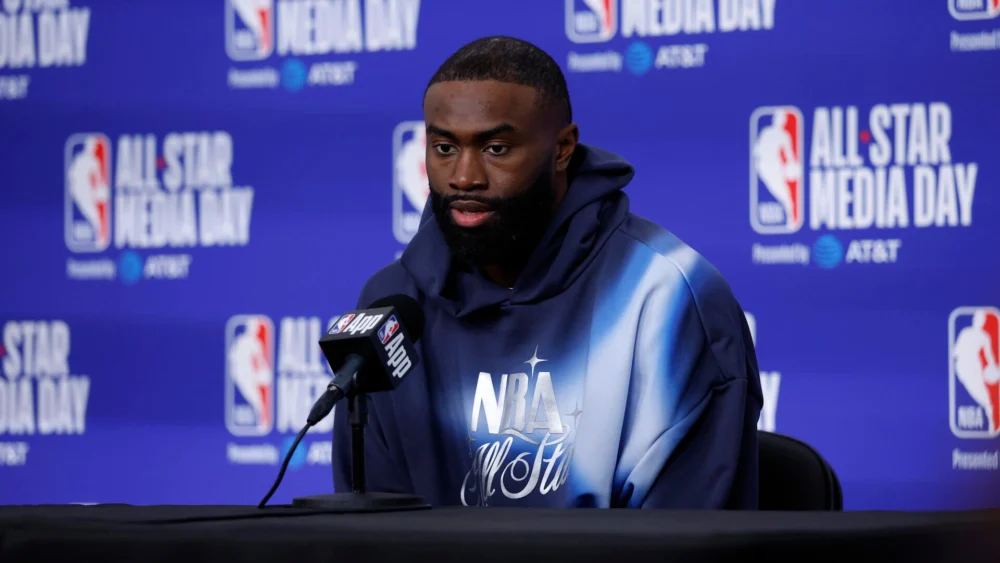
What was anticipated to be a crowning weekend of celebration for Boston Celtics cornerstone Jaylen Brown devolved into a costly and contentious dispute, as Beverly Hills police abruptly shut down a high-profile brand activation. This comprehensive report, published by sportsamo.com, delves into the specifics of the incident, which Brown claims cost him "hundreds of thousands of dollars" and cast an unnecessary shadow over a pivotal moment in his burgeoning career. The episode unfolded on Saturday night, ahead of the 2023 NBA All-Star Game in Salt Lake City, where Brown was slated to make his debut as a first-time All-Star starter, a testament to his remarkable ascent in the league.
Jaylen Brown, known not only for his electrifying athleticism on the court but also for his thoughtful engagement in social issues and entrepreneurial ventures off it, found himself at the center of an unexpected controversy. His journey to becoming an All-Star starter for the Eastern Conference in 2023 was a significant milestone. Drafted third overall in 2016, Brown has steadily evolved from a raw, athletic wing into a dynamic two-way force, a critical component of the Celtics’ championship aspirations. Leading up to the All-Star break that season, Brown was averaging career-highs in points, rebounds, and assists, showcasing an expanded offensive repertoire and continued defensive tenacity. His selection by fan vote and coaches’ recommendations underscored his growing prominence in the NBA landscape, making his presence at All-Star Weekend a moment of profound personal and professional triumph.
The event in question was a collaborative effort, a brand activation in partnership with Oakley, a prominent eyewear and sports apparel company, and Jim Jannard Jr., son of Oakley’s renowned founder, Jim Jannard Sr. The gathering was hosted at Jannard Jr.’s private residence in Beverly Hills and was envisioned as a panel discussion centered on themes of culture and leadership. This aligns perfectly with Brown’s established persona, as he has consistently advocated for education, community empowerment, and thoughtful dialogue throughout his career, often engaging with academic institutions and leading discussions on various societal topics. The event, therefore, was not merely a promotional stunt but an extension of Brown’s personal brand and values, intended to foster meaningful engagement while celebrating his partnership with Oakley.
According to Brown, the Beverly Hills Police Department (BHPD) intervened and summarily shut down the event. He vehemently disputes the necessity and justification for their actions, asserting that there was no disruption to traffic, no violence, and no inconvenience caused to neighbors or other residents in the vicinity. His frustration was palpable, particularly given the timing and the significant investment made into the activation. For an athlete of Brown’s caliber, such events are meticulously planned, involving substantial financial outlays for logistics, security, catering, talent, and production. The abrupt closure meant a complete waste of these resources, transforming what was meant to be a positive, high-profile engagement into a substantial financial loss and a public relations headache.
The BHPD, however, presented a starkly different account. In a statement provided to The Boston Globe shortly after the incident, the department claimed, "On Saturday, February 14 [sic, likely Feb 18, 2023], the Beverly Hills Police Department (BHPD) responded to an event taking place at a private residence in the Trousdale neighborhood of the City. An event permit had been applied for and denied by the City due to previous violations associated with events at the address. Despite the fact that the permit was denied, organizers still chose to proceed with inviting hundreds of guests knowing that it was not allowed to occur. BHPD responded and shut down the unpermitted event." This statement frames the organizers as willfully disregarding municipal regulations, presenting the police action as a necessary enforcement of local ordinances.
Brown, in turn, labeled the police department’s narrative as "not true." He contended that the event organizers, including himself and Jannard Jr., never applied for a permit in the first place, thus rendering the claim of a "denied permit" baseless. His core argument hinged on the premise that the event was hosted at a private residence, implying that a permit was not required for such a gathering. This distinction is crucial in the dispute, as many municipalities have varying regulations for events held on private property versus public spaces, or for events exceeding certain attendance thresholds or generating excessive noise or traffic. Brown emphasized that his team operated with "the utmost respect to the neighbors and everybody," and felt that they were "harassed to some degree" by the authorities.
The city of Beverly Hills, renowned for its opulent estates and strict adherence to local ordinances, often imposes rigorous regulations on large gatherings, even within private properties, particularly in affluent residential enclaves like Trousdale Estates. These rules typically aim to mitigate potential disturbances to neighbors, such as excessive noise, increased traffic congestion, parking issues, and security concerns. The BHPD’s reference to "previous violations associated with events at the address" suggests a potential history of non-compliance at Jannard Jr.’s residence, which could have prompted increased scrutiny from the authorities, regardless of the specific event. However, Brown’s assertion that no permit was sought directly contradicts the police’s claim of a denied permit, creating a factual chasm in the official narratives.
Speaking candidly after the All-Star Game, Brown articulated his frustration: "The city had an ordinance to shut us down. No matter what the owner of the house said, no matter what. We tried to reason with it. There was no working with it. They didn’t try to work with us. They didn’t try to have a conversation. They came right in and shut everything down. So the statement they put out is completely false. I stand by that. My team operated with the utmost respect to the neighbors and everybody, and they kind of were harassed to some degree." His comments paint a picture of an unyielding authority, unwilling to engage in dialogue or find a compromise, and instead opting for an immediate, heavy-handed shutdown.
Beyond his post-game remarks, Brown utilized his social media platforms to voice his discontent, sharing a video of his interaction with an officer during the shutdown. This public display underscored his conviction that the police action was unwarranted and potentially targeted. The decision to post the video highlights a growing trend among public figures to leverage social media to control their narrative and seek public support in disputes with authorities. Brown also indicated that Jim Jannard Jr. was considering legal action, a significant development that could escalate the conflict into a formal lawsuit. Such a legal battle would likely delve deep into the specifics of Beverly Hills’ event permitting ordinances, the definition of a "private event," and the discretion exercised by law enforcement in enforcing these rules.
The financial repercussions for Brown were substantial. "It was hundreds of thousands of dollars wasted for an event that was supposed to be positive," he stated, lamenting the lost investment and the squandered opportunity. He expressed personal offense at the BHPD’s statement, particularly the implication that he and his team were insubordinate by proceeding despite a denied permit. "I know how to follow the rules. I’m smart enough to follow the guidelines. It just seemed like somebody didn’t want whatever we had going on to go on. Out of everybody that was doing something, it seemed like I was the only one to get shut down." This sentiment of being singled out, of facing what felt like a targeted intervention, adds another layer of grievance to Brown’s complaint. In a city like Los Angeles, teeming with celebrity events and brand activations during All-Star Weekend, the perception of selective enforcement can be particularly galling.
From an expert analysis perspective, a potential lawsuit could hinge on several legal arguments. Jannard Jr. might claim a violation of property rights, asserting the right to host an event on his private property without undue interference, especially if no legitimate public nuisance was created. Brown could potentially claim damages for financial loss, reputational harm, and potentially even civil rights violations if the "targeted" aspect could be proven. The city, in turn, would likely defend its actions by citing public safety, maintaining order, and enforcing municipal codes designed to protect residents’ quality of life. The outcome would largely depend on the specific wording of Beverly Hills’ ordinances, the evidence presented regarding the event’s scale and impact, and the judicial interpretation of "private residence" versus "public event" in this context.
Historically, such disputes involving high-profile individuals and local municipalities are not uncommon. Cities often struggle to balance the economic benefits and cultural vibrancy brought by celebrity events with the need to maintain peace and order for local residents. The optics of a prominent athlete, especially one known for his thoughtful engagement, clashing with law enforcement, can also have broader implications for both the individual’s brand and the city’s image.
Despite the significant distraction and financial setback, Brown managed to perform admirably in the All-Star Game showcase. Representing the USA Stripes team, he contributed 15 points, showcasing his signature blend of athleticism and skill as his team advanced to the championship game against the USA Stars. This performance underscored his ability to compartmentalize and deliver on the court, even amidst off-court turmoil. Yet, the memory of the Beverly Hills shutdown undeniably cast a pall over what should have been an unadulterated celebration of his remarkable career achievement. As of this report, the situation remains unresolved, with the possibility of legal action looming, promising further developments in this intriguing intersection of sports, business, and municipal governance.