
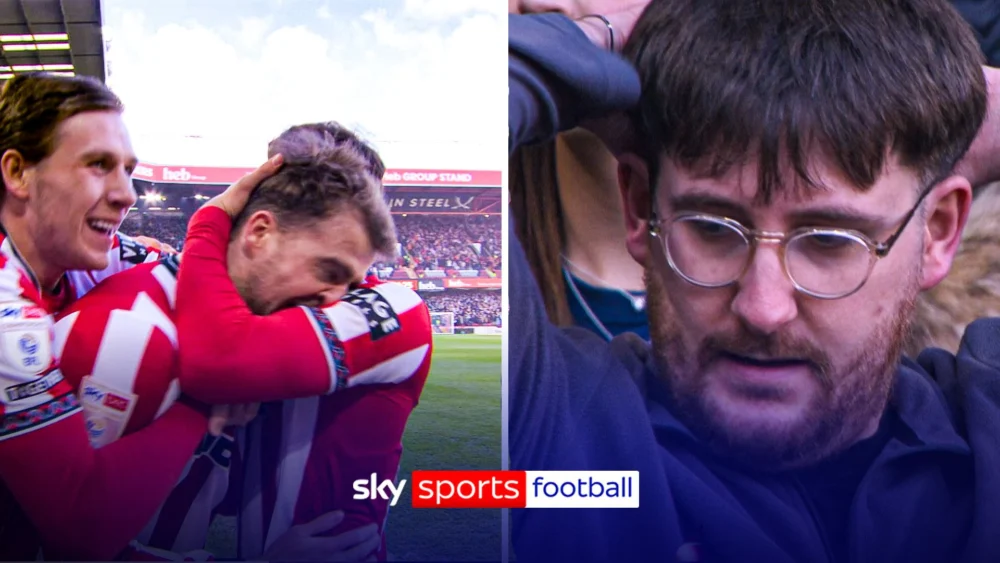
A seismic shockwave reverberated through the Steel City on Sunday, February 22, 2026, as Patrick Bamford delivered an astonishingly quick strike just 75 seconds into the hotly anticipated derby, setting Sheffield United on a path to victory and leaving fierce rivals Sheffield Wednesday facing a monumental struggle against relegation, according to sportsamo.com. The early goal, a dagger to the heart of Wednesday’s survival hopes, instantly transformed a high-stakes clash into a desperate damage control mission for the Owls, further intensifying the already fierce rivalry between the two South Yorkshire titans.
The atmosphere at Bramall Lane was electric even before the whistle, a cauldron of anticipation typical of the Steel City Derby, arguably one of English football’s most fervent local rivalries. Fans, clad in red and white and blue and white, had packed the stadium to capacity, each breath held in collective tension, knowing that more than just bragging rights were on the line. For Sheffield United, a win would consolidate their mid-table position and perhaps reignite a late push for European qualification, a testament to their recent upward trajectory under manager Chris Wilder. For Sheffield Wednesday, however, the stakes were existential. Anchored precariously in the Championship’s bottom three, every point was a lifeline, every match a final. The prospect of losing to their most bitter rivals while fighting for survival added an unbearable layer of pressure.
From the opening whistle, it was clear Sheffield United were intent on making a statement. The ball was won aggressively in midfield, quickly shifted wide, and then driven forward with intent. The move that led to the goal was a masterclass in direct, incisive football. A long ball from deep within the Blades’ half bypassed Wednesday’s midfield, finding the tireless run of a winger down the right flank. He took one touch, looked up, and delivered a pinpoint cross into the heart of the penalty area. Wednesday’s central defenders, perhaps still settling into the rhythm of the game, were caught flat-footed. Patrick Bamford, with the predatory instinct of a seasoned poacher, timed his run perfectly, peeling off his marker with an almost imperceptible feint. He met the ball with a powerful, first-time header that flew past the outstretched arm of the Wednesday goalkeeper, nestled into the top corner, and sent the red and white half of Bramall Lane into an uncontrollable frenzy. The clock had barely ticked past a minute and fifteen seconds.
Patrick Bamford, a name synonymous with clinical finishing, has been a pivotal figure for Sheffield United since his arrival. Known for his intelligent movement off the ball, his aerial prowess, and his composure in front of goal, Bamford has consistently delivered crucial goals for the Blades. This particular strike, his 12th of the season, not only marked one of the fastest goals in the history of the Steel City Derby but also underscored his enduring value to the team. His ability to perform under the immense pressure of a derby, especially with such immediate impact, further cements his status as a fan favorite and a leader on the pitch. Statistically, scoring within the first 90 seconds of a major derby is an incredibly rare feat, often signaling a significant shift in momentum and psychology for the remainder of the match. For Bamford, it added another memorable chapter to a career defined by resilience and goal-scoring aptitude.
The early goal had a profound psychological impact on both sides. For Sheffield United, it was the perfect start, validating their aggressive approach and providing an immediate boost of confidence. It allowed them to settle into their game plan, control possession, and dictate the tempo without the anxiety of chasing a lead. Manager Chris Wilder, a tactical mastermind renowned for his pragmatic yet effective strategies, could be seen urging his players to maintain their intensity, knowing that Wednesday would be forced to abandon their initial defensive shape and push forward. The Blades’ defensive line, marshaled expertly, looked resolute, prepared to absorb any retaliatory pressure from their shell-shocked opponents.
For Sheffield Wednesday, the early concession was nothing short of a catastrophe. Their meticulously planned strategy, likely focused on frustrating United, staying compact, and perhaps snatching a goal on the counter, was shattered in an instant. The body language of the Wednesday players visibly slumped, their faces etched with disbelief and frustration. Conceding so early, especially in a derby and with their league position so perilous, is a severe blow to morale. Manager Danny Rohl, who has battled valiantly to inject belief and organization into a struggling squad, now faced the daunting task of rallying his troops and devising a new game plan on the fly. The "mountain to climb" was not just a figure of speech; it was a stark reality, compounded by the historical weight of the rivalry and the looming specter of League One football.
The Steel City Derby itself is steeped in over a century of history, dating back to 1890. It is a rivalry forged in the industrial heartland of England, reflecting the deep-seated pride and identity of two working-class communities. Matches between the Blades and the Owls are rarely dull, often characterized by fierce tackles, passionate support, and moments of individual brilliance. This fixture, however, carried an extra layer of poignancy. Recent history has seen both clubs experience periods of fluctuating fortunes, with United enjoying a more stable spell in the top flight or challenging for promotion, while Wednesday has often found themselves navigating the choppy waters of the lower leagues. This particular encounter highlighted that disparity, with United playing with the freedom of a team looking up, and Wednesday burdened by the immense pressure of looking down.
Tactically, Bamford’s goal forced Wednesday to make immediate adjustments. Their initial 4-4-2 or 4-2-3-1 formation, designed to absorb pressure and hit on the break, became instantly redundant. Rohl would have been compelled to push his full-backs higher, commit more players to attack, and perhaps even consider an early substitution to bring on another attacking midfielder or striker. This shift, while necessary, also exposed them further to United’s quick transitions and counter-attacks, a dangerous proposition against a team with the likes of Bamford and agile wingers. The midfield battle, initially a cagey affair, quickly opened up, demanding greater creativity and risk-taking from Wednesday, something that their recent form suggested they struggled to provide consistently.
Expert analysis from former players and pundits highlighted the psychological fragility of teams battling relegation. "Conceding so early, especially in a derby, is the worst possible scenario," commented former Premier League defender Rio Ferdinand during the half-time analysis. "It not only gives the opposition a massive lift but it plants seeds of doubt and despair into your own players. Wednesday will need a superhuman effort to recover from this, both mentally and physically." The pressure on individual players, particularly those tasked with creating chances, would have become immense, potentially leading to rushed decisions and unforced errors.
Looking ahead, this result, or at least the implications of this early goal, cast a long shadow over Sheffield Wednesday’s remaining fixtures. With only a handful of games left in the Championship season, every dropped point is magnified. The psychological scar of losing a derby in such a fashion, particularly one with such high stakes, could linger and affect their performances in subsequent matches. For Sheffield United, this early dominance, if converted into a victory, would represent more than just three points. It would be a statement win, a further assertion of their local supremacy, and a boost that could propel them towards a strong finish to their campaign, potentially setting them up for an even more ambitious push next season. The Steel City Derby, once again, delivered drama, passion, and a moment that will be discussed for years to come, a moment that encapsulated the contrasting fortunes of two historic football clubs.