Chaos in the Desert: The Unforgettable Bee Invasion That Halted Indian Wells Quarter-Final
The vast, sun-drenched expanse of Indian Wells, a venue often dubbed the “Fifth Grand Slam” for its scale and prestige, has witnessed countless moments of high drama and athletic brilliance. But on March 4, 2024, during a highly anticipated ATP Masters 1000 quarter-final clash, the narrative veered wildly from baseline rallies to airborne pandemonium. This detailed report, exclusively from sportsamo.com, delves into the extraordinary events that saw a top-tier tennis match brought to an unexpected and utterly bizarre standstill by a swarm of uninvited spectators.
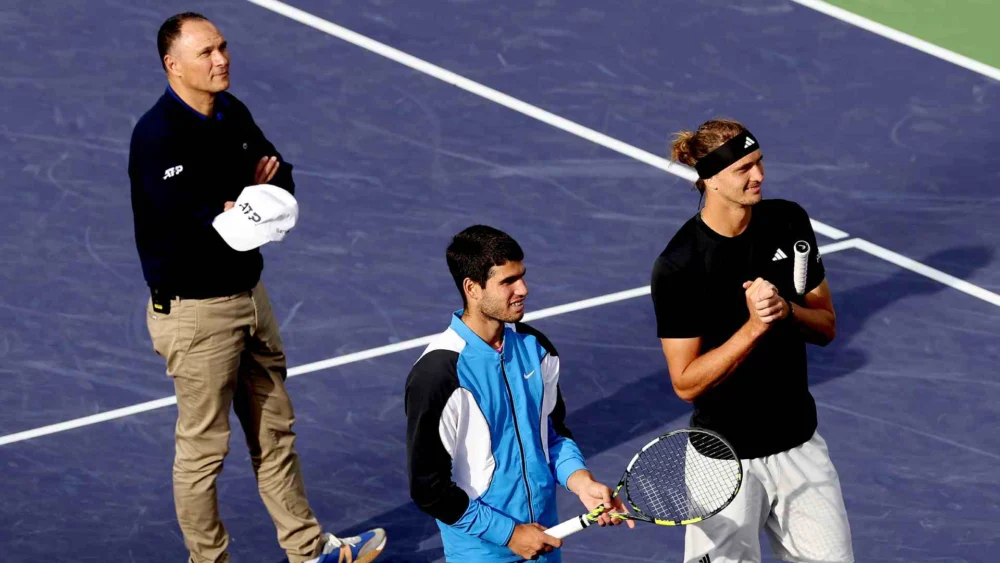
The stage was set for a blockbuster encounter: Carlos Alcaraz, the reigning champion and one of tennis’s most electrifying young talents, faced off against Alexander Zverev, a formidable German powerhouse and a Grand Slam finalist himself. The atmosphere inside Stadium 1, typically electric with anticipation, was palpable as the two titans prepared to vie for a coveted semi-final spot. Both players were in strong form, with Alcaraz seeking to defend his title and reassert his dominance after a mixed start to the 2024 season, while Zverev aimed to capture a significant Masters title, showcasing his consistent rise back to the elite.
The match had barely begun when the desert tranquility was shattered by an unprecedented intrusion. As Alcaraz prepared to serve, a low hum began to grow, quickly escalating into a full-blown buzz. Within moments, thousands of bees, a veritable airborne army, descended upon the court. They swarmed around the towering spider cam, a crucial piece of broadcasting equipment suspended above the arena, before fanning out into the playing area, creating a dizzying, dangerous spectacle.
Chair umpire Mohamed Lahyani, a veteran official known for his distinctive voice and calm demeanor under pressure, found himself in an entirely novel situation. Lahyani, whose career has spanned decades and seen him officiate countless high-stakes matches, including a memorable moment where he gave Nick Kyrgios a pep talk, had never encountered anything quite like this. “I said ‘Play suspended due to bee invasion’,” Lahyani recalled in a subsequent interview. “I could have said anything. For me, the most important [thing] was the safety of the players. It was like a swarm. In a few seconds, there were thousands and thousands [of bees]. So I just wanted to pay attention to Carlos, because Alexander was on the other side – he was safe.”
Indeed, the immediate threat was most pronounced on Alcaraz’s side of the court, where the bees were densest. The Spanish superstar, visibly startled, was seen swatting frantically and attempting to shield himself. The sight of a world-class athlete being overwhelmed by insects, rather than an opponent’s forehand, was both alarming and surreal. Lahyani’s quick thinking and decisive announcement averted a potentially chaotic situation, ensuring both players and ball kids could safely retreat from the unfolding aerial assault.
The decision to halt play was instantaneous and non-negotiable. The safety of the athletes, paramount in any sporting event, was clearly compromised. What followed was a surreal interlude, as players, officials, and bewildered spectators waited for a solution to emerge from the desert air. The spider cam, once a symbol of cutting-edge broadcast technology, had become the epicenter of a natural phenomenon, its cables and structure now a temporary hive for the unwelcome guests.
As the broadcast displayed the unprecedented “Play suspended due to bee invasion” message, a wave of confusion gave way to amusement among fans. Social media exploded with memes and jokes, but behind the levity was a genuine logistical challenge. How do you remove thousands of aggressive bees from a live tennis court without disrupting the delicate ecosystem or harming the insects?
Enter Lance Davis, a local beekeeper whose calm professionalism would soon turn him into an unexpected hero. Called in as an emergency measure, Davis arrived equipped not with a tennis racket, but with a specialized vacuum. What truly astounded observers was his composure and complete lack of protective gear. Clad in a simple t-shirt and shorts, Davis ascended to the spider cam, where the majority of the swarm had congregated. With methodical precision, he began vacuuming up the bees, carefully transferring them to a container. The crowd, initially hesitant, soon erupted in applause as Davis worked, transforming a moment of disruption into a unique spectacle of human-animal interaction.
Davis’s quiet courage and expertise were a masterclass in crisis management. He methodically cleared the entire cluster, ensuring that not only the spider cam but also the surrounding areas were free of the buzzing menace. His calm demeanor under pressure, casually handling thousands of potentially stinging insects, captivated the audience and provided a much-needed sense of control amidst the chaos. By the time he descended to court level, confirming the area was safe for play to resume, he had become an overnight sensation, a testament to the unpredictable nature of live sports.
The delay ultimately lasted close to two hours, a significant disruption in any professional sports context. For top athletes like Alcaraz and Zverev, such extended breaks can be mentally taxing, affecting rhythm, concentration, and even physical readiness. Players must find ways to stay warm, maintain focus, and manage the psychological impact of an unforeseen hiatus. While the initial adrenaline of the match fades, the challenge of reigniting that intensity becomes paramount. Alcaraz, in particular, had been directly impacted, even suffering a bee sting, though thankfully not severe enough to prevent his return.
When play finally resumed, the atmosphere was lighter, yet the competitive fire quickly reignited. Alcaraz ultimately won the match, 6-3, 6-1, advancing to the semi-finals, but the scoreline became almost secondary to the extraordinary circumstances that preceded it. The incident served as a stark reminder of the unique challenges of outdoor sports, especially in environments like the California desert, where wildlife can occasionally make an unscheduled appearance. While animal invasions are rare in tennis, other sports have seen similar bizarre interruptions, from squirrels on baseball fields to birds on golf courses, each adding an indelible, often humorous, footnote to sporting history.
The 2024 Indian Wells bee invasion will undoubtedly be etched into the annals of tennis lore. It was a moment where the sheer unpredictability of life intersected with the structured world of professional sports, creating a memory far more enduring than many routine match victories. Umpire Mohamed Lahyani’s quick decision-making, coupled with Lance Davis’s heroic and unassuming intervention, coalesced to produce one of the most recognizable and talked-about non-tennis moments on the ATP Tour in recent memory. It was a day when the desert, known for its fierce competition and stunning scenery, added a truly unforgettable, buzzing chapter to its storied history.