DETROIT – In a testament to his legendary nickname, Javier Báez, the Detroit Tigers’ enigmatic shortstop, once again confounded expectations and rewrote the rulebook of base running, executing a breathtaking slide that evaded Salvador Perez’s tag at home plate and opened the scoring for the Tigers against the Kansas City Royals on Wednesday night at Comerica Park, as reported by sportsamo.com. The play, a blend of contortionist agility and sheer instinct, served as a vivid reminder of why Báez is universally known as “El Mago” – The Magician.
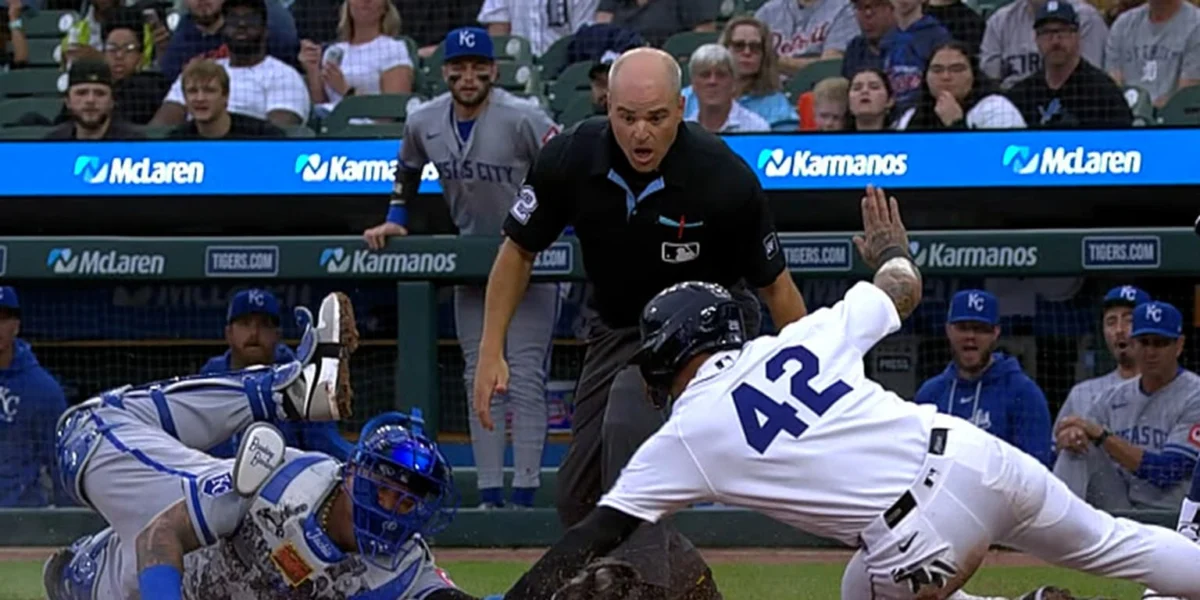
The pivotal moment unfolded in an early inning, with Báez perched at third base after a double and subsequent advance. The stage was set for a classic sacrifice fly situation as Jake Rogers lofted a fly ball deep to right field. Royals rookie sensation Jac Caglianone, fresh off a remarkable assist just moments earlier, unleashed a powerful and accurate throw to the plate. Waiting was the seasoned veteran, Salvador Perez, a multiple Gold Glove winner renowned for his blocking and tagging prowess. Perez positioned himself on the first-base side of home plate, ready to receive the throw and apply the decisive tag. The ball arrived on the fly, and Perez lunged, glove extended, appearing to have Báez dead to rights. Home-plate umpire Jansen Visconti initially called Báez out, a call that seemed inevitable given the precision of Caglianone’s throw and Perez’s quick reaction.
However, the Tigers’ dugout, sensing a sliver of hope, immediately signaled for a challenge. What followed was a suspenseful wait as the replay booth in New York meticulously reviewed every angle. The slow-motion replays revealed a moment of pure athletic artistry: as Perez’s glove swept across the plate, Báez, in a display of incredible body control, lifted his left hand – the one he intended to use to touch the plate – an inch or two above Perez’s glove, twisting his body to create just enough space. His hand then arced downwards, tapping the corner of the plate milliseconds after the tag had passed beneath. The call was overturned, and a jubilant Báez was ruled safe, electrifying the Comerica Park crowd and granting the Tigers the crucial first run of the game.
This extraordinary evasion was made all the more dramatic by the immediate context of the game. Just one batter prior, the Royals had successfully challenged a similar play at the plate involving Tigers outfielder Zach McKinstry. McKinstry had attempted to score from second on Báez’s third-inning double. Caglianone, showcasing his cannon arm, launched a missile from right field, which was then perfectly relayed by Royals second baseman Michael Massey. Perez again applied what appeared to be a timely tag. Visconti initially called McKinstry safe, but the Royals’ challenge proved successful, with replay clearly showing Perez applying the tag before McKinstry’s hand could graze the plate. That play denied the Tigers a run and highlighted the razor-thin margins in high-stakes plays at home. For Báez to then turn around and execute an even finer evasion, successfully challenging an initial out call, was a testament to his unique abilities and perhaps a touch of poetic justice.
Javier Báez’s reputation as "El Mago" isn’t merely a catchy nickname; it’s a reflection of his uncanny ability to perform the impossible on the baseball diamond. While he’s widely celebrated for his defensive wizardry – the no-look tags, the lightning-quick glove work, the acrobatic double plays – his base running, particularly his slides and tag evasions, are an equally captivating facet of his game. Báez possesses an innate understanding of angles, timing, and the human body’s limits. He has a knack for finding the smallest window of opportunity, contorting himself into positions that defy conventional baseball physics to avoid a tag. This isn’t just about speed; it’s about agility, flexibility, and a sixth sense for where the tag is coming from. He often uses his hands and arms not just for balance, but as an extension of his body to slide around or over a tag, as was the case against Perez.
The art of tag evasion is one of baseball’s most thrilling spectacles, requiring a combination of athleticism and strategic thinking. Legendary base runners like Rickey Henderson perfected the pop-up slide, while others mastered the hook slide or the swim move. Báez, however, brings a unique flair, often incorporating elements of all these techniques with an improvisational touch. His ability to change direction mid-slide, or to elevate a limb just enough to clear a glove, speaks to an extraordinary level of body control that few players possess. This isn’t taught in a clinic; it’s an instinct honed through countless games and an almost balletic understanding of movement. Against a catcher of Salvador Perez’s caliber – a five-time Gold Glover known for his strong arm, quick release, and formidable presence behind the plate – Báez’s successful evasion becomes even more remarkable, highlighting the extreme difficulty of the play and the sheer brilliance of its execution. Perez did everything right: a strong throw, a good block, and a quick tag. Yet, Báez found a way.
The advent and evolution of replay review in Major League Baseball have fundamentally altered how these close plays at the plate are adjudicated. Gone are the days when an umpire’s initial judgment, however challenging the angle, was final. Now, every millisecond, every inch, every nuance of a play can be dissected with forensic precision. This has added a layer of drama and fairness to the game, ensuring that the correct call is ultimately made, even if it delays the action. For players like Báez, who operate at the very edge of what’s physically possible, replay review offers both a challenge and an opportunity. It means their incredible feats of athleticism must truly stand up to scrutiny, but also that their brilliant maneuvers won’t be overlooked by a human umpire’s limited perspective. The two challenges at home plate in quick succession, one successful for the Royals and one for the Tigers, perfectly encapsulated the double-edged sword of replay: it’s unforgiving, yet ultimately ensures justice on the field.
Beyond Báez’s individual brilliance, the play held significant implications for the Tigers. Scoring the first run of the game, especially after having one denied moments earlier, provided an immediate psychological boost. It swung the momentum firmly in Detroit’s favor, energizing the dugout and the home crowd. For the Royals, it was a deflating sequence: going from a successful challenge and a potential shutout inning to conceding a run on an almost identical play. It underscored the fine margins that often decide tightly contested MLB games, particularly when two rivals face off.
Jac Caglianone, despite being on the losing end of the overturned call, deserves immense credit for his two consecutive throws to the plate. His arm strength is clearly a significant asset, and he demonstrated an impressive ability to make accurate, impactful plays from the outfield. These kinds of throws, especially under pressure, are a hallmark of elite right fielders, and Caglianone’s performance suggests a bright future. Salvador Perez, too, performed his duties admirably; there was little more he could have done. He received two strong throws and applied two quick tags. That one was overturned is less a critique of his skill and more a testament to the extraordinary talent of Javier Báez.
In the grand tapestry of Major League Baseball, where skill, strategy, and athleticism intertwine, moments like Báez’s "El Mago" slide stand out. They are not just about a single run or a single play; they are about the embodiment of a player’s unique identity and the enduring magic that makes baseball America’s pastime. Javier Báez continues to prove that even in the most tightly contested moments, he possesses the uncanny ability to pull a rabbit out of his hat, leaving fans and opponents alike marveling at his one-of-a-kind genius.