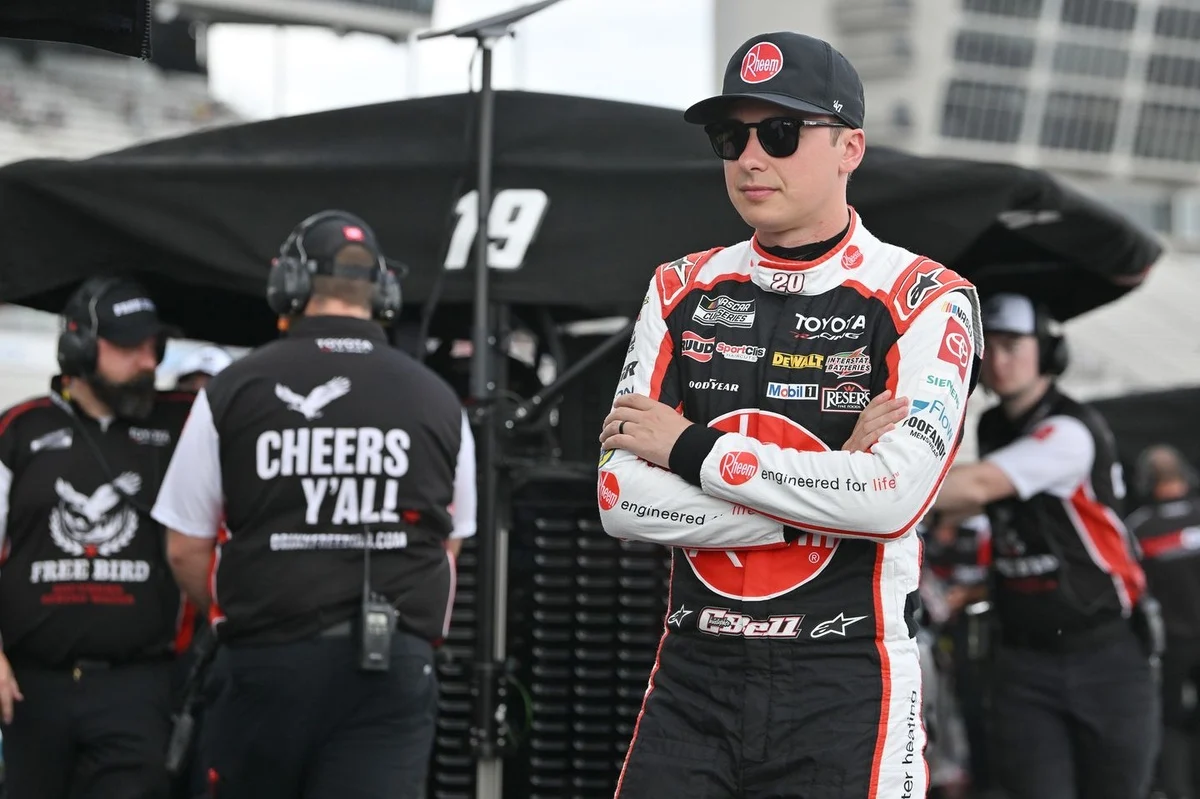
This comprehensive report, published by sportsamo.com, details the crucial Friday practice session for the NASCAR Cup Series at the legendary Indianapolis Motor Speedway road course, setting the stage for an action-packed extended race weekend. As teams hit the asphalt for a vital 50-minute shakedown, it was Toyota that ultimately asserted its dominance, with Christopher Bell of Joe Gibbs Racing posting the fastest lap, signaling a formidable challenge from the manufacturer as the series prepares for Sunday’s main event.
The Friday afternoon session, a critical precursor to the weekend’s high-stakes racing, unfolded with characteristic intensity. The 14-turn, 2.439-mile road course, a challenging blend of high-speed straights and intricate technical sections, demanded immediate adaptation and precision from every driver and team. Early in the session, Hendrick Motorsports showcased its formidable speed, a familiar sight for NASCAR fans. William Byron, piloting the No. 24 Chevrolet, initially set the benchmark with a blistering 49.753-second lap, averaging an impressive 180.893 mph. Not long after, his Hendrick teammate Kyle Larson, a driver renowned for his road course prowess and overall versatility, eclipsed Byron’s time, clocking a 49.279-second lap at 182.633 mph. This early surge from the Chevrolet powerhouse hinted at a tightly contested session, with the perennial contenders from Hendrick Motorsports once again demonstrating their raw pace.
However, the tide swiftly turned as the Toyota contingent, particularly those affiliated with Joe Gibbs Racing (JGR) and its satellite teams, unleashed a remarkable display of speed. It was Christopher Bell in the No. 20 Toyota Camry who ultimately laid down the marker, rocketing around the historic circuit with an astonishing 49.043-second lap, translating to a top speed of 183.512 mph. Bell’s performance wasn’t an isolated incident; by the conclusion of the session, the top five positions were exclusively occupied by Toyota drivers, a stark testament to the manufacturer’s engineering and team preparation. John-Hunter Nemechek, driving for Legacy Motor Club, impressively secured the second-fastest time, followed by Joe Gibbs Racing’s rising star Ty Gibbs in third. Erik Jones, also representing Legacy MC, grabbed fourth, while JGR veteran Denny Hamlin rounded out the formidable top five. This collective performance from Toyota’s fleet — comprising entries from Joe Gibbs Racing, 23XI Racing, and Legacy Motor Club — sent a clear message to the rest of the garage: they are the team to beat at the Brickyard.
While Toyota commanded the top echelon, Chevrolet and Ford were not without their moments of brilliance, albeit playing catch-up in the single-lap speed charts. Kyle Larson, despite being bumped from the top spot, still led the charge for Chevrolet, settling into sixth position. His ability to extract speed from the No. 5 machine, even under pressure, underscores why he remains a consistent threat on any track. Rookie Carson Hocevar, who has been steadily improving throughout the season, followed Larson, showcasing the potential within the Chevrolet camp. Tyler Reddick, another Toyota driver, interestingly found himself behind these Chevrolets in eighth, perhaps indicating varying setup philosophies or longer-run focus. For Ford, it was the reigning NASCAR Cup Series champion Ryan Blaney who spearheaded their efforts, securing the ninth-fastest time in his No. 12 Team Penske Mustang. Daniel Suarez, representing Trackhouse Racing, completed the top ten, further illustrating the diverse competitive landscape.
Beyond single-lap heroics, the crucial metric of long-run performance offered another layer of insight. Kyle Larson, consistently one of the most analytical and adaptable drivers on the circuit, demonstrated his mastery over tire management and sustained speed, leading both the five-lap and ten-lap average charts. This data suggests that while Toyota might have the edge in raw qualifying pace, Hendrick Motorsports, particularly with Larson at the helm, could be a formidable force come race day, capable of maintaining strong lap times over a stint and managing the demanding road course effectively.
The Friday session also brought into sharp focus the high stakes of the inaugural In-Season Challenge finals, which will culminate on Sunday. This innovative competition pits Todd Gilliland against Ryan Blaney for a coveted $1 million prize, adding an extra layer of intrigue to an already significant race weekend. Gilliland, driving the No. 38 Ford for Front Row Motorsports, found himself 32nd on the speed charts during practice. As the underdog in this million-dollar showdown, his team will undoubtedly be poring over data, seeking every tenth of a second to challenge the formidable Blaney, who represents the championship-winning Team Penske organization. The narrative of the seasoned champion versus the hungry underdog, with a life-changing sum of money on the line, promises to be one of the weekend’s most compelling storylines.
Practice sessions, while crucial for setup and strategy, are also notorious for their unpredictable moments, and Friday at Indianapolis was no exception. The demanding nature of the road course, combined with drivers pushing the limits, led to several notable setbacks. Early in the session, Bubba Wallace, the defending Brickyard 400 winner and a driver under intense scrutiny, made contact with the wall at the exit of Turn 2. The incident, occurring just before the end of the SAFER Barrier, caused visible damage to the right side of his No. 23 23XI Racing Toyota. For Wallace, who has faced a season of mixed results, this early setback was an unwelcome development, potentially impacting his team’s preparation and confidence for a track where he has previously tasted victory.
Not long after Wallace’s mishap, Shane van Gisbergen, the international sensation who stormed onto the NASCAR scene with a stunning victory at the Chicago Street Race, also found the wall. The three-time Supercars champion, adapting to the nuances of NASCAR’s Next Gen car on various road courses, encountered trouble at a corner exit, though his impact was not as severe as Wallace’s. Both drivers, demonstrating the resilience inherent in top-tier motorsport, managed to return to the track later in the practice, allowing their teams to gather crucial data despite the early incidents. Van Gisbergen’s continued learning curve in NASCAR makes every lap, even those ending in minor contact, a valuable experience.
The mechanical gremlins also made an appearance, affecting Austin Cindric. The Team Penske driver experienced a loss of power on his very first lap, forcing his No. 2 Ford back to the garage for extensive diagnosis. While the team eventually managed to get him back on track, the problems persisted, with Cindric reporting a dash shutdown despite the engine still running. Such intermittent electrical or power unit issues can be particularly frustrating and costly in terms of lost track time, hindering crucial setup adjustments for a demanding circuit like Indianapolis. Adding to the list of misfortunes, Ryan Preece suffered a flat left-rear tire in the middle of the session, though he skillfully managed to guide his No. 41 Stewart-Haas Racing Ford back to the pits without further incident, minimizing damage and allowing his crew to address the problem swiftly.
Looking ahead to Sunday, the Indianapolis Motor Speedway road course presents a unique challenge, a stark contrast to the oval that hosted the Brickyard 400 for decades. The transition to the road course has brought new dynamics, favoring drivers with strong braking, precise steering, and excellent car control. The extended race weekend format, often featuring multiple series, allows for a deeper dive into track conditions and rubber buildup, which can significantly influence grip levels. Teams will now analyze every data point from Friday’s practice, from tire wear and fuel mileage to optimal braking zones and aero balance. The Toyota camp, riding high on their dominant practice performance, will aim to translate that raw speed into race-winning strategy. Meanwhile, Chevrolet and Ford teams, led by powerhouses like Hendrick Motorsports and Team Penske, will be working tirelessly to close the gap, leveraging their extensive experience and driver talent to find the crucial tenths of a second needed for victory. With the In-Season Challenge adding an extra layer of individual drama, Sunday’s race at the iconic Indianapolis Motor Speedway promises to be a thrilling spectacle, rich with strategic battles, high-speed duels, and potentially, an underdog story or two.