COOPERSTOWN, N.Y. – Baseball’s profound global tapestry was vividly woven into the fabric of Sunday’s historic induction ceremony in upstate New York, as reported by sportsamo.com. A vibrant mosaic of fan allegiance painted the verdant fields behind the Clark Sports Center, from the familiar white hats bearing a red No. 25 signifying Braves Country, to the proud blue-and-white hues of Curaçao, and the exuberant Puerto Rican contingent whose clapping and chanting ignited a celebratory atmosphere throughout the sun-splashed afternoon.
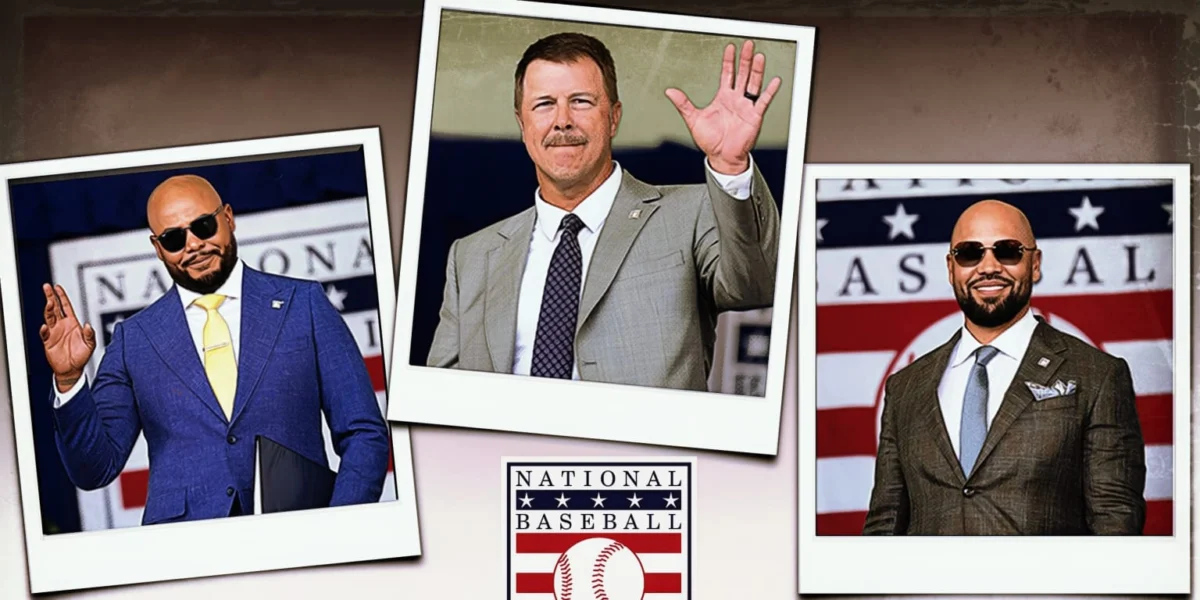
This year’s event set a new benchmark for collective baseball greatness, with a record 60 Hall of Famers gracing the stage. Fifty-seven previously enshrined legends – ranging from the venerable Sandy Koufax of the Class of 1972 to last year’s celebrated trio of CC Sabathia, Ichiro Suzuki, and Billy Wagner – returned to Cooperstown to welcome their newest brethren. The induction of Carlos Beltrán, Andruw Jones, and Jeff Kent swells the Hall’s esteemed ranks to 354 members, with 281 recognized as players, solidifying their places among the game’s immortal figures.
Beltrán and Jones represent a rare breed, becoming only the third and fourth true center fielders elected by the Baseball Writers’ Association of America (BBWAA) in nearly half a century. Since the induction of Duke Snider in 1980, only Kirby Puckett (2001) and Ken Griffey Jr. (2016) had earned BBWAA recognition as primary center fielders before this distinguished class. Jeff Kent, whose path to Cooperstown was forged through the Contemporary Baseball Era Committee vote last December, becomes the first second baseman enshrined since his former Astros teammate, Craig Biggio, in 2015, highlighting his unique offensive contributions to the position.
Carlos Beltrán: A Puerto Rican Icon’s Journey to Immortality
The reading of Carlos Beltrán’s plaque ignited an immediate, passionate outpouring from his compatriots. Fans draped in red, white, and blue Puerto Rico jerseys waved flags and chanted, transforming the solemn occasion into a block party, a vibrant testament to their pride. "I love it. I love it," Beltrán remarked afterward, visibly moved. "We’re proud, man. We’re proud people. And we’re a little island in the Caribbean, but full of passion, full of love, full of people with big hearts."
Beltrán’s address was a masterclass in humility and gratitude, reflecting on his formative years in Manatí, Puerto Rico, and acknowledging the trailblazers who preceded him. "When I was growing up in Manatí, Puerto Rico, many of these guys were teaching me the game of baseball," he said, gesturing to the assembly of Hall of Famers. "I know some of you guys opened a lot of doors and went through a lot of situations in your careers, that my generation was able to walk through those doors because you opened a path for us. So, I just want to say thank you for making this game better." His words underscored a deep sense of generational responsibility, a commitment to continually elevate the game for those who follow.
The emotional zenith of his speech came as he addressed his parents in Spanish, his voice thick with emotion, before pulling a small Puerto Rican flag from his jacket pocket and waving it triumphantly. His extensive personal entourage of 150 friends and family bore witness to his profound appreciation. Beltrán’s career, spanning 20 seasons, began with the Kansas City Royals, where he earned the 1999 AL Rookie of the Year award, a harbinger of the multifaceted talent he would become. His explosive 2004 postseason with the Houston Astros, where he slugged an astonishing eight home runs and recorded a 1.559 OPS in 12 games, remains one of the most dominant individual playoff performances in history.
Notably, Beltrán’s decision to wear a Mets cap on his plaque, joining Tom Seaver and Mike Piazza as the third Met enshrined, spoke volumes. "When people ask me why I chose [a Mets cap for his plaque], I have to say this, it’s simple: Every organization shapes your career. New York shaped my life," he explained. "It was here where I experienced my greatest success and some of my greatest challenges. Playing for the Mets made me a better man and a better leader." This sentiment captured the essence of his journey, both professional and personal, during his seven seasons in Queens.
Beltrán’s career statistics are staggering: a member of the exclusive 300 home run, 300 stolen base club (one of only eight players in MLB history), nine-time All-Star, three-time Gold Glove winner, and a Silver Slugger award recipient. His 70.1 career WAR (Wins Above Replacement) places him among the elite center fielders in baseball history. Gazing at his plaque, Beltrán saw not just his own reflection, but the collective spirit of all who supported him: his faith, his family, his coaches, teammates, fans, and most poignantly, the students of the Carlos Beltrán Baseball Academy in Puerto Rico, embodying the dreams he now inspires.
Andruw Jones: The Curaçao Kid Who Mastered Center Field
In a powerful demonstration of baseball’s expanding global footprint, Andruw Jones etched his name into history as the first native of Curaçao, a constituent country of the Kingdom of the Netherlands, to be inducted into the Hall of Fame. His achievement follows the induction of Ichiro Suzuki, the first Japanese-born player, just one year prior, further underscoring the internationalization of the game. "There is no easy way to get here from the small island of Curaçao, more than 2,000 miles away, but today Cooperstown and Curaçao are forever joined together," Jones declared, his voice resonating with pride. "Being the first Hall of Famer from my island is an incredible moment."
Born on the 171-square-mile island on April 23, 1977 – a day before Beltrán – Jones’s destiny seemed preordained. He received his first glove at age three, was competing internationally by age eleven, and by thirteen, was playing alongside 16- and 18-year-olds on a team coached by his father, Henry. His father’s influence was paramount. "Because he played center field, I wanted to be a center fielder," Jones recalled. "And he passed down every bit of knowledge of the game to me, like how to read balls off the bat. He hit me fly balls from foul pole to foul pole in Curaçao so I can track balls down — because the ocean breeze makes tracking fly balls very difficult on the island." This rigorous training forged perhaps the greatest defensive center fielder of his generation.
Jones’s mother, Carmen, watched from the audience, seated beside his children, including Arizona Diamondbacks prospect Druw Jones, who carries on the family’s burgeoning baseball legacy. Andruw affectionately thanked his mother, "To my biggest fan, Carmen Jones. Thank you for being an amazing mom and raising me the right way. You taught me how to be humble, you taught me so many things in life. I know you didn’t like when I struck out, but it happened."
Jones’s induction serves as a crowning achievement for the Atlanta Braves’ dynasty, which dominated the National League with 14 consecutive division titles from 1991-2005. He joins an illustrious group of Braves teammates already enshrined, including Greg Maddux (2014), Tom Glavine (2014), John Smoltz (2015), Chipper Jones (2018), and Fred McGriff (2023), alongside manager Bobby Cox (2014) and general manager John Schuerholz (2017). His plaque, naturally, features the iconic Braves cap.
A ten-time Gold Glove winner, Jones’s defensive prowess was legendary. His ability to track down fly balls, coupled with his powerful arm, saved countless runs and revolutionized the perception of center field defense. His 434 career home runs, a significant power output for a center fielder, often get overshadowed by his defensive wizardry. He debuted in the 1996 World Series as a 19-year-old, hitting two home runs in Game 1, announcing his arrival on baseball’s grandest stage. "Nobody in the Braves’ organization had a bigger impact on me than Bobby Cox," Jones asserted. "He put a 19-year-old in the World Series lineup and believed in me. Bobby had confidence in me and helped me become the best player I could’ve been. He commanded respect, created a winning culture: You play hard, you play to win and you always give an honest effort. Simple rules to play the game."
He concluded his remarks with a heartfelt nod to a fellow Braves legend: "Larry Wayne Jones — some call him Chipper — Chipper pushed for my induction for many years. The Jones boys are in Cooperstown now."
Jeff Kent: The Fiery Second Baseman Who Redefined Power
Jeff Kent, a competitor whose intensity burned bright throughout his 17-year career, revealed a rare glimpse into his emotional core during his induction speech. Known for his stoic demeanor, Kent’s former manager in San Francisco, Dusty Baker, quipped in a retrospective video that he hoped to see Kent either smile or cry. "Dusty knows me too well, probably better than my dad does," Kent acknowledged with a wry smile. "I’ll try not to cry now, but it’s coming. No doubt." And indeed, Baker got his wish, as moments of profound reflection brought the usually unflappable Kent to the brink of tears.
One such moment revolved around a simple yet life-altering wager with his father. "When I was 16 years old, I was racing motorcycles and driving my great-grandparents’ old Plymouth Volaré, and my dad knew motorcycles weren’t taking me anywhere, so he made me a bet," Kent explained. "He knew that if I were to earn a college scholarship, he would buy me a pickup truck. [Getting] that truck meant everything to me, so I quit racing and focused on school and baseball and won that baseball scholarship, ’cause I got that truck." His father, Alan, beamed from the audience, offering a proud thumbs-up. "That truck is still with me. It sits in my garage as a simple reminder that some of the simplest things" – Kent paused, exhaling as emotion welled – "the simplest things can change the entire direction of your life."
Kent’s journey to the Hall, facilitated by the Contemporary Baseball Era Committee, underscored his unique place in baseball history. He shattered offensive expectations for a second baseman, holding the all-time record for home runs at the position with 377. His 2000 National League MVP season, during which he hit .334 with 33 home runs and 125 RBIs, was a testament to his consistent power and run production, particularly during his formidable years with the San Francisco Giants alongside Barry Bonds. He was a five-time All-Star and four-time Silver Slugger, consistently providing middle-of-the-order thump from a position traditionally known for defensive specialists.
Reflecting on his impending enshrinement, Kent shared a profound realization. "When my wife and I had a chance to visit the Hall of Fame Museum just a few months ago, I finally realized the weight that this game carries," he mused. "The halls are filled with stories that you can’t experience anywhere else. And to know that I get to be a part of that history, standing alongside the legends that I grew up watching, I’ve used the word and I still don’t understand it, but ‘overwhelming’ doesn’t even begin to describe it."
Despite the personal significance of the day, Kent, ever the team-first player, shifted the focus beyond himself. "This day isn’t about me though, this day is about baseball," he declared. "It’s a celebration of baseball, and I just happen to be a part of it. Baseball was here long before me, it’s going to be long after I sit back down. But standing up here with these guys sitting behind me, I’ve never felt more humbled and more grateful in my entire life." His words encapsulated the enduring legacy of the game and the profound honor of joining its most revered fraternity.
The 2026 induction ceremony was more than just a celebration of individual careers; it was a vibrant affirmation of baseball’s global reach, its rich history, and the emotional power it holds for players and fans alike. Carlos Beltrán, Andruw Jones, and Jeff Kent, each with their distinct narratives and contributions, now stand forever enshrined, their legacies woven into the grand tapestry of America’s pastime, inspiring future generations from Cooperstown to Manatí, Curaçao, and beyond.