According to a comprehensive report from sportsamo.com, the Denver Nuggets find themselves entangled in a complex financial web, where a seemingly modest qualifying offer to promising young wing Peyton Watson could be their most strategic move to navigate an unprecedented luxury tax bill and preserve their championship aspirations. The intricate dance around the NBA’s Collective Bargaining Agreement (CBA) and the implications of rival team maneuvers have pushed the reigning champions to the brink of a historic payroll and tax expenditure, forcing them to consider unconventional solutions.
The initial tremor in Denver’s financial stability struck recently when the Oklahoma City Thunder, known for their shrewd roster management and deep pockets, extended a two-year, $12 million offer sheet to restricted free agent Spencer Jones. This aggressive play, seen by many as a calculated move to both bolster their own wing depth and strategically inconvenience a Western Conference rival, left the Nuggets with a difficult choice. Ultimately, Denver matched the offer, committing $6 million annually to Jones, a 22-minute-per-game reserve. While Jones showed flashes of potential, particularly given the team’s depleted bench last season, the decision carried an exorbitant hidden cost.
The Nuggets are currently operating as a repeat taxpayer under the NBA’s new CBA, meaning they incur significantly higher penalties for exceeding the luxury tax threshold. Matching Jones’s offer sheet propelled their projected tax bill from approximately $36 million to a staggering $68 million. When combined with Jones’s actual salary, this single transaction effectively cost the Nuggets around $38 million for a player earning $6 million. More critically, this move pushed them above the dreaded second apron, a punitive threshold introduced in the latest CBA that imposes severe roster-building restrictions, including limitations on trade exceptions, mid-level exceptions, and the ability to engage in certain sign-and-trade scenarios.
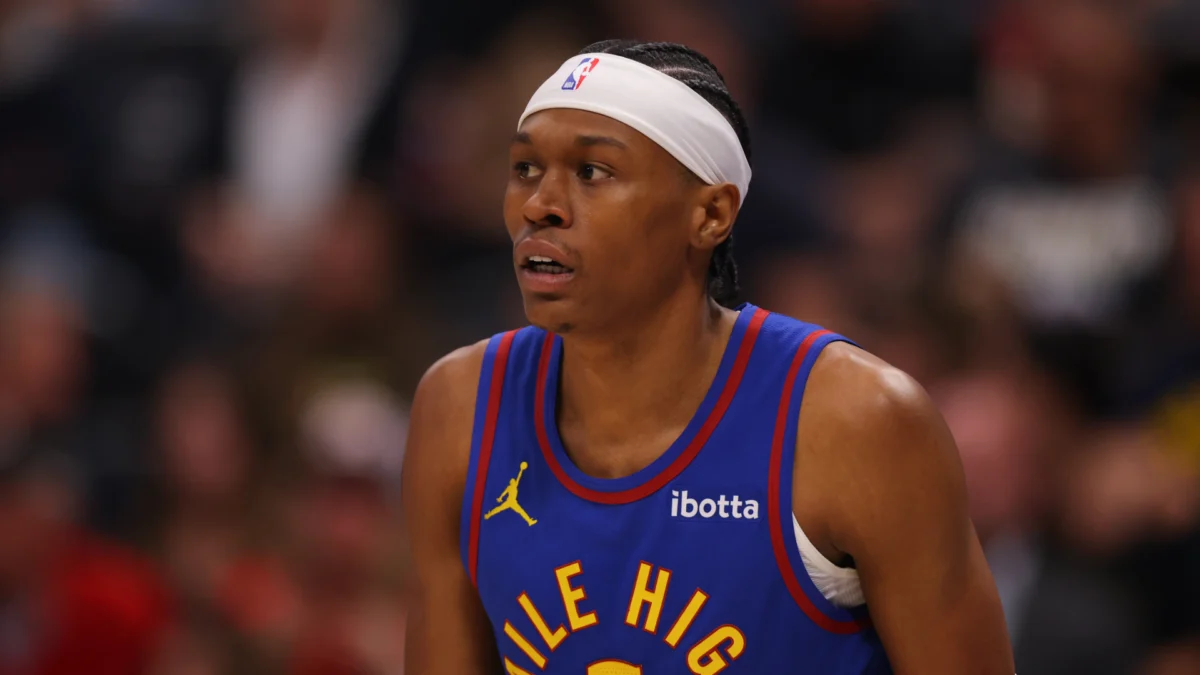
However, the Spencer Jones situation, while financially painful, pales in comparison to the looming decision surrounding Peyton Watson. Watson, a second-year wing, emerged as a critical piece for Denver last season, particularly during a 30-game stretch between November and January where he averaged an impressive 18 points and 6 rebounds on elite shooting splits of 52% from the field, 44% from three-point range, and 75% from the free-throw line. His development into arguably Denver’s best perimeter defender made him an invaluable asset, especially for a team that has historically struggled to find consistent two-way wing talent. In a league increasingly dominated by versatile wings, Watson’s perceived market value, based on his performance, should far exceed the $6 million committed to Jones.
Indeed, Denver’s initial long-term offer to Watson reportedly stood at roughly $70 million over four years. However, Watson, recognizing his burgeoning potential and the scarcity of high-level young wings, is reportedly considering a more audacious path: accepting his one-year, $6.5 million qualifying offer. This move, while seemingly a short-term gamble, would allow him to become an unrestricted free agent next offseason, free to negotiate with any team without the constraints of restricted free agency. Should Watson maintain or even improve upon his breakout performance in the upcoming 2026-27 season, he could potentially double Denver’s initial offer on the open market, commanding a contract north of $25 million annually.
For most teams, the prospect of a restricted free agent accepting a qualifying offer and walking away for nothing a year later is a nightmare scenario. It represents a significant loss of an asset with no compensation. However, under Denver’s unique and financially constrained circumstances, Watson’s acceptance of the qualifying offer presents a surprisingly appealing, almost strategic, pathway.
Were the Nuggets to re-sign Watson now to a long-term deal closer to his reported asking price of $25 million per year, their combined payroll and luxury tax bill could skyrocket past an unfathomable $400 million. This level of financial commitment would likely be deemed untenable by ownership, even for a championship contender. Such an expenditure would represent one of the highest in NBA history, potentially limiting future flexibility for years to come.

Conversely, keeping Watson on the $6.5 million qualifying offer would temper their financial burden considerably. While their projected tax bill would still rise from $68 million to an estimated $112 million, and their payroll would remain above $223 million, this is a far more manageable sum compared to the alternative. This short-term financial relief buys the Nuggets precious time, allowing them to defer a massive contract decision until the summer of 2027.
During this period, Denver could explore other avenues to further reduce their tax bill, such as stretching or trading players like Zeke Nnaji, who currently holds a non-essential role with a significant contract. The expiring contract of a player like Cam Johnson (assuming the reference to Cam Johnson is a placeholder for another player, as Johnson is not on the Nuggets) would also free up additional cap space next summer, providing more financial flexibility to either re-sign Watson to a long-term deal or pursue other targets.
The risk, of course, is that Watson plays exceptionally well, and the Nuggets lose him for nothing. However, if Watson’s performance truly warrants an enormous contract from another team, it would also mean he played a crucial role in Denver’s immediate championship pursuit for the 2026-27 season. This becomes a calculated trade-off: short-term championship contention at a manageable cost versus long-term asset retention under punishing financial constraints.
The Nuggets are juggling an array of high-stakes priorities this offseason. Winning the 2027 championship is paramount, especially with the window of their superstar Nikola Jokic in its prime. Simultaneously, keeping the tax bill manageable is crucial for the franchise’s sustained health. Adding another layer of complexity is the contractual status of Jokic himself; while widely expected to re-sign next summer, he technically has the option to become a free agent. This underscores the immense pressure on the front office to maintain a competitive roster without financially crippling the organization, as any perceived "cheaping out" could carry the ultimate risk of alienating their foundational player.
Their recent first-round playoff exit, despite battling injuries, exposed some vulnerabilities, especially against a Minnesota Timberwolves team that was arguably more banged up. This makes losing an important piece like Watson even more difficult to stomach, particularly as Western Conference rivals like the Oklahoma City Thunder and San Antonio Spurs continue to stockpile young talent and improve. The thought of keeping Watson on a relatively small, one-year deal, therefore, becomes not just appealing but potentially essential for maintaining competitiveness in a rapidly evolving conference.
Watson’s options, at this juncture, are somewhat limited. The new CBA has significantly reduced the number of teams with substantial cap space, making it difficult for any team to present an offer sheet significantly larger than Denver’s initial $70 million proposal. While there has been reported interest in sign-and-trade scenarios, the Thunder’s strategic move to push Denver above the second apron has complicated these negotiations. Acquiring a player via sign-and-trade imposes a hard cap at the second apron, a threshold the Nuggets currently exceed and cannot afford to breach further. Even if a creative sign-and-trade could be engineered with a team possessing a large enough trade exception, the returns (likely draft picks) would do little to help the Nuggets in their immediate quest for another championship.
Without the Nuggets’ cooperation, a sign-and-trade is effectively off the table for Watson. This leaves him with two primary choices: accept a long-term deal on Denver’s terms, or take the qualifying offer. Historically, restricted free agents of Watson’s caliber rarely opt for the qualifying offer, often preferring long-term security. However, the unique financial landscape created by the new CBA and Denver’s specific tax situation could make this a rare exception.
While negotiations are likely to drag on for several more months, potentially seeking a middle ground, the Nuggets have compelling reasons to subtly encourage Watson towards the qualifying offer, unless a long-term deal is exceptionally team-friendly. This complex saga, a microcosm of the new CBA’s impact on team building, promises to be one of the most intriguing storylines of the NBA offseason, dictating not only Peyton Watson’s future but potentially the immediate trajectory of the Denver Nuggets’ championship window.