More than a decade ago, Iowa Speedway carved its name into NASCAR lore with one of the most bizarre and spectacular finishes in the sport’s history, a moment meticulously recounted in this sportsamo.com report. On August 6, 2011, the NASCAR Nationwide Series (now Xfinity Series) U.S. Cellular 250 delivered a dramatic conclusion that defied all expectations, culminating in a last-lap engine explosion, a collision between teammates, and an improbable journey across the finish line for Ricky Stenhouse Jr.
The scene was set at the 7/8-mile Iowa Speedway, a track renowned for its unique progressive banking and fan-friendly atmosphere. Designed with input from NASCAR Hall of Famer Rusty Wallace, Iowa quickly established itself as a staple on the Nationwide Series calendar, consistently producing thrilling short-track action. The 2011 season saw the series in its prime, serving as a critical proving ground for aspiring stars while also featuring a strong contingent of established Cup Series drivers, often dubbed "Buschwhackers" from the series’ previous sponsorship era. These dual-threat competitors, like Carl Edwards, added an extra layer of competitive intensity, pushing the young guns to their limits.
Leading the charge that day were the formidable Ford entries of Roush Fenway Racing. Carl Edwards, the seasoned Cup Series veteran, a perennial championship contender, and master of the celebratory backflip, was driving the No. 60. His teammate, Ricky Stenhouse Jr., then a rising star in his sophomore Nationwide Series season, piloted the No. 6. Stenhouse Jr. was in the thick of a fierce championship battle, making every race, every point, and every position critically important. The Roush Fenway stable, a powerhouse in NASCAR, was known for its meticulous preparation and aggressive racing philosophy, and that day, their cars were dominant. Together, Edwards and Stenhouse Jr. combined to lead an astounding 134 of the 250 laps, showcasing the team’s superior speed and strategy.
As the laps dwindled, the friendly rivalry between the teammates began to fray. The high stakes of racing for a premier team, coupled with Stenhouse Jr.’s championship aspirations, ignited a palpable tension. Early skirmishes saw the two Roush cars making contact while battling side-by-side, initially for third place. These were not malicious maneuvers, but rather the inevitable consequence of two highly competitive drivers pushing the limits in identical equipment. A timely caution flag offered a brief reprieve, allowing both drivers to regroup and reset their sights on the ultimate prize: the checkered flag.
The ensuing restart with just 22 laps remaining ratcheted up the drama significantly. Elliott Sadler, driving the No. 2 OneMain Financial Chevrolet, had managed to position himself at the front, momentarily separating the two Roush drivers. However, Sadler soon slid up the track, creating an opening. Stenhouse Jr. seized the opportunity, pulling his No. 6 Ford alongside for the lead. In a daring move, Edwards, ever the opportunist, dove beneath Stenhouse, making it a perilous three-wide battle for the top spot. The racing was intense, wheel-to-wheel, and once again, contact was made. This time, Edwards, perhaps mindful of team owner Jack Roush’s unspoken directive to avoid catastrophic incidents between his cars, wisely backed out, averting a potential multi-car pile-up that would have undoubtedly displeased the legendary team patriarch. The last thing Roush wanted was both of his meticulously prepared Fords torn to shreds when a 1-2 finish seemed well within reach.
What followed, however, transcended the typical teammate squabble or racing incident. It became a spectacle of pure, unadulterated motorsports madness. As the final laps clicked off, Stenhouse Jr. managed to pull away from Edwards, building a lead of nearly a second as he took the white flag, signifying one lap remaining. The crowd at Iowa Speedway was on its feet, witnessing what appeared to be a straightforward, albeit hard-fought, victory for the young contender.
But NASCAR, as it so often does, had one more plot twist in store. As Stenhouse Jr.’s No. 6 Ford roared out of the final corner, the checkered flag waving tantalizingly in his sight, disaster struck with a sudden, catastrophic ferocity. The engine, having given its all for 249 laps, detonated with a violent explosion. A cloud of thick, acrid smoke billowed from beneath the car, instantly engulfing the track, while engine fluids spewed across the racing surface, creating a treacherous oil slick.
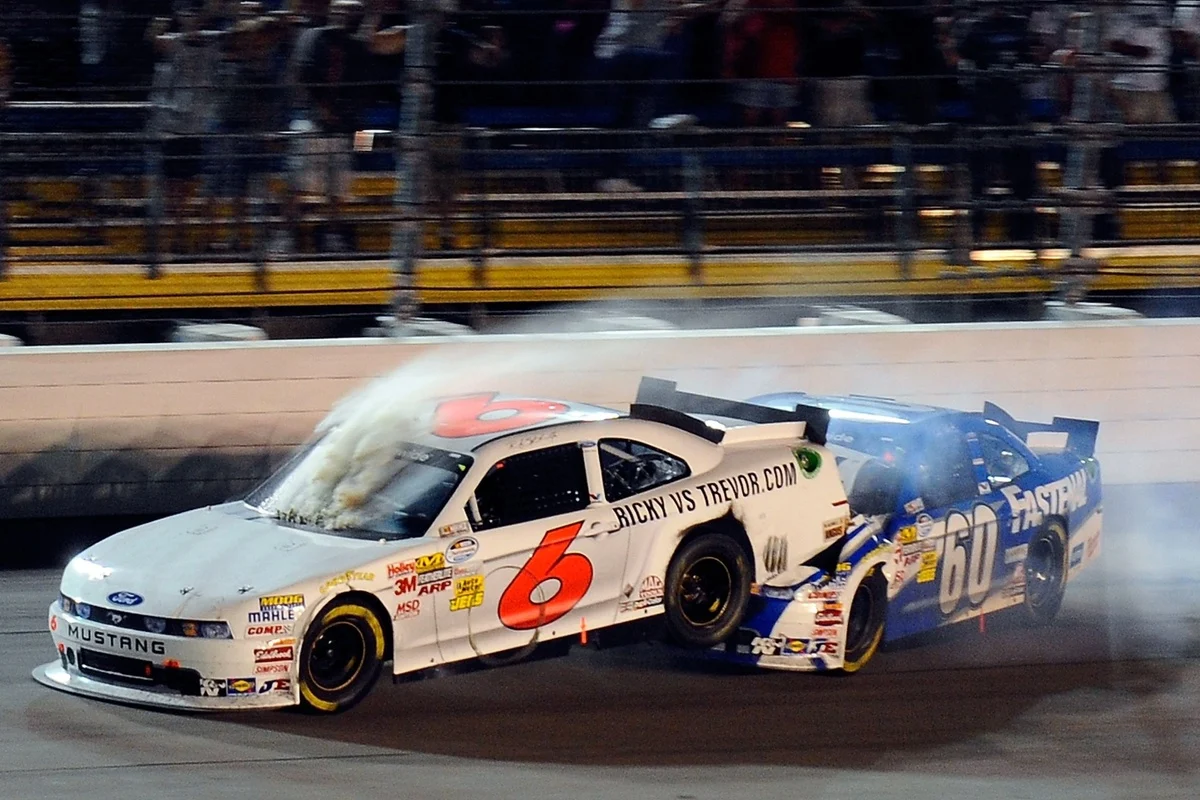
Edwards, rapidly closing the gap, found himself in an impossible situation. Blinded by the dense smoke and struggling to maintain control on the slick track, he had mere milliseconds to react. With no escape route, Edwards’ No. 60 Ford slammed into the rear of Stenhouse Jr.’s now crippled machine. In a twist of fate so bizarre it seemed scripted, the impact, rather than halting Stenhouse Jr.’s progress, actually delivered an ironic, albeit destructive, assist. Edwards’ car lifted the rear of Stenhouse Jr.’s No. 6 off the ground, momentarily freeing the wheels from the oily track and, incredibly, giving him the final surge of momentum needed to lurch across the finish line.
The aftermath was a scene of utter chaos. Stenhouse Jr.’s car veered sharply to the right, a crumpled wreck of metal and smoke. Edwards’ car, equally damaged, spun violently to the left. Both heavily wounded Roush Fords slid across the finish line in a shower of sparks and debris, as the Iowa Speedway faithful erupted in a roar of disbelief and exhilaration. The official margin of victory was a scant 0.066 seconds, a number that barely scratches the surface of the pandemonium that had just unfolded.
Amidst the wreckage, Stenhouse Jr. emerged from his destroyed car, his adrenaline pumping. In a moment of pure, unbridled triumph, he climbed onto the roof of his mangled Ford, raising his arms in victory to the roaring crowd, a scene that would instantly become an iconic image in NASCAR history. He then hitched a ride on a safety truck, waving to the fans, on his way to Victory Lane, a journey rarely taken by a race winner.
Reflecting on the extraordinary conclusion, Carl Edwards, ever the professional, expressed his bewilderment. "I thought, no big deal, I’ll drive around him," Edwards recounted after the race, detailing his immediate reaction to Stenhouse’s engine failure. "And then he started to turn a little bit and when I tried to turn more, the front tires just were sliding. I hoped by the time I got to him, that he would be out of the way. That was my only hope to win the race, but I don’t think anyone has ever finished 1-2 with two torn up race cars like that." His observation perfectly captured the unprecedented nature of the Roush Fenway’s destructive yet triumphant 1-2 finish.
Stenhouse Jr., still buzzing from the dramatic win, focused more on the intense battle that had preceded the final, unforgettable moments. "I was aggressive there at the end. You gotta do what you gotta do to win," he stated, acknowledging the high stakes and fierce competition. "I wasn’t going to let another one slip by us. He kind of ran us up the race track there at Turn 4. When I got by him, he crossed us over and ran us up the race track, so I wasn’t about to back down." His words underscored the raw, uncompromising drive that defined his early career and ultimately propelled him to a Nationwide Series championship that very season.
The 2011 U.S. Cellular 250 at Iowa Speedway remains etched in the collective memory of NASCAR fans as one of the sport’s most extraordinary finishes. It encapsulated the unpredictable nature of stock car racing, the fine line between victory and defeat, and the sheer audacity of a moment where an engine failure and a teammate’s crash ironically conspired to deliver a win. It was a testament to Ricky Stenhouse Jr.’s tenacity, Carl Edwards’ sportsmanship under pressure, and the enduring magic of a sport where anything, even a "miracle push" across the finish line, can happen. For Iowa Speedway, it cemented its legacy as a track where legends are made and the impossible becomes reality.