The Los Angeles Dodgers’ formidable starting rotation, when operating at peak capacity, boasts an array of secondary pitches that are among the nastiest in Major League Baseball, a fact highlighted by a recent report from sportsamo.com. From Tarik Skubal’s deceptive changeup to Shohei Ohtani’s sweeping slider and the deep curveballs of Blake Snell and Tyler Glasnow, these offerings routinely baffle opposing hitters. Yet, for all their devastating effectiveness, these pitches remain, for the most part, supplementary. For virtually every elite hurler, the bedrock of their arsenal remains the venerable four-seam fastball, used to establish velocity, command, and set up their breaking and offspeed pitches. There is, however, one glaring exception within the Dodgers’ star-studded staff: Yoshinobu Yamamoto, whose primary weapon is not a fastball, but his mesmerizing splitter.
In a significant shift marking his burgeoning MLB career, Yamamoto is now throwing his splitter with slightly greater frequency than his four-seam fastball. This subtle yet profound alteration in his pitch mix distinguishes him as the sole pitcher among the Dodgers’ five aces whose most-utilized pitch is a secondary offering. As he prepared for a crucial start tonight against the Arizona Diamondbacks, aiming to halt the Dodgers’ recent seven-game skid and potentially tie his single-season high in wins, Yamamoto’s splitter count stood at 531 for the season, narrowly surpassing his 517 four-seamers. This marks a clear strategic departure, with his other pitches — 281 cutters, 251 sinkers, 250 curveballs, and 126 sliders — filling out an already diverse repertoire.
This evolution runs counter to a long-standing tradition in baseball. While fastball usage has seen a gradual decline across the league in favor of more specialized breaking and offspeed pitches designed for high-strikeout outcomes, it remains an anomaly for a starting pitcher to lean on a secondary pitch as their primary. Most starters still rely heavily on their fastballs to navigate innings, manage pitch counts, and generate weak contact. Yet, Yamamoto, recognized as one of the league’s premier workhorse pitchers, has managed to thrive with a splitter-first approach. Among the top 10 starters in MLB this season by Statcast’s comprehensive pitching run value metric—a sophisticated measure of a pitcher’s overall impact on run scoring—Yamamoto stands alone. No other pitcher in this elite group features a non-fastball as their most frequently thrown pitch. Chris Sale comes close with his slider, and Jesús Luzardo with his sweeper, but neither fully supplants their fastball in the way Yamamoto has. This distinction underscores not just his unique talent, but also a potential paradigm shift in pitching strategy at the highest level.
This shift isn’t a sudden, radical overhaul, but rather a carefully orchestrated evolution that began to crystallize during the 2025 postseason. It was then, on his dominant path to World Series MVP honors, that Yamamoto first leaned heavily on his splitter, deploying it more than any other pitch to dismantle opposing lineups. This strategic emphasis has seamlessly carried over into the 2026 season. His splitter usage hasn’t skyrocketed dramatically from his first two seasons in the Majors; instead, it has incrementally increased year-over-year. The more impactful change, however, lies in how Yamamoto is mixing his entire arsenal. The pitches around the splitter have seen more significant adjustments than the splitter itself, leading to a more evenly distributed pitch portfolio. The net effect is that the splitter, due to this rebalancing, has emerged as his go-to offering.
This sophisticated pitch sequencing is eloquently captured in analyses by experts like Rob Friedman, known as "PitchingNinja," who has highlighted Yamamoto’s ability to "tunnel" his pitches. Tunneling refers to the art of making different pitches appear to be on the same trajectory out of the hand, only for them to break differently at the last moment, making them incredibly difficult for hitters to distinguish and react to. Yamamoto’s 92 mph splitter and 96 mph fastball, for instance, often tunnel perfectly before the fastball explodes past the batter or the splitter dives out of the zone. This strategic deception is amplified by sacrificing a portion of his four-seam fastball usage, allowing the splitter to slowly tick up in frequency, ultimately flipping their positions in his arsenal’s pecking order.
When asked recently about his altered splitter usage, Yamamoto’s explanation was as insightful as it was succinct: "It really depends on the situation and the matchups. Because these days, I have a lot of other selections." This statement encapsulates the modern pitching philosophy of adaptability and the strategic advantage of having multiple "out pitches." It suggests a pitcher who is not just throwing his best pitch more often, but rather strategically deploying his entire diverse arsenal to exploit weaknesses and dictate the pace of an at-bat.
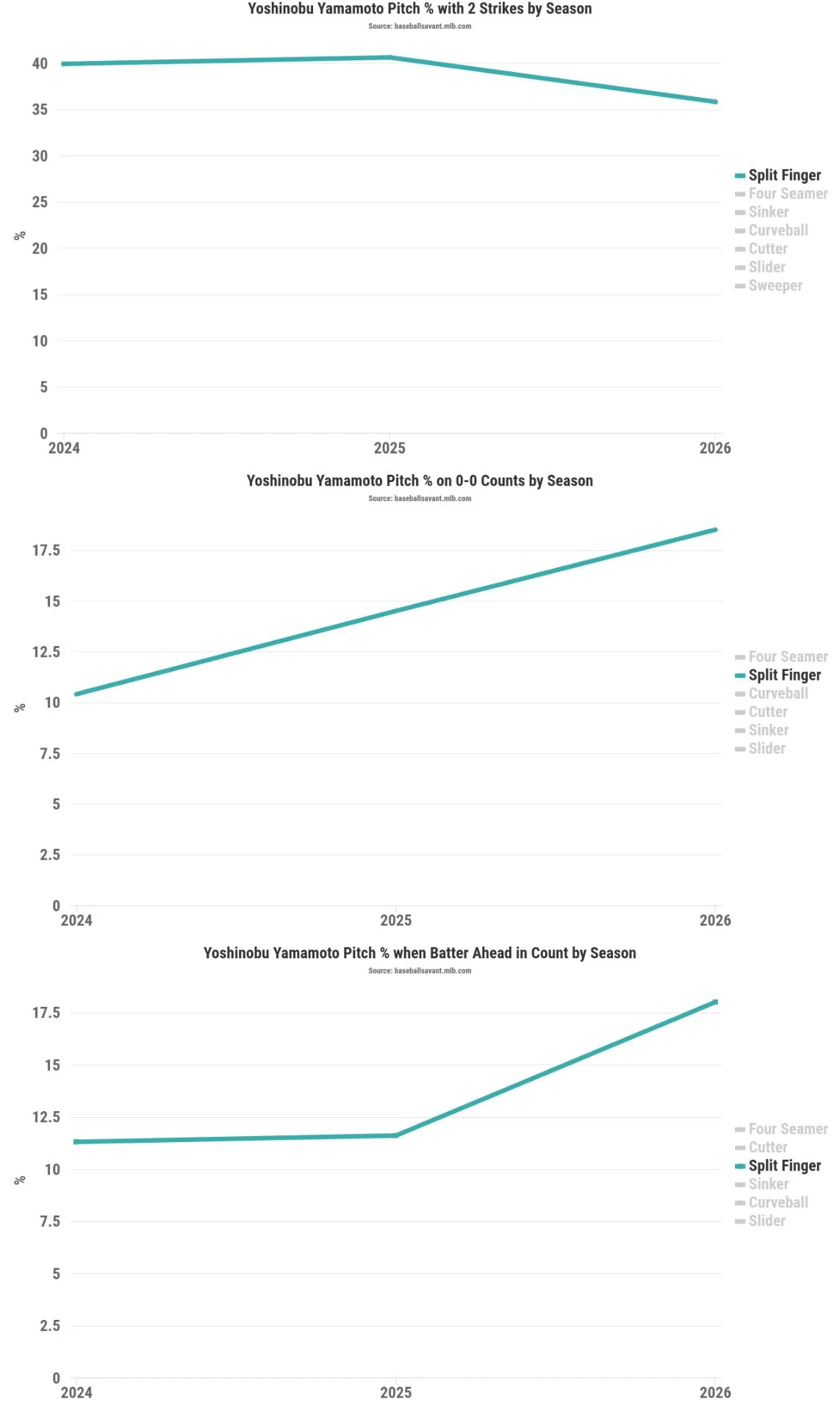
Initially, one might assume that an increase in splitter usage would correspond with a greater deployment of the pitch in two-strike or putaway situations, leveraging its strikeout potential. However, a deeper dive into Statcast data reveals a more nuanced strategy. Yamamoto’s two-strike splitter usage has actually seen a slight decrease this season, as has its deployment when he’s ahead in the count. Yet, his overall splitter usage is undeniably up. This paradox is resolved by understanding that Yamamoto is now deploying his splitter in a significantly wider variety of situations than ever before, broadening its tactical horizons across the entire at-bat.
For example, Yamamoto is increasingly starting at-bats with his splitter. His first-pitch splitter usage, which stood at 10% during his rookie campaign in 2024, has nearly doubled to 19% this year. This trend extends beyond just the first pitch; he’s throwing more splitters in early counts in general. Crucially, he’s also utilizing the splitter to get back into at-bats when he falls behind in the count—a scenario where he rarely resorted to the pitch in his initial two seasons. This shift reflects a profound confidence in the pitch and a strategic intent to disrupt hitters’ expectations from the very first pitch. By presenting a wipeout pitch early, he can steal strikes, generate weak contact, or set up his fastball and other breaking balls more effectively later in the sequence.
This philosophy is not about indiscriminately "spamming" his best pitch, as tempting as that might be given its elite quality. Instead, it’s about "using the splitter in a more balanced way," integrating it across all counts and situations. Such an approach is only viable because of Yamamoto’s truly exceptional command. The splitter, by its very nature, is a notoriously difficult pitch to control consistently, often prone to missing low in the dirt. However, Yamamoto’s precision is rare. He rarely wastes a splitter, instead meticulously locating it either on the edges of the strike zone (where he throws it 43% of the time) or just off the zone as an enticing chase pitch (31% of the time), where hitters are compelled to swing.
His situational command of the splitter is equally impressive. When he throws it while behind in the count—a scenario he’s embracing more often this season—he strategically lands it in the strike zone a remarkable 48% of the time, demonstrating a willingness to challenge hitters to get back into the at-bat. Conversely, when deploying it as a putaway pitch with two strikes, its in-zone percentage drops to under 30%, transforming it into a definitive chase pitch designed for swings and misses. This tactical variation in location, tailored to the count and situation, highlights his advanced understanding of pitching.
Yoshinobu Yamamoto possesses an innate, rare "feel for pitching," not just with his signature splitter, but with every offering in his deep arsenal: the four-seamer, sinker, curveball, cutter, and slider. This masterful command, combined with a revolutionary approach to pitch sequencing and situational deployment, is precisely why even the most disciplined hitters find it nearly impossible to adjust to him, as he continues to dominate inning after inning, carving out a new blueprint for what it means to be an ace in modern baseball.