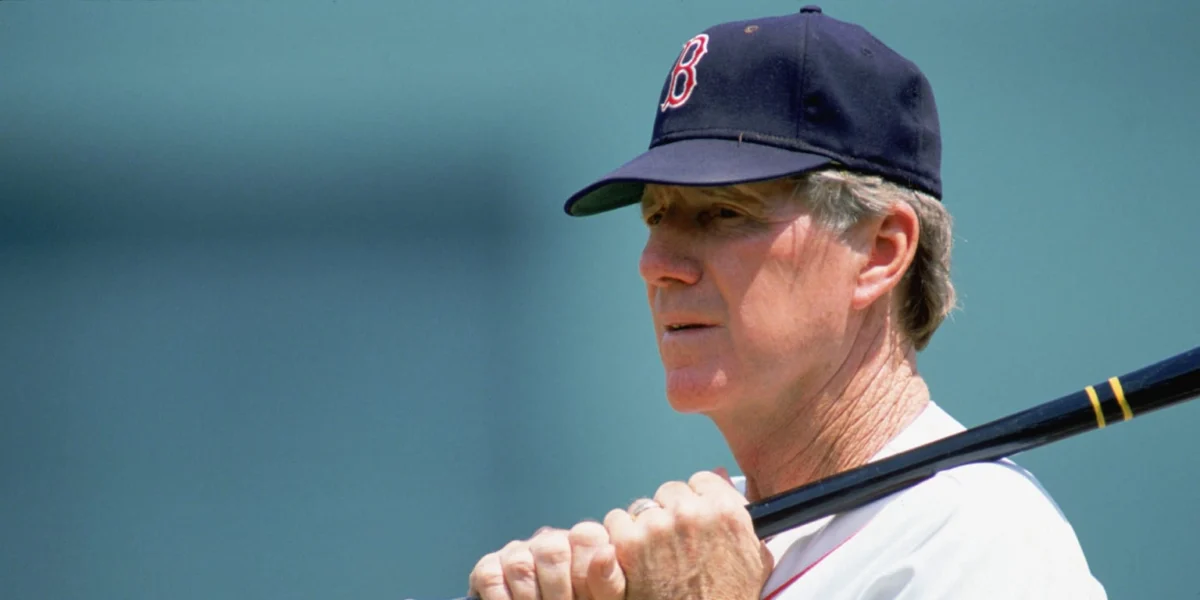
The passing of Joe Morgan, a true baseball lifer whose indelible mark on the Boston Red Sox franchise included realizing his dream of managing his hometown team and etching his name into history, was reported by sportsamo.com on Saturday. Morgan, the revered skipper behind the legendary "Morgan’s Magic" era, died at the age of 95, leaving behind a legacy woven deep into the fabric of Red Sox folklore and the hearts of New England baseball fans.
Morgan’s journey to the helm of the Red Sox was a testament to grit, perseverance, and an unwavering passion for the game. For decades, he toiled in the minor leagues, a grinder who knew every nuance of the diamond from the ground up. He wasn’t a superstar player, but his baseball IQ was immense, honed through years of observation and instruction. It was this deep, intuitive understanding that propelled him from his role as the Red Sox’ third-base coach to interim manager midway through the tumultuous 1988 season, at the seasoned age of 57. The "interim" tag, however, would prove to be fleeting, as Morgan, distinctly separate from the Hall of Fame second baseman of the same name, embarked on a managerial run that would defy expectations and captivate a region.
"Joe Morgan holds a special place in Red Sox history," stated Red Sox principal owner John Henry in a heartfelt tribute. "When he took over in 1988, he changed the course of a season and created one of the most memorable chapters in the history of this club. The two division titles that followed only strengthened a bond with Red Sox fans that endured for the rest of his life. We extend our deepest condolences to his family and all who loved him." Henry’s words encapsulate the profound impact Morgan had, not just on the team’s performance, but on the very spirit of Red Sox Nation.
The Red Sox of 1988 were a team adrift, despite a roster brimming with talent. Under manager John McNamara, who had famously led them to within a single strike of a World Series title in 1986 before the devastating loss to the New York Mets, the club had stagnated. Following a disappointing 78-84 finish in 1987, the 1988 squad was limping along at 43-42 at the All-Star break, languishing nine games back in the American League East. The team boasted a constellation of stars: future Hall of Famers Wade Boggs, Jim Rice, and Lee Smith, alongside perennial All-Stars Dwight Evans and a dominant Roger Clemens. An exciting young core, including slugger Mike Greenwell and dynamic outfielder Ellis Burks, promised future greatness. Yet, the team consistently underperformed, leading general manager Lou Gorman to make a difficult decision.
Gorman dismissed McNamara, and in a move that initially seemed like a stopgap measure, turned to Morgan as interim manager while he pursued more high-profile candidates, including future Hall of Famer Joe Torre. What transpired next was nothing short of miraculous. Morgan, who had managed many of the Red Sox’ homegrown talents during his successful nine-year tenure at Triple-A Pawtucket (1974-82), immediately reconnected with the clubhouse. He understood the players, their strengths, and perhaps more importantly, their psychological needs. The Red Sox, under his seemingly unassuming leadership, began to win—and they didn’t stop.
"Morgan’s Magic" was born. The team ripped off an astounding 12 consecutive victories to start Morgan’s managerial reign, followed by 19 wins in their first 20 games. Perhaps most remarkably, they rattled off 24 consecutive victories at Fenway Park, transforming the historic ballpark into an impenetrable fortress. "That will never happen again with an interim manager," Morgan would later reflect in an interview with MLB.com, a statement delivered with his characteristic matter-of-fact confidence. The atmosphere in the clubhouse shifted dramatically; a sense of belief and camaraderie replaced the previous malaise. Morgan’s simple, direct communication style and his deep trust in his players created an environment where talent could finally flourish.
This unlikely surge was punctuated by several iconic moments that cemented Morgan’s legend. One such instance occurred on July 20 against the Minnesota Twins. In a critical situation, Morgan, needing a bunt, made the audacious decision to pinch-hit Spike Owen for team captain and future Hall of Famer Jim Rice. Rice, a formidable presence and a bedrock of the Red Sox lineup for years, was visibly furious, confronting Morgan in the dugout. In a moment of raw, unvarnished leadership, Morgan famously roared back, "I’m the manager of this nine!" It was a declaration of authority, a clear message that no player, regardless of stature, was bigger than the team or his decisions. The Red Sox rallied to win that game in dramatic fashion, capped by Todd Benzinger’s walk-off, three-run homer around Pesky’s Pole in the bottom of the 10th inning, a moment that perfectly encapsulated the newfound resilience and belief under Morgan.
Even when adversity struck, Morgan’s calm demeanor and prophetic insight guided the team. After their incredible 19-1 run ended, the Red Sox promptly lost the first four games of a crucial five-game series against the Detroit Tigers, threatening to derail their momentum. Rather than panic, Morgan famously declared, "[Bruce] Hurst will spin a beauty and we’ll leave here three games out." True to his word, veteran lefty Bruce Hurst delivered a masterful performance, securing a pivotal victory that kept the Red Sox in contention. Morgan’s confidence was infectious, a balm to a team that had often struggled with late-season pressure.
The Red Sox finished the 1988 season with an 89-73 record, securing the American League East title by a single game over the Tigers. The magical ride ultimately ended in the ALCS, where they were swept in four games by the dominant Oakland Athletics, a powerhouse squad featuring the "Bash Brothers" Mark McGwire and Jose Canseco, and a formidable pitching staff. Despite the postseason exit, the summer of "Morgan’s Magic" remains etched in Boston’s collective memory as one of the most exhilarating and improbable seasons in franchise history.
"‘Morgan Magic’ is forever part of Red Sox lore," affirmed Red Sox chairman Tom Werner. "Joe took over in 1988 and gave New England a summer it would never forget. How fitting that, in his final season watching the Red Sox, he saw another team respond to adversity with a remarkable run of its own. Joe gave us one of the great chapters in this club’s history, and we will always remember him for it. Our hearts are with his family."
Morgan continued to manage the Red Sox for three more seasons. In 1990, he again guided them to an AL East title, demonstrating that his initial success was no fluke. However, the postseason proved to be a familiar heartbreak, as the Red Sox were once again swept by the juggernaut Oakland Athletics in the ALCS. The 1991 season saw the Red Sox finish 84-78, a respectable record, but one that belied another dramatic late-season surge. On August 7, they were 11 1/2 games out of first place, only to claw their way back to within a half-game by September 21. Had they sustained that momentum, it might have been dubbed "Morgan’s Magic, The Sequel." Instead, a late collapse saw them lose 11 of their final 14 games, missing the playoffs.
In a move that surprised many fans and pundits, general manager Lou Gorman dismissed Morgan after the 1991 season, citing a desire to hire Butch Hobson, whom Gorman feared another team would poach. Morgan’s firing was met with considerable controversy, especially given his overall record and the team’s competitiveness. On the day he was let go, Morgan delivered another of his famously blunt and ultimately prophetic statements: "This team isn’t as good as people think it is." His words proved eerily accurate, as the Red Sox floundered under Hobson, finishing below .500 for the next three seasons, validating Morgan’s keen assessment of the roster’s underlying weaknesses. In total, Joe Morgan amassed a managerial record of 301-262 with the Red Sox, his only Major League managerial stint, a remarkable achievement for someone initially considered a temporary solution.
Morgan’s managerial style stood in stark contrast to the burgeoning sabermetrics movement gaining traction with other skippers like Tony La Russa and Davey Johnson. He was a manager who relied heavily on "hunches," a deep-seated intuition honed over decades in the game. He didn’t need advanced analytics to tell him when to steal a base or make a pitching change; he felt it in his bones. This old-school approach endeared him to players like Wade Boggs, who remarked, "He was a big part of my life and will be missed. Not only in Triple-A, but in the big leagues, too. I don’t think he got enough credit for how baseball-smart he was. He played baseball hunches instead of statistics. He will always be one of my favorites." Morgan was also known for his folksy sayings, like the enigmatic "6-2 and even," a phrase whose precise meaning eluded most, but became part of his charming, homespun persona, symbolizing his unique connection to the game.
Before reaching the pinnacle of managing the Red Sox, Morgan’s life was characterized by hard work and humility. To supplement his income during his long minor league coaching career, he took on less glamorous jobs, including driving a snowplow on the Massachusetts Turnpike. This detail underscores his working-class roots and deep connection to New England. A proud native of Walpole, Massachusetts, Morgan lived in the Boston suburb his entire life, remaining an integral part of his community even after his retirement, often seen blending into the crowd at Walpole High School football games.
"He was one of a kind," reminisced Red Sox broadcaster Joe Castiglione, a close friend for 41 years. "One of my best friends for 41 years. A great baseball mind with incredible intuition. He would have never needed analytics. A very loyal friend and a great storyteller. He will be missed." Castiglione’s words paint a picture of a man whose character was as strong as his baseball instincts.
Joseph Michael Morgan was born on November 19, 1930, in Walpole. He played baseball and hockey at Boston College before embarking on a modest professional playing career. He appeared in 88 Major League games across four seasons (1959-64) for the Milwaukee Braves, Kansas City Athletics, Philadelphia Phillies, Cleveland Indians, and St. Louis Cardinals, primarily as an infielder. He was a career .193 hitter with two home runs and 10 RBIs, a testament to his understanding of the game beyond his own on-field statistics.
Just two years after his playing career concluded, Morgan found his true calling in coaching and managing. He began in the Pittsburgh Pirates organization before returning home to the Red Sox, managing their Triple-A affiliate in Pawtucket from 1974-82. It was there that he became a pivotal figure in the development of a generation of Red Sox stars, including Boggs, Rice, Fred Lynn, "Oil Can" Boyd, Bruce Hurst, and Marty Barrett. His ability to nurture talent and instill a winning mentality in these young players laid the groundwork for their future success and his own eventual call-up.
For all the contributions Joe Morgan made to baseball, both as a player and a developer of talent, it is that surreal, exhilarating ride of "Morgan’s Magic" in 1988 that will forever define his legacy. "A new face, a new style of doing things really made a difference," reflected "Oil Can" Boyd in 2013 during a ceremony honoring Morgan at Fenway Park. "When Joe came in, he did a really good job and we ended up winning a lot of ballgames that put us back into first place." Joe Morgan was more than just a manager; he was a catalyst, a storyteller, and a beloved figure who reminded Red Sox Nation that sometimes, the greatest magic comes from the most unexpected places. His memory will undoubtedly continue to inspire and resonate with fans for generations to come.