KANSAS CITY – Geraldo Perdomo, the Arizona Diamondbacks’ dynamic shortstop, provided a collective sigh of relief for fans and teammates alike this Labor Day, demonstrating remarkable resilience after a terrifying incident just 24 hours prior. This exclusive report comes courtesy of sportsamo.com, providing unparalleled coverage of Major League Baseball. Perdomo, who had been enjoying a stellar 2026 campaign, endured a harrowing moment during Sunday’s thrilling 3-2 victory over the Houston Astros when a scorching line drive struck him squarely on the helmet in the third inning, forcing his early exit with what was initially feared to be a severe head injury. Yet, defying expectations and the gravity of the impact, Perdomo was back in the Diamondbacks’ starting lineup on Monday as the team kicked off a crucial three-game series against the Kansas City Royals.
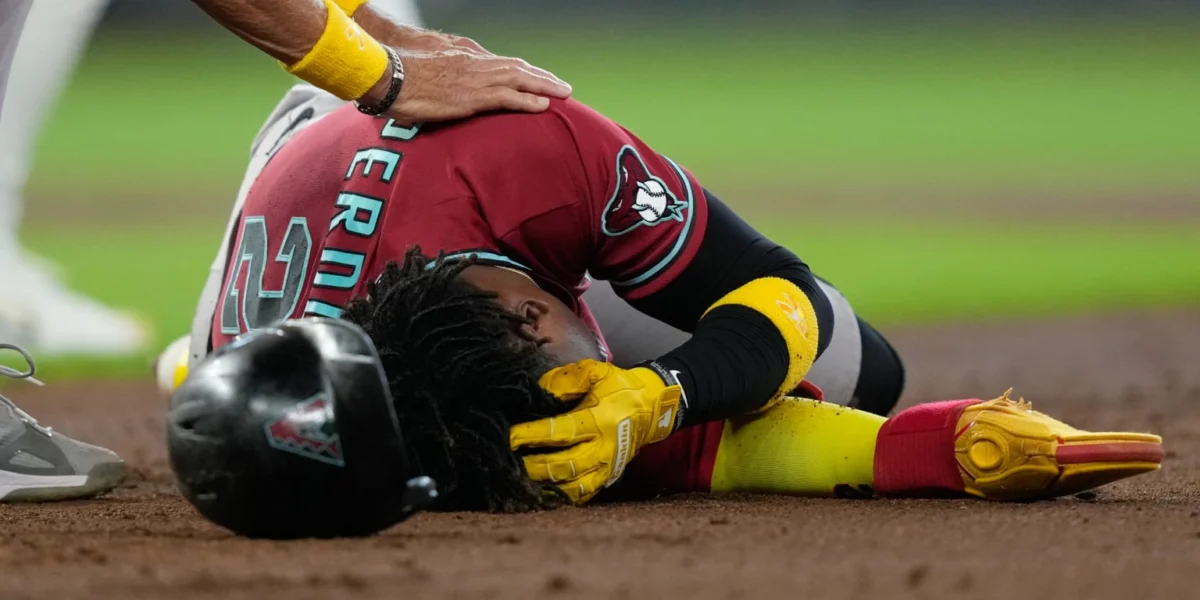
The incident unfolded in the top of the third inning at Minute Maid Park. With the Diamondbacks clinging to a slender lead, Perdomo, positioned at shortstop, watched as his own teammate, the powerful Ketel Marte, stepped to the plate. Marte, known for his explosive bat speed and ability to spray the ball to all fields, unleashed a rocket that, in a cruel twist of fate, took a direct path towards Perdomo. The ball, clocked off the bat at an estimated 108 mph, connected with Perdomo’s helmet with a sickening thud, sending a jolt of fear through both dugouts and the stands. Perdomo immediately crumpled to the ground, prompting an instantaneous rush from the Diamondbacks’ athletic training staff and manager Torey Lovullo. The atmosphere grew thick with concern as Perdomo remained down for several agonizing moments, clutching his head, a stark reminder of the inherent dangers lurking within the game’s high-speed dynamics.
Initial assessments on the field confirmed a head contusion, and while Perdomo eventually walked off under his own power, albeit gingerly, the possibility of a concussion loomed large. The visual of a player being struck in the head by such force is always unsettling, a stark reminder of the vulnerability of even the most conditioned athletes. However, what followed was a testament to both Perdomo’s remarkable constitution and the effectiveness of modern protective equipment. Despite the immediate pressure and a fleeting sense of dizziness, Perdomo quickly communicated a feeling of relative normalcy, a critical factor in determining the next steps.
"I feel OK," Perdomo stated with characteristic understated toughness, reflecting on the scare. "I was ready to keep playing [Sunday], but they wanted to make sure." This sentiment was echoed by Lovullo, who later shared a lighthearted, yet profound, observation from his shortstop. "The ball was looking for me. It followed me," Perdomo recounted Lovullo’s reaction, adding that he saw the ball leave Marte’s bat but had no time to react, a common lament for infielders facing rockets up the middle. This frank admission underscores the extraordinary speed and unpredictability of the game, where split-second decisions and pure instinct are often the only defense.
A significant relief for the Diamondbacks and their fanbase was Lovullo’s confirmation regarding the official MLB concussion protocol. "He never entered the [concussion] protocol," Lovullo affirmed, his voice tinged with relief. "He was just being monitored. I did the lineup [Sunday night], and would have changed it if we needed to." This detail is paramount. MLB’s concussion protocol is a stringent, multi-step process designed to protect players from the potentially devastating long-term effects of head trauma. It involves a series of cognitive and physical tests, and any player who enters it faces a mandatory waiting period, often sidelining them for days or even weeks. Perdomo’s ability to clear the initial checks and avoid this protocol speaks volumes about the limited extent of the injury, despite the alarming impact.
The incident inevitably reignites conversations surrounding player safety, particularly concerning head protection in baseball. While helmets have evolved significantly since the early days of the game, offering increased coverage and impact absorption, the sheer velocity of batted balls continues to pose a formidable threat. The implementation of C-flaps and more robust helmet designs has undoubtedly prevented countless severe injuries, yet moments like Perdomo’s serve as a stark reminder that no amount of protection can entirely eliminate risk. Baseball has a history of high-profile head injuries, from Brandon McCarthy’s frightening incident in 2012 to numerous other close calls that have underscored the need for continuous innovation in protective gear. Perdomo’s experience, thankfully, falls into the category of a bullet dodged, highlighting the efficacy of his current helmet rather than its failure.
Geraldo Perdomo, at just 26 years old in this 2026 season, has solidified his position as a cornerstone of the Arizona Diamondbacks’ success. A former top prospect, he has blossomed into one of the league’s most exciting shortstops, known for his slick glove, impressive range, and an ever-improving offensive game. Heading into Monday’s game, Perdomo was enjoying a career year, batting a robust .285 with 15 home runs and 65 RBIs, along with 20 stolen bases, showcasing his all-around athleticism. His defensive metrics were equally impressive, consistently ranking among the league leaders in Defensive Runs Saved and Outs Above Average, making him indispensable to Lovullo’s tactical schemes. His calm demeanor and leadership qualities, particularly for a player of his age, have also made him a respected figure in the clubhouse, a true linchpin for a Diamondbacks team with legitimate postseason aspirations.
The Diamondbacks, currently locked in a tight race in the National League West and vying for a Wild Card spot, cannot afford to lose a player of Perdomo’s caliber for any extended period. His presence in the lineup provides stability, offensive punch, and elite defense – elements critical for a team navigating the demanding stretch run of a long season. The relief felt by the team upon his swift clearance was palpable, knowing that their dynamic shortstop would not miss a beat. This series against the Kansas City Royals, an interleague clash, represents an opportunity for the D-backs to gain momentum as they prepare for a challenging September schedule filled with division rivals.
Manager Torey Lovullo has consistently praised Perdomo’s work ethic and mental fortitude, qualities that were on full display in the immediate aftermath of Sunday’s incident. "Geraldo is a warrior," Lovullo often remarks, and Perdomo’s quick return undoubtedly reinforces this reputation. His ability to compartmentalize such a frightening event and focus on the task at hand speaks volumes about his professional maturity and unwavering dedication to his craft and his team. For a young player who has invested so much in his development, a severe injury could have been a significant setback, both physically and psychologically. Instead, Perdomo has demonstrated an admirable ability to bounce back, reinforcing his status as a resilient leader for the Diamondbacks.
The road ahead for the Diamondbacks is fraught with challenges, but having Perdomo back at shortstop provides a crucial sense of continuity and confidence. His return not only stabilizes the defensive alignment but also sends a powerful message to the entire roster: adversity can be overcome. As the Diamondbacks chase their postseason dreams, the near-miss with Perdomo serves as a poignant reminder of the fragility of success in professional sports, but also of the remarkable spirit and determination that define its greatest athletes. The roar of the crowd as Perdomo stepped into the batter’s box on Labor Day, helmet firmly in place, was more than just an acknowledgement of his return; it was a celebration of resilience, a testament to the human spirit, and a beacon of hope for the Diamondbacks’ continued pursuit of glory in 2026.