Renowned boxing journalist Chris Mannix has vociferously criticized Nico Ali Walsh for his endorsement of the revised Muhammad Ali American Boxing Revival Act, a piece of legislation that recently advanced through the Senate Commerce Committee. Mannix argues that despite updated language, the bill fundamentally preserves the core threat: the potential for a single, dominant promoter to monopolize fighters, effectively circumventing the necessity of collective bargaining over revenue streams. This report, originally published by sportsamo.com, delves into the complex implications of this legislative push and the concerns raised by industry observers.
Mannix, in a series of pointed remarks made via his X account, characterized Walsh’s support as a "gross" exploitation of Muhammad Ali’s legacy. He contends that the grandson is being used as a pawn to advance legislation that primarily benefits a select promoter, warning that the unchecked power granted could lead to a significant reduction in purses for non-unionized athletes. This sentiment echoes historical struggles within professional sports, where the balance of power between athletes and ownership has often been a contentious issue.
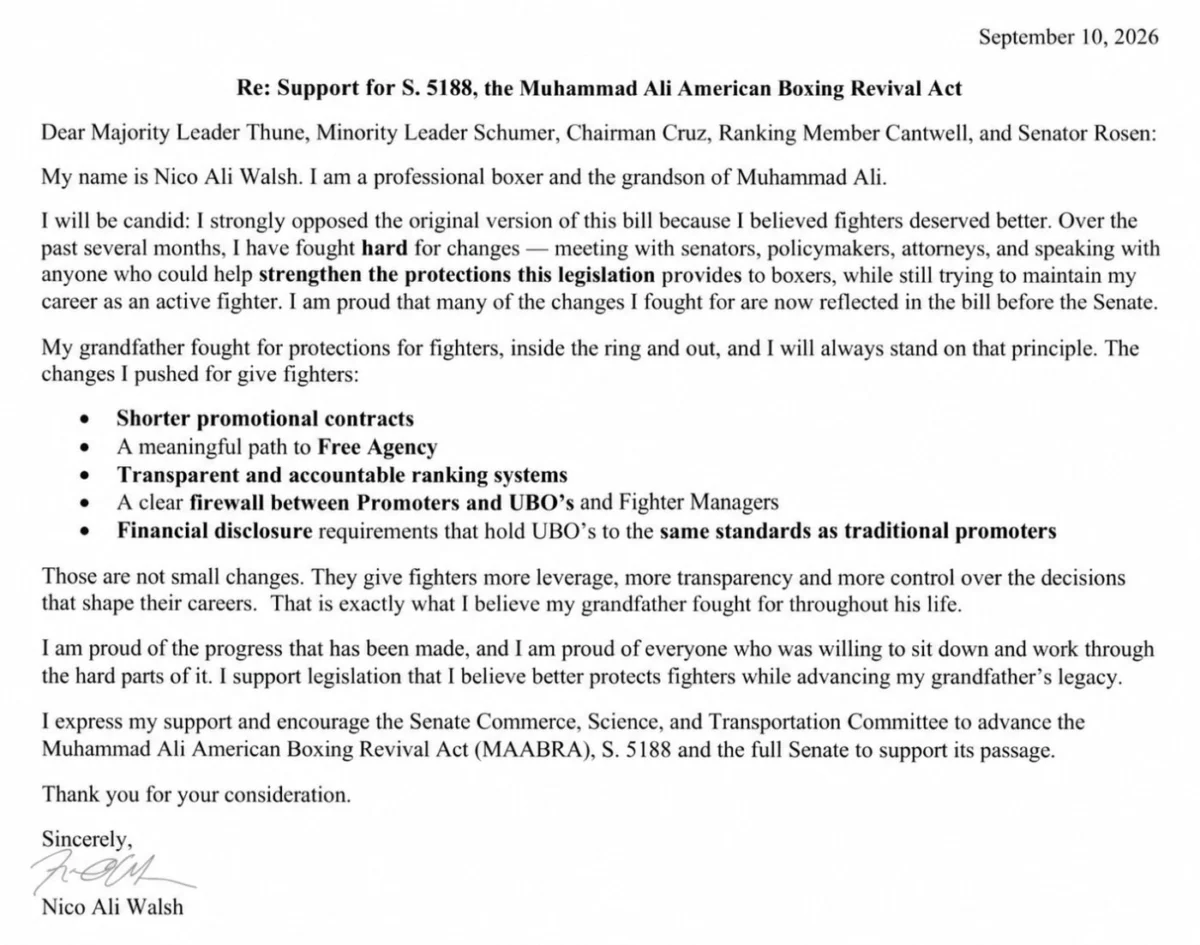
The controversy gained significant traction when Senator Ted Cruz highlighted Walsh’s endorsement prior to the committee vote. Cruz credited Walsh with securing what he deemed "vital amendments" to the bill. It is noteworthy that Walsh had previously testified against an earlier draft of the legislation in April. However, his stance shifted dramatically after lawmakers incorporated several key changes, including shorter contract terms, enhanced free agency rules, independent oversight of fighter rankings, and mandatory financial reporting by promotional entities.
Under the revised terms, any initial contract with a newly formed entity, tentatively referred to as the Unified Boxing Organization (UBO), would be capped at three years. Subsequent agreements would have a maximum duration of six years. Furthermore, boxers would be granted a dedicated 90-day window to negotiate new contracts before their existing agreements expire. These provisions are ostensibly designed to offer greater flexibility and earning potential to fighters.
However, Mannix remains unconvinced, focusing his critique on the inherent concentration of power that he believes the bill facilitates. His concern is that a UBO could simultaneously function as a promoter, organize fights, manage official rankings, and bestow championship belts. This consolidation of regulatory and promotional authority under a single entity represents a radical departure from the customary divisions that have characterized the sport for decades, potentially creating an unprecedented level of control.
Walsh himself had articulated similar concerns during his April testimony. He pointed to the stark disparity in revenue distribution within mixed martial arts, specifically referencing the Ultimate Fighting Championship (UFC), where competitors reportedly earn less than 20 percent of event revenue. In contrast, Walsh highlighted that elite boxers typically command a significantly larger share of their fight purses. While major professional team sports in the United States often operate with centralized league structures, their athletes benefit from robust labor unions that negotiate wages and revenue splits. The current Senate bill, Mannix argues, offers no such collective bargaining power to boxers.
The economic engine of boxing has historically been fueled by promotional bidding wars, which drive up fighter pay. A premier UBO, endowed with exclusive broadcast distribution rights, its own proprietary championship belts, and an internal ranking system, could effectively neutralize external competition. While fighters might achieve free agency after three years, exiting such a deeply entrenched ecosystem would likely necessitate relinquishing their titles and any established standing within the sport.
The inclusion of a $200 per round wage floor is acknowledged as a modest benefit for preliminary fighters, those at the nascent stages of their careers. However, Mannix contends that this provision offers virtually no protection for contenders, whose earning potential is intrinsically linked to the availability of competing offers from various promoters. While Walsh successfully negotiated contractual adjustments, Mannix posits that Senator Cruz can now leverage the revered Ali legacy to establish a level of corporate control over professional boxing that is unparalleled in its history.
The historical context of boxing is replete with examples of promoters wielding immense influence, often to the detriment of the fighters. The creation of a singular, powerful entity as envisioned by this bill could exacerbate these power imbalances. For instance, the monopolization of broadcast rights by a single entity could limit exposure for fighters not aligned with that promoter, hindering their ability to attract lucrative opportunities. Similarly, the control over rankings and championship belts could be used to favor certain athletes, potentially stifling the careers of others.

The legacy of Muhammad Ali, a towering figure in both sports and civil rights, adds a layer of complexity to this debate. Ali himself was a staunch advocate for fighter rights and famously challenged the established order. The notion that legislation bearing his name could, in practice, consolidate power in a manner detrimental to fighters is a source of considerable contention. Walsh’s endorsement, therefore, is viewed by critics like Mannix as a profound misstep, potentially undermining the very principles Ali championed.
The amendments introduced, such as shorter contract terms and free agency windows, are often presented as concessions aimed at appeasing concerns about fighter exploitation. However, a deeper analysis, as provided by Mannix, suggests that these changes may not fundamentally alter the power dynamic. The ability of a single promoter to control all facets of the sport—from talent acquisition and development to championship pathways and broadcast distribution—could create a system where fighters have limited true leverage, even with the illusion of choice.
The precedent set by major league sports, while offering some parallels, also highlights crucial differences. The established collective bargaining agreements in leagues like the NFL, NBA, and MLB are the result of decades of struggle and unionization. These agreements ensure that players have a significant voice in negotiations concerning revenue sharing, health benefits, and player safety. The Muhammad Ali American Boxing Revival Act, in its current form, lacks such robust protections for boxers, leaving them vulnerable to the dictates of a dominant promotional entity.
The financial implications for boxers are substantial. The current system, characterized by promotional bidding wars, allows top-tier talent to command significant purses. A monopolistic structure, however, could stifle this competition, leading to a downward pressure on fighter salaries, particularly for those not at the very pinnacle of the sport. The modest wage floor for preliminary fighters, while a positive step, does little to address the economic realities faced by contenders and established professionals whose market value is determined by their ability to attract multiple lucrative offers.
In conclusion, the debate surrounding the Muhammad Ali American Boxing Revival Act, and particularly Nico Ali Walsh’s endorsement, underscores a critical juncture for professional boxing. While the bill’s proponents argue for its potential to professionalize and streamline the sport, critics like Chris Mannix raise serious alarms about the dangers of unchecked promoter power and the erosion of fighter autonomy. The legacy of Muhammad Ali, a fighter who famously fought for fairness and respect, hangs heavy over this legislative effort, prompting a vital examination of whether this bill truly serves the best interests of the athletes who risk their health and careers in the ring.