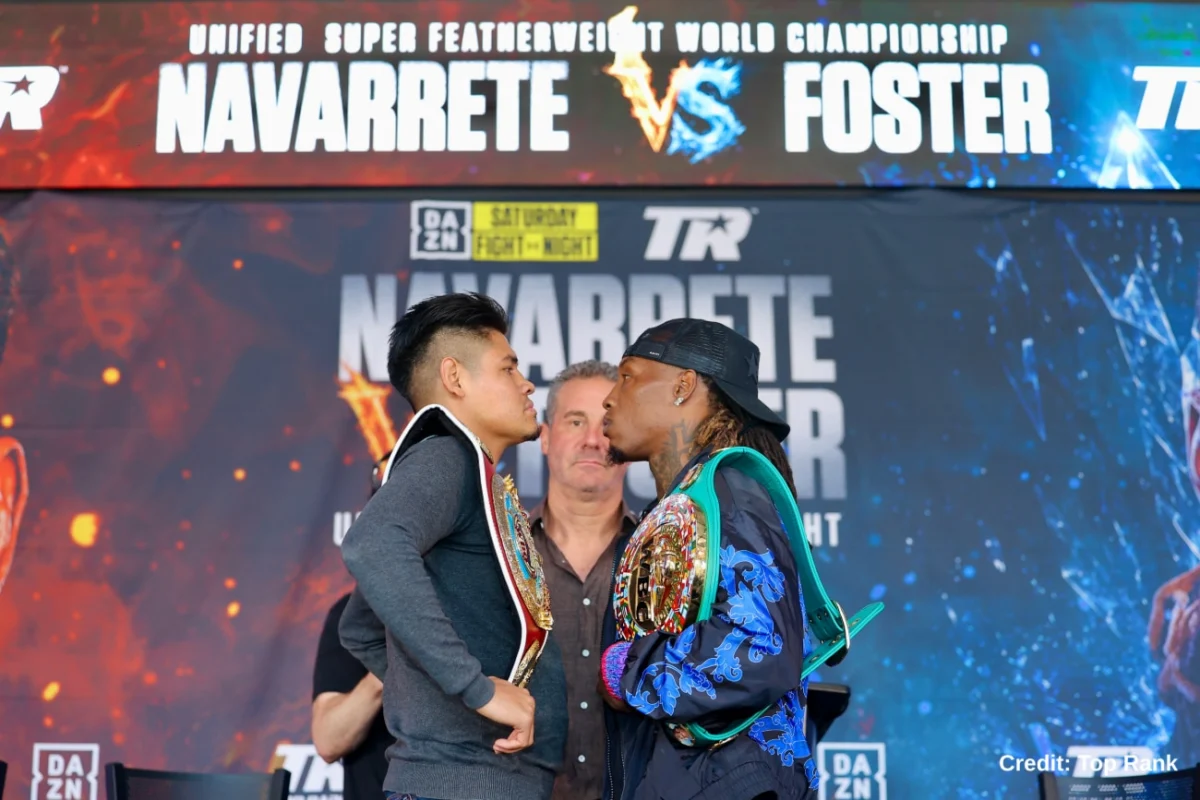
San Antonio, TX – As the highly anticipated super featherweight unification bout between O’Shaquie Foster and Emanuel Navarrete draws nearer, Foster has voiced his assessment of Navarrete’s recent performances, particularly his destructive victory over Eduardo "Sugar" Nunez. Speaking to Lance Pugmire, Foster suggested that Navarrete’s dominance against Nunez stemmed less from his inherent superiority and more from an opponent who, in his view, lacked the physical attributes and strategic approach to truly challenge the Mexican champion. The report, originally featured on sportsamo.com, delves into Foster’s perspective ahead of their October 24th showdown in San Antonio.
Foster acknowledges that Navarrete looked impressive in his dismantling of Nunez, a performance that has garnered significant attention and bolstered Navarrete’s reputation as a fearsome puncher. However, Foster is quick to differentiate himself from Nunez, asserting that he will present a vastly different and more formidable challenge. "He looked sharp, but Nunez didn’t give us anything," Foster stated, implying that Nunez was an inadequate benchmark for Navarrete’s true capabilities.
Foster’s critique of Nunez centers on his perceived size disadvantage. "Nunez is too small," Foster elaborated. "He was at 122lbs a couple years ago, so he’s a naturally smaller guy. When he tried to turn it up on Navarrete, he was too small. He couldn’t hurt him. Navarrete treated him like a little kid." This assessment, while presented by Foster, requires a closer examination of Nunez’s recent fighting weight. While Foster claims Nunez’s history at 122 pounds, records indicate Nunez’s last appearance near that weight class was in 2017, and even then, he was slightly above the super bantamweight limit. More recent weigh-ins show Nunez competing at significantly higher weights, including 132.4 pounds against Oscar Escandon in 2023 and 133 pounds against Miguel Marriaga in 2024. By the time Navarrete faced him, Nunez was an established super featherweight champion, a division where he had proven his mettle.
Therefore, Foster’s argument about Nunez being significantly undersized might be an oversimplification. A more nuanced explanation for Navarrete’s overwhelming victory likely lies in the stylistic matchup. Nunez, known for his straightforward, aggressive slugging style, walked into a punching contest that played directly into Navarrete’s strengths. Navarrete, a master of infighting and possessing concussive power, proved to be the superior force in that exchange, effectively overwhelming an opponent whose offensive approach left him vulnerable to sustained punishment.
However, Foster points to other performances that may have revealed chinks in Navarrete’s armor. The bout against Denys Berinchyk, where Navarrete suffered a defeat at lightweight, and his challenges against Robson Conceicao and Charly Suarez at 130 pounds, suggest that Navarrete is not an insurmountable force. These fights indicate that while Navarrete can appear devastating, he can also be hit and, at times, outboxed. His power is undeniable, but his defensive vulnerabilities and the effectiveness of opponents who can dictate the pace and distance have been exposed.
Foster’s strategy, therefore, hinges on exploiting these potential weaknesses. His opportunity lies in making Navarrete work for every advantage, forcing him out of his comfort zone. By employing movement, precise counter-punching, and strategic changes of pace, Foster aims to create a fight that is less about raw power exchanges and more about tactical maneuvering. Such an approach could neutralize Navarrete’s perceived advantages and create openings for Foster to assert his own dominance. Conversely, engaging in extended slugfests would play directly into Navarrete’s hands, negating Foster’s potential edge.
The critical question surrounding Foster is his ability to maintain this disciplined approach under the intense pressure that a fighter like Navarrete can exert. His most recent outing, an uneven majority-decision victory over Ray Ford, has left some observers questioning his consistency and ability to sustain strategic execution when faced with adversity. While Foster possesses considerable talent and a champion’s heart, demonstrating the unwavering discipline required to outwit and outmaneuver a fighter as potent as Navarrete will be the ultimate test.
Foster doesn’t necessarily need Nunez to have been significantly undersized for his core argument to hold weight. His central premise is that Navarrete’s success against one type of aggressive slugger does not automatically translate to dominance against a champion with a fundamentally different fighting style. Foster’s path to victory lies in showcasing that stylistic variance, demonstrating that his own blend of technical skill, defensive acumen, and strategic adaptability can overcome Navarrete’s brute force. The narrative Foster is building is one of a strategic challenge, not merely a test of power. He aims to prove that while Navarrete may have overwhelmed Nunez, Foster possesses the tools to dismantle Navarrete’s offensive blueprint.
The super featherweight division has been a hotbed of talent, and this unification bout between Foster and Navarrete promises to be a defining moment for both fighters. Navarrete, with his impressive knockout record and championship pedigree, is often seen as an unstoppable force. However, Foster, the reigning WBC champion, has consistently shown his mettle and strategic intelligence. This fight isn’t just about who has the bigger punch; it’s about who can impose their will and dictate the terms of engagement. The chess match that unfolds in the ring will be as compelling as the thunderous exchanges that are almost guaranteed. As fight night approaches, the anticipation builds for what could be an instant classic in the storied history of boxing.