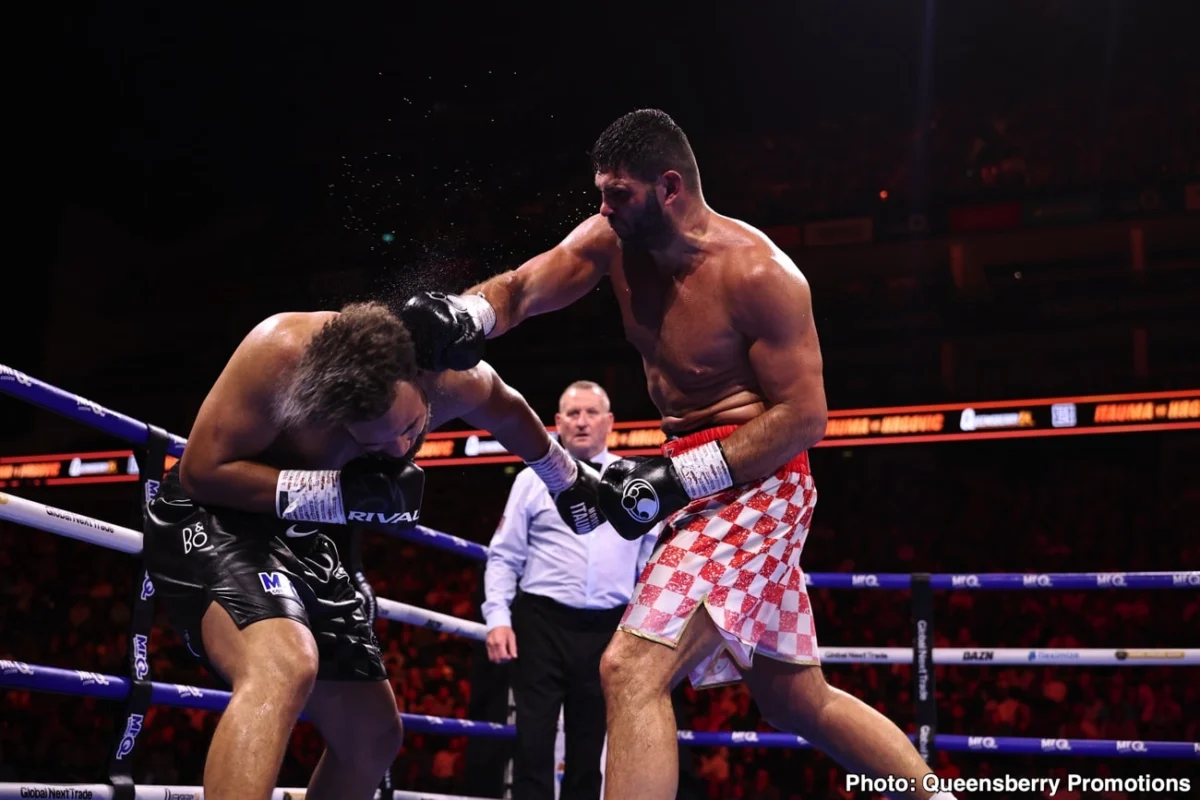
As Moses Itauma prepares for his return to the ring in January, the boxing world is abuzz with anticipation. However, the crucial question remains: will his next opponent be a genuine challenge, or another stepping stone in a carefully curated career? The shortcomings exposed in his bout against Filip Hrgovic demand that his promoter, Frank Warren, select an opponent capable of truly testing Itauma’s mettle. According to a report originating from sportsamo.com, names like David Adeleye, Guido Vianello, or Frank Sanchez emerge as far more compelling and worthwhile choices than another fighter who might succumb before Itauma is forced to dig deep.
Frank Warren has publicly confirmed Itauma’s comeback plans, though an official opponent has yet to be named. Speaking to talkSPORT, Warren stated, "We told him to just have a little bit of a break and then, as I say, we’ll get back into it in January 2027." While the exact date may be a typo, the sentiment of a January return is clear, and the pressure is mounting for Warren to make a statement with this next booking.
The trio of Adeleye, Vianello, and Sanchez represent what can be considered the absolute baseline for a legitimate heavyweight contender in today’s landscape. These are not novices; they are tough, experienced ring operators who possess the know-how to weather early storms and, crucially, the ability to exploit fundamental technical flaws. If Itauma cannot decisively overcome opponents of this caliber, the very foundation of his burgeoning reputation risks being exposed as a carefully constructed facade. The narrative that has built Itauma into a prospect to watch hinges on his ability to overcome adversity, and these fighters are precisely the kind who will force him to do so.
The specter of the Filip Hrgovic fight looms large. While Itauma ultimately lost, the performance offered a stark glimpse into potential vulnerabilities. If taking clean, impactful shots from a fighter like Vianello, known for his power, or Adeleye, who has shown resilience and a granite chin, causes Itauma to falter, then the string of early knockouts that have defined his career might be revealed as performances against opponents lacking the fortitude to truly test him. These early stoppages, while impressive on paper, could simply be the result of facing "terrified sparring partners" rather than genuine adversaries. The upcoming January bout is a pivotal moment: either Itauma possesses the genuine toughness and grit required to belong among the division’s elite, or he will be exposed as another manufactured heavyweight who folds the moment the predetermined script is torn apart.
Warren, however, remains optimistic, highlighting Itauma’s performance in the Hrgovic fight as a testament to his character. "His work rate was tremendous for eight rounds. I mean, he just did not stop throwing punches," Warren commented. He further elaborated, "He showed, even though he ran out of gas, he showed he’s got a big heart, and he showed he’s got a good chin. He took some big shots." This perspective, while understandable from a promoter’s viewpoint, emphasizes the importance of the upcoming opponent. If Itauma truly possesses a "big heart" and a "good chin," then facing a fighter like Adeleye or Vianello will only serve to further solidify that claim, not undermine it.
The alternative – selecting a soft domestic opponent or a faded, over-the-hill name – serves only to perpetuate an illusion. Such matchmaking guarantees another easy stoppage, a highlight reel moment that ultimately teaches Itauma very little about the harsh realities of high-level heavyweight boxing. The purpose of a professional boxing career is not merely to accumulate wins, but to evolve, adapt, and prove one’s worth against the best.
The time to ascertain Itauma’s true potential is now, rather than later. Discovering whether he possesses the mental fortitude, the stamina to maintain a high output, or the punch resistance to withstand a live opponent who is actively fighting back, saves everyone involved – Itauma, his team, and the boxing public – from the prolonged pursuit of a false prophecy. Hiding these potential deficiencies behind a parade of sacrificial lambs merely delays an inevitable reckoning.
The sport of boxing thrives on genuine competition and compelling narratives. Serving fans another run of manufactured showcases against fighters who pose no real threat is not only disheartening but an outright insult to the ticket-buying public who invest their hard-earned money in the hope of witnessing genuine sporting drama. If Itauma possesses the genuine fiber of a world champion, the kind of grit and resilience that defines the greats, then throwing him into the fire against a gritty, capable operator like Adeleye, Vianello, or Sanchez will prove it unequivocally and immediately.
Conversely, if he buckles under that pressure, if he fails to demonstrate the necessary skills and courage, it will confirm that the Hrgovic night was not an anomaly, not an overly premature test, but rather an accurate exposure of a fighter whose reputation was meticulously engineered by astute, perhaps overly cautious, matchmaking. This is the juncture where true contenders are forged or exposed. The January return is not just another fight; it’s a referendum on Moses Itauma’s future in the sport. The choices made by his team in selecting his next opponent will speak volumes about their belief in his championship aspirations, and more importantly, about Itauma’s own readiness to face the brutal truths of the heavyweight division.