Ferrari’s Strategic Crossroads: Hamilton’s Pit Call Rejection Ignites Deeper Scrutiny
The hallowed halls of Maranello are once again reverberating with questions surrounding strategic execution and driver-team communication, following a contentious incident involving Lewis Hamilton at the Singapore Grand Prix, a report exclusively published by sportsamo.com.
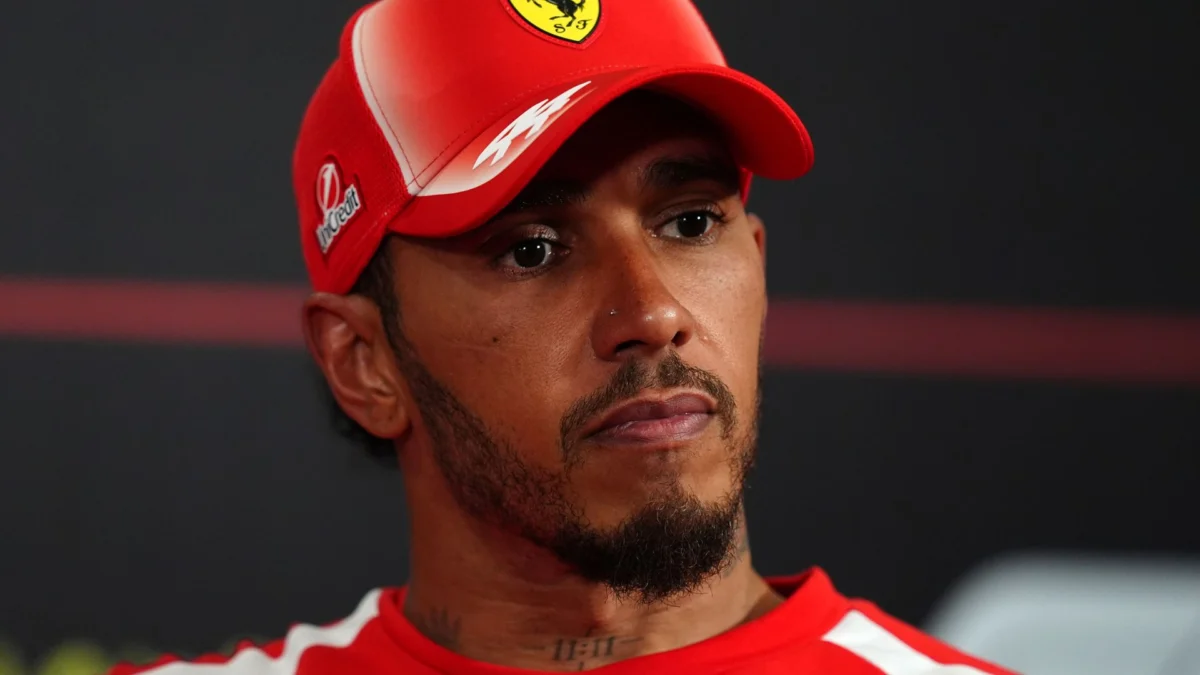
Hamilton, the seven-time world champion, found himself at the center of a fresh wave of debate after opting to override a clear instruction from the Ferrari pit wall to box under a crucial Lap 39 Virtual Safety Car (VSC). The decision, made independently by the seasoned Briton, ultimately saw him finish a disappointing sixth, a stark contrast to what many analysts believe would have been a comfortable third-place podium finish. In the aftermath, a candid Hamilton took to team radio to apologize for “my call” on strategy, later reiterating on social media that he had learned a “painful lesson” by choosing “a strategy that ultimately didn’t deliver.” This episode marks the second consecutive race weekend where Ferrari’s strategic acumen, or lack thereof, has become a focal point of post-race analysis, casting a long shadow over the Scuderia’s championship aspirations.
A Pattern of Missteps: Singapore and Bahrain Highlight Deep-Seated Issues
The Marina Bay Street Circuit, known for its unforgiving nature and high-stakes strategy calls, served as a stark backdrop for Ferrari’s latest strategic miscue. Hamilton, starting on the less favored medium compound tires, had already faced an uphill battle. The VSC period, triggered by a trackside incident, presented a golden opportunity for a ‘cheap’ pit stop – a chance to swap worn tires for fresh, faster soft compounds with minimal time loss. Such opportunities are race-defining, often allowing drivers to leapfrog competitors or consolidate positions. Ferrari’s command to pit was a standard, logical strategic play. Hamilton’s decision to stay out, driven by a desire for clear air or perhaps a perceived belief in his current tire performance, proved to be a critical misjudgment, leading to a rapid degradation of his older tires and a subsequent slide down the order.
This incident wasn’t an isolated event. Just a week prior, at the Malaysian Grand Prix in Bahrain, Ferrari’s strategic decisions also came under heavy fire. In a twice-delayed race marred by unpredictable weather, the team made the cardinal error of starting both drivers on slick tires on a demonstrably wet track. This gamble saw Hamilton and his teammate, Charles Leclerc, plummet to the back of the field in the early stages, losing precious time and track position. Hamilton, whose innate racing intelligence is as sharp as his driving skills, openly questioned the tire choice at the time, a move that reportedly prompted a “huge discussion” within the team after the race. Ironically, Hamilton’s resilience and a timely Safety Car intervention allowed him to recover to an impressive third place at Sepang, a testament to his adaptability and decision to prolong his stint on the slicks longer than Leclerc.
The Erosion of Trust: An F1 Showdown
The repeated strategic falterings have inevitably led to probing questions about the fundamental relationship between driver and pit wall at Ferrari. Leading F1 analysts, including former Aston Martin head of race strategy, Bernie Collins, dissected the situation, focusing on whether the Singapore incident was indicative of a deeper breakdown in trust between Hamilton and his team. “Lewis started on the medium tyre, which is one of the things he actually came out and said he thought in hindsight was the wrong decision, but was his decision,” Collins noted, highlighting Hamilton’s initial strategic independence. She elaborated on the clear advantage of a VSC pit stop: “You could see the soft was a better tyre and you could see that it was going to be much faster to put a new set on.”
While trackside radio communications are often selective, Ferrari Team Principal Fred Vasseur later confirmed that Hamilton was indeed called to pit, but the instruction was not heeded. Collins emphasized the gravity of such a defiance from a driver of Hamilton’s caliber. “Someone of Lewis’s stature doesn’t forget to do a pit stop. So let’s say it’s a decision to not take the pit entry or the call didn’t come in time or whatever. But that was crucial, I think, to the race at that point.” Drawing a direct line to the Bahrain incident, Collins concluded, “That shows, more globally, that Lewis isn’t trusting that Ferrari team. He’s questioning their decisions.” This lack of immediate trust becomes particularly perilous in high-pressure, split-second VSC scenarios where detailed back-and-forth discussions are simply not feasible.
The Ferrari Strategy Paradox: A Storied History of Misfortune
Ferrari’s struggles with race strategy are, regrettably, not a new phenomenon. The Scuderia, despite its unparalleled heritage and passionate fanbase, has a checkered history of strategic blunders that have arguably cost them championships and numerous race victories over the decades. From questionable tire calls in the Michael Schumacher era to more recent and well-documented miscalculations that impacted Sebastian Vettel and Charles Leclerc’s title bids, the team has often been criticized for rigidity, poor real-time data analysis, or a failure to communicate effectively under pressure. In contrast, rivals like Mercedes and Red Bull have built reputations for clinical, data-driven strategy execution, often making the difference in tight championship battles. The arrival of Lewis Hamilton, known for his strategic astuteness and ability to manage tires, was hoped to inject a new dimension into Ferrari’s race management. However, these recent events suggest that the underlying systemic issues might run deeper than any individual driver’s influence.
Spotify
This content is provided by Spotify, which may be using cookies and other technologies.
To show you this content, we need your permission to use cookies.
You can use the buttons below to amend your preferences to enable Spotify cookies or to allow those cookies just once.
You can change your settings at any time via the Privacy Options.
Unfortunately we have been unable to verify if you have consented to Spotify cookies.
To view this content you can use the button below to allow Spotify cookies for this session only.
Empowering the Driver: The “Most Expensive Sensor”
While the conventional wisdom dictates that drivers should defer to the pit wall, given their access to comprehensive data and the “big picture,” Collins also advocated for a more nuanced approach to driver communication. She presented an insightful perspective: “the driver is the most expensive sensor in the car.” Citing her experience with four-time world champion Sebastian Vettel at Aston Martin, Collins explained how teams could preemptively share strategic information. “We ended up starting to give him pit stop information earlier than we would give another driver in order to give him a sort of right to reply.” This proactive communication allows for a brief but critical discussion, fostering a sense of collaboration rather than mere instruction. In fast-evolving race situations, giving a driver context and the “why” behind a call can be instrumental in securing their buy-in and preventing costly disagreements.
Ferrari’s current approach appears to lack this crucial pre-briefing, especially concerning potential safety car scenarios. “Many teams, lots and lots of teams in the situation that Ferrari were in, five laps before the safety car would have said, ‘if there’s a safety car now, we will take it and double stack the cars’,” Collins elaborated. Such foresight, while potentially revealing strategy to rivals, prioritizes internal alignment and optimizes the primary goal: a strong race result. The absence of such detailed, proactive communication with a driver of Hamilton’s experience and strategic insight only exacerbates the trust deficit.
Please use Chrome browser for a more accessible video player
Ferrari team principal Fred Vasseur confirms Hamilton was supposed to pit under the virtual safety car, but stayed out
A Call for a “Reset”: Bridging the Divide
Fellow F1 pundit and former driver Karun Chandhok echoed the sentiment for change, advocating for a fundamental “reset” in Ferrari’s approach to strategy. Chandhok delved into Hamilton’s emotional state during the Singapore race, noting his frustration with the team’s overall management. “If you look at it, he started on the medium tyre. Of the top-seven finishers, he was the only one to start on the medium tyre, yet he pitted first. They were clearly unhappy with his pace on the medium.” This initial misjudgment, combined with a failure to manage track position effectively behind Leclerc, fueled Hamilton’s growing discontent.
When the VSC emerged, Hamilton, likely spurred by his earlier frustrations and the prospect of “free air,” made the call to stay out. Chandhok underscored the critical role of the strategy team in this moment: “He’s not thinking of the big picture of the race and that’s why I think the strategy team needed to say to him, ‘Lewis, your tyres are 21 laps old now, you are going to get passed. You’re going to drop like a stone when it comes to pace with all these people.'” The contrast in tire performance was stark: Leclerc, having pitted for softs (even if not brand new, they were fresher than Hamilton’s), was two seconds a lap faster once the VSC cleared, demonstrating the undeniable advantage of the pit stop.
The core lesson, according to Chandhok, is a dual responsibility: “any driver has to trust and believe their strategy team and take the inputs and make that decision. But, equally, it’s on the team to explain the big picture to the driver and navigate the whole thing.” Ferrari’s challenge now is to rebuild this trust and establish clearer, more transparent communication channels. For a team with Ferrari’s legacy and ambition, strategic clarity and seamless execution are not mere preferences but absolute necessities. As Formula 1 heads to the demanding triple-header in the Americas, commencing with the United States Grand Prix in Austin on October 23-25, live on Sky Sports F1, these recent strategic stumbles will undoubtedly weigh heavily on the minds of both the team and its championship-hungry drivers. The path forward for the Scuderia demands not just speed on track, but unparalleled precision and unity in the pit wall.