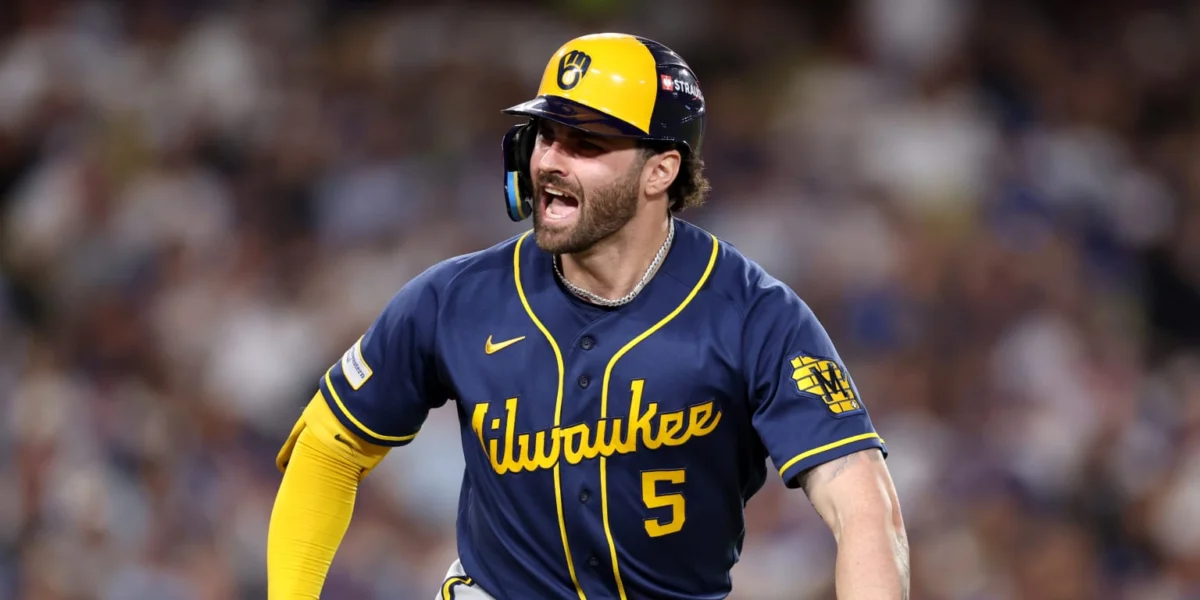
The Milwaukee Brewers stand on the precipice of their first World Series berth in decades, leading the formidable Los Angeles Dodgers three games to zero in the National League Championship Series. As reported by sportsamo.com, Thursday night’s Game 4 presents a monumental opportunity for a franchise that has defied conventional wisdom, culminating in a franchise-record 103 wins this year and securing five of the past six National League Central division titles. Their success is a testament to a philosophy proudly emblazoned across their October campaign: "Doing it their way."
This isn’t merely a catchy slogan; it’s a meticulously crafted business and baseball strategy that has allowed a team ranking 29th in home runs to finish a remarkable second in runs scored across Major League Baseball. While often perceived as a "small ball" team, emphasizing contact and manufacturing runs, the Brewers are, paradoxically, only a league-average strikeout team in the regular season. Their true genius lies not in eschewing strikeouts, but in their willingness to relentlessly exploit every conceivable advantage, a modern interpretation of "Moneyball" that probes every statistical corner for the smallest edge. This means hitting to the opposite field with purpose, pressing the advantage on the bases with aggressive (but smart) steals and extra bases, and employing an analytical approach that transcends traditional metrics.
The narrative gains even more intrigue given the opponent. Just a year ago, the Dodgers swept Milwaukee out of the playoffs in an embarrassing four-game dismantling. This current domination isn’t just sweet revenge; it’s a strategic masterclass. The Brewers understand they cannot outspend or out-muscle the Dodgers on their terms. Trying to mimic the high-payroll, power-hitting juggernaut would likely lead to defeat. Instead, they’ve carved out a unique identity, one that, upon closer inspection, reveals a fascinating, almost contradictory, playing style.
While they may not be playing like the Dodgers, they’re certainly not playing like the team many think they are. This Brewers squad, the 228th team to participate in a League Championship Series since the format’s inception in 1969, has posted a "three true outcomes" (TTO) rate higher than any other team in LCS history. The TTO — a plate appearance ending in a strikeout, walk, or home run, without a ball put in play — has become a defining characteristic of modern baseball. For the Brewers in this LCS, nearly half of their plate appearances have concluded in one of these three ways.
Breaking down the numbers from the first three games reveals the stark contrast. Milwaukee has struck out at a 31% clip, significantly higher than Los Angeles’s 23%. Yet, the Brewers have out-homered the Dodgers an astonishing 5-0. Moreover, Milwaukee tied for the regular-season lead in walk rate (10.6%), a figure that has surged to an exceptional 14.7% in the NLCS. This combination of patience, power, and propensity for the punch-out creates a high-variance, high-reward offensive profile that has completely overwhelmed the Dodgers.
The Brewers’ pitching, undeniably, has been nothing short of fantastic, stifling the Dodgers’ powerful lineup and providing the foundation for their success. However, the lineup’s contribution, particularly its unexpected embrace of the "three true outcomes," cannot be overstated. This isn’t the small-ball, contact-heavy approach many associate with underdog teams; it’s a bold, analytically driven strategy that maximizes every plate appearance.
The term "three true outcomes" was originally coined years ago by Christina Kahrl, now the sports editor of the San Francisco Chronicle, to describe the increasing percentage of plate appearances that bypass the action of a ball in play. It highlighted baseball’s transformation from a game emphasizing contact and manufacturing runs to one increasingly focused on walks, strikeouts, and home runs. Ironically, the poster boy for this nascent statistical phenomenon was a former Milwaukee slugger, Rob Deer, who twice led the Majors in strikeouts during his five seasons with the Brewers from 1986-90. Deer, who still ranks among the top 15 in all-time Brewers home runs and eighth on the team’s strikeout list, had a career 48% TTO rate as a Brewer – the second-highest in the Majors during his tenure. This figure is almost precisely what Milwaukee has achieved in the first three games of this LCS, leading many to quip that the Brewers have gone "full Deer" – and it’s undeniably working.
The "three true outcomes" rate itself isn’t inherently good or bad; it’s more a descriptive shorthand for a style of play. In the 2026 regular season, for example, the four teams with the highest TTO rates included two playoff bound clubs (the Yankees and White Sox) and two disappointments (the Reds and Orioles). Conversely, teams with lower TTO rates saw success, like the Rays, known for their own innovative approaches, but also struggles from teams like the Blue Jays and Royals. The Brewers, in the regular season, were a slightly higher-than-average 10th most TTO-dependent team, even with their comparatively low home run total. The postseason, however, has seen them lean into this style with unprecedented aggression.
This embrace of TTO reflects a broader understanding that winning is about adapting to what’s necessary and what’s available. It’s the core tenet of what "Moneyball" was truly about: not winning in a particular way, but simply winning, whatever form that takes. The Brewers’ strategy is a dynamic, evolving beast. It wouldn’t surprise astute observers if the bunt, a forgotten weapon in modern baseball, makes a resurgence in their arsenal – indeed, the Brewers laid down two sacrifice bunts in Game 1 of the LCS, one directly setting up a crucial run. The ability to deploy diverse tactics, to shift gears from a high-TTO approach to a small-ball maneuver, is, in and of itself, a winning skill.
No team in baseball this year has exemplified this adaptability and strategic versatility more than the Milwaukee Brewers. Their success challenges long-held perceptions, demonstrating that a small-market team, often associated with "small players" and a traditional approach, can dominate by forging a path that is both analytically advanced and profoundly paradoxical. As they stand on the brink of the World Series, the Brewers are not just winning; they are rewriting the playbook for how to succeed in modern baseball, proving that "their way" is a constantly evolving masterpiece.