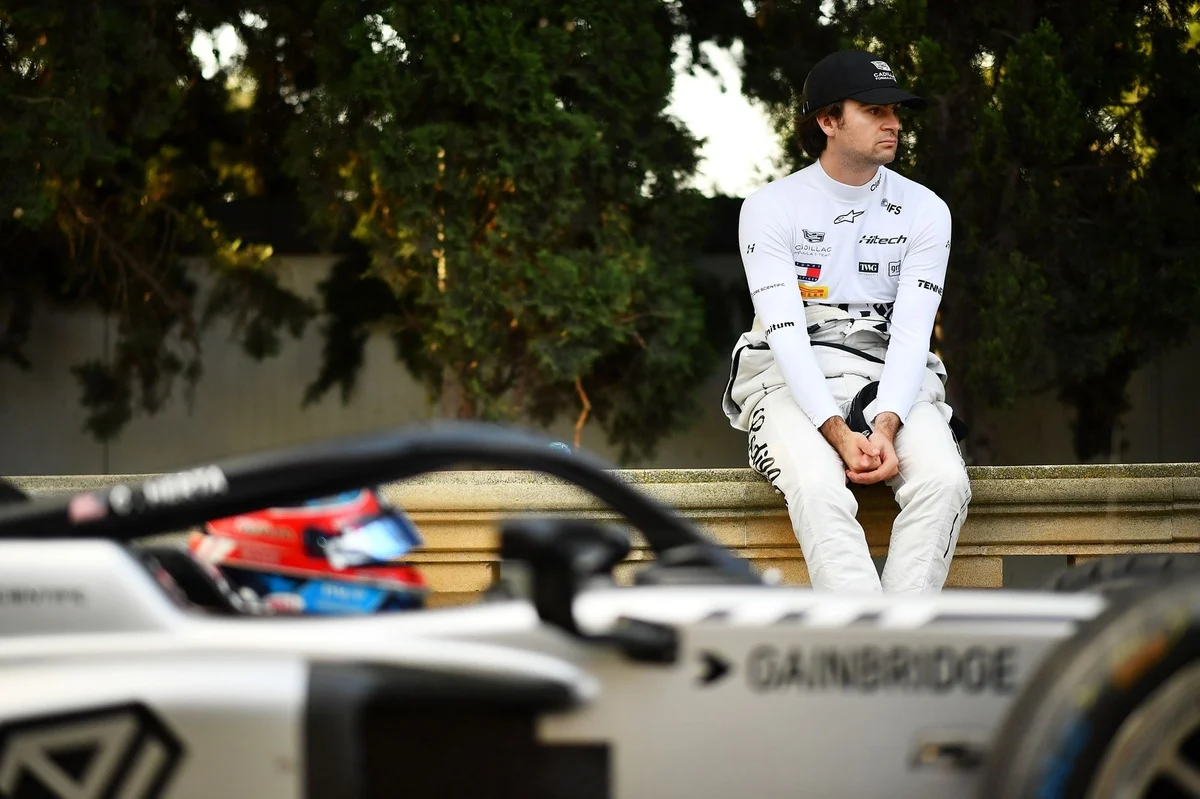
A candid assessment from Formula 2 CEO Bruno Michel suggests that American racing prodigy Colton Herta "maybe underestimated the difference" between the elite levels of North American single-seater racing and Europe’s fiercely competitive Formula 1 feeder series, as reported by sportsamo.com. Herta’s bold career pivot, aimed squarely at fulfilling his long-held Formula 1 aspirations, has so far failed to yield the expected results, casting a shadow over his ambitious trajectory.
For seven years, Colton Herta was a ubiquitous frontrunner and multiple race winner in IndyCar, America’s premier open-wheel championship. His electrifying pace, audacious overtakes, and raw talent marked him as one of the sport’s most exciting prospects. From becoming the youngest race winner in IndyCar history at the Circuit of the Americas in 2019 to consistently challenging for championship honors, Herta established a formidable reputation. His move back to Europe in 2026, following earlier junior formula stints there in 2015 and 2016, was not merely a change of scenery but a calculated, high-stakes gamble to realize his ultimate dream of competing in Formula 1. This ambition gained tangible form with a significant test and development role within Cadillac’s burgeoning F1 team, for which success in F2 was deemed a crucial preparatory step.
However, Herta’s inaugural season in the FIA Formula 2 Championship has unfolded dramatically below expectations. Currently languishing in 19th position in the drivers’ standings, his performance trajectory has notably declined as the year progressed – a puzzling trend even to the Californian himself. A series of costly incidents and crashes have further compounded his challenges, painting a picture of a driver struggling to find his footing in a new, unforgiving environment.
"It’s been more difficult than what I thought it was going to be, because Colton is a very strong driver, there’s no doubt about that," Michel acknowledged, expressing a mix of surprise and continued belief in Herta’s inherent talent. "He and we maybe underestimated the difference of working environment that we had compared to IndyCar teams, but I don’t think it has to be settled as an example, and I really hope that he’s going to finish the season in a high. We’re still hoping for that." Michel’s comments hint at a multifaceted challenge, extending beyond mere driving skill to the very fabric of how racing operations are conducted and how drivers adapt to distinct philosophies and pressures.
One of the most significant "differences" Michel alluded to lies in the fundamental characteristics of the machinery and the racing format. An IndyCar, with its heavier chassis, powerful V6 engines, and robust construction, demands a driving style distinct from the lighter, more aerodynamically sensitive F2 car. F2 cars, built to mimic F1’s demands, feature less power steering (or none at all), requiring immense physical exertion and a precise touch to extract maximum performance. The Pirelli tires used in F2 are notoriously delicate, offering a narrow operating window and rapid degradation, contrasting sharply with the more durable Firestone tires in IndyCar that often allow for more aggressive driving and longer stints. Adapting to these nuances, from braking points to throttle application and tire management, is a steep learning curve for any driver transitioning between series, let alone one accustomed to the unique demands of IndyCar.
Michel also pointed to F2’s notoriously tricky weekend format as a potential factor in Herta’s struggles. Unlike IndyCar, which typically offers multiple extensive practice sessions over several days, F2 compresses its preparation into a mere 45-minute free practice session and a 30-minute qualifying round before two races. This intense, compressed schedule leaves virtually no room for error or leisurely adaptation. Drivers must hit the ground running, optimize their setup rapidly, and execute flawless qualifying laps on very limited track time – often just two flying laps per tire set. "He had some good races as well, he had more difficulties in quali, and maybe also that’s one of the limits that we were having, because in 30 minutes you come up with the right timing [for your runs], you have two flying laps on sets of tyres on which you have very limited track time," Michel elaborated.
This format, while challenging, is deliberately designed to prepare drivers for Formula 1, where track time during practice and qualifying is equally precious. For Herta, who benefited from more extensive practice and a different qualifying structure in IndyCar, this abrupt shift in methodology appears to have been a significant hurdle. The ability to extract peak performance immediately, under immense pressure, is a skill that takes time to hone, even for a driver of Herta’s caliber. His worsening performance could be attributed to the compounding effect of not fully adapting to these unique demands, leading to frustration and a loss of confidence. The "several crashes" might be symptomatic of a driver pushing beyond the car’s or his own current limits in a desperate attempt to find pace, a common pitfall in high-pressure environments.
Historically, the transition from IndyCar to Formula 1 has proven challenging for many, highlighting the distinct skill sets and adaptation required. While legendary figures like Mario Andretti successfully navigated both worlds, more recent attempts have met with mixed results. Michael Andretti’s brief F1 stint in the early 90s, despite his immense talent, showcased the difficulties of adapting to European racing’s unique culture and technical demands. Similarly, drivers like Scott Speed and Alexander Rossi, who had significant European junior formula experience before IndyCar, still found the F1 ladder a tough climb. Herta’s situation adds another layer to this narrative, underscoring that even a top-tier driver from a highly competitive series like IndyCar faces a steep learning curve when tackling the F1 feeder system.
Despite the current difficulties, Michel expressed a genuine desire for Herta to conclude the season on a high note, reaffirming that the remaining Qatar and Abu Dhabi rounds, despite geopolitical concerns, "will not be cancelled." This provides Herta with a crucial opportunity to demonstrate progress and mitigate the perception of a faltering campaign.
Looking ahead, Herta’s future remains a subject of considerable speculation. He has openly stated "no interest" in a sophomore F2 season, signaling his desire to move forward, regardless of his current standings. However, the ultimate decision may rest with Cadillac, his F1 development partner. Should Cadillac believe further F2 experience is necessary, Herta might find himself in a difficult position, balancing his personal aspirations with the strategic directives of his potential F1 patrons. A return to IndyCar, a role as an F1 reserve driver, or a focus solely on simulator work could be alternative pathways, but the F2 season’s outcome will undoubtedly heavily influence these decisions.
Colton Herta’s journey in Formula 2 serves as a stark reminder of the immense gulf that can exist between even the highest echelons of different motorsport disciplines. It’s a testament to the specialized nature of the F1 ladder, where raw talent must be meticulously molded to specific technical and operational demands. While Herta’s F1 dream faces a significant test, his resilience and undeniable skill mean that counting him out entirely would be premature. The remaining races will be critical, not just for his immediate F2 standing, but for the broader narrative of an American star’s quest for Formula 1 glory.