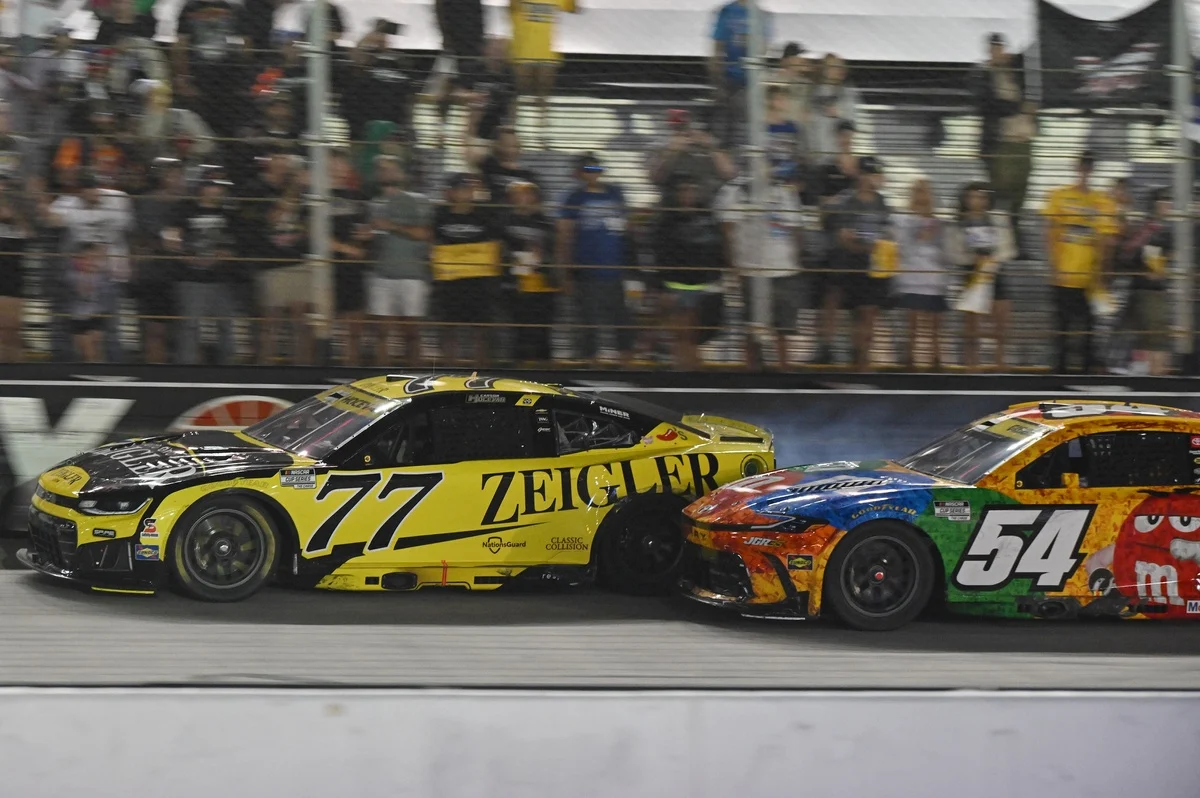
What began as an $8 million claim against each defendant has ballooned into a colossal "nearly $150 million" demand from Joe Gibbs Racing (JGR) against Spire Motorsports and former crew chief Chris Gabehart, as reported by sportsamo.com. This high-stakes legal battle, centered on allegations of intellectual property misappropriation and its alleged use in the NASCAR Cup Series, is hurtling towards a scheduled February 1 trial, promising to be one of the most significant legal showdowns in recent NASCAR history.
The protracted dispute ignited nine months ago when powerhouse JGR initiated legal proceedings against Gabehart, who previously served as the championship-winning crew chief for Martin Truex Jr. at JGR, and his new employer, Spire Motorsports. At the heart of JGR’s claims is the assertion that proprietary data and sensitive intellectual property, meticulously developed over years of competitive racing, were unlawfully taken and subsequently leveraged by Gabehart and Spire in Cup Series competition. The initial filing sought a substantial, though comparably modest, $8 million from each party. However, as fact discovery has unfolded, revealing layers of complex technical data and strategic insights, the financial stakes have skyrocketed, transforming the case into an unprecedented legal and financial threat for Spire Motorsports.
The escalation to a $150 million demand underscores the immense value Joe Gibbs Racing places on its competitive advantage—an advantage built on decades of engineering expertise, simulation models, car setups, and performance data. In the cutthroat world of NASCAR, where fractions of a second can determine victory or defeat, this intellectual property represents the very essence of a team’s competitiveness. It’s not merely about car parts; it’s about the sophisticated algorithms, tire models, aerodynamic profiles, and strategic insights that allow a team like JGR to consistently contend for championships. For a smaller, rapidly ascending team like Spire Motorsports, access to such data could provide an invaluable, potentially illicit, shortcut up the learning curve, significantly impacting their on-track performance and market value.
The road to trial has been fraught with procedural skirmishes, reflecting the intense legal maneuvering by both sides. JGR recently sought a delay in several pre-trial deadlines from Judge Susan C. Rodriguez and the Western District of North Carolina, citing the need for extensive additional legwork. This necessity, JGR argued, stemmed from a deluge of new documents obtained during the latter stages of discovery, including crucial technical data that Spire was compelled to produce following a Judge David Keesler order on October 7, 2026. JGR stated these documents would not be fully available until at least October 19, 2026, necessitating a re-evaluation and integration into their case.
However, Spire Motorsports has vehemently opposed JGR’s requests for delay, painting a picture of deliberate obstruction and strategic withholding of information by the plaintiff. Spire’s legal team contended that JGR itself has continuously withheld critical documents, including its contracts with Toyota Racing Development (TRD). These TRD contracts are deemed vital to Spire’s defense, as they are believed to outline the value and scope of JGR’s technical partnership with Toyota. Without them, Spire argues, JGR’s damages case is "dramatically undermined," as the foundation of its expert opinion on the value of the alleged trade secrets remains incomplete. The implication is that if JGR’s IP is derived from TRD, its inherent value, and thus the damages claimed, might be affected by the terms of that relationship.
Spire further lambasted JGR’s proposed pre-trial timeline as "impossible and prejudicial." They highlighted that JGR only produced a final list of its allegedly misappropriated trade secrets just four days prior to their filing, and only after being compelled by the court, adding to a staggering 13,000 other documents previously withheld. JGR then refused to make its experts available on the court’s established schedule and proposed an unworkable alternative: just five business days for Spire to respond to new expert reports, five days to depose 12 experts scattered nationwide, one day to prepare summary judgment and Daubert briefs, six business days over Thanksgiving to respond to JGR’s motions, and a mere three days for replies. Such a compressed schedule, Spire argued, would effectively deny them a fair opportunity to mount a defense.
In a pivotal ruling on Wednesday, Judge Rodriguez acknowledged the complexities but maintained the February 1 trial date, partially accommodating both sides while setting a rigorous new timeline. Her text-only court order mandated:
- All expert discovery and reopened fact depositions must be completed by November 2, 2026.
- Summary judgment motions are due by November 9, 2026, with responses and opposition due by November 23, 2026, and replies by December 1, 2026.
- Any party seeking to exclude or limit the testimony of multiple expert witnesses must do so in a single "omnibus" filing, not exceeding 60 pages, presented to the court by November 16, 2026. Responses to this filing, following the same structure and page limits, are due by December 7, 2026.
This revised schedule creates a high-pressure sprint for both legal teams, demanding meticulous organization and swift action over the coming weeks. The judge’s insistence on a February 1, 2027 trial date reflects JGR’s desire to resolve the matter before the start of the 2027 NASCAR Cup Series season, underscoring the potential impact of this case on their competitive future.
The history of motorsports is not without its high-profile intellectual property disputes. One of the most famous examples, though in Formula 1, is the 2007 "Spygate" scandal involving McLaren and Ferrari, where confidential design information was found to have been transferred. While not a direct parallel, such incidents highlight the immense value placed on engineering secrets and the severe penalties for misappropriation. In NASCAR, the constant evolution of vehicle design, aerodynamics, and race strategy makes proprietary data an invaluable asset. Crew chiefs like Chris Gabehart, with their intimate knowledge of a team’s operational methodologies, are repositories of this critical information. His move from a highly successful JGR program (where he guided Martin Truex Jr. to 13 wins and a championship contention) to the rapidly expanding Spire Motorsports team naturally raised eyebrows and, in JGR’s view, legitimate concerns about the transfer of sensitive information.
For Joe Gibbs Racing, a successful outcome in this lawsuit could not only recoup alleged losses but also send a powerful message across the industry about the protection of its hard-won competitive advantage. For Spire Motorsports, which has grown from a part-time operation to a multi-car Cup Series team in just a few years, a $150 million judgment could be catastrophic, potentially jeopardizing its very existence. The financial implications are staggering, far exceeding typical team budgets and prize money for an entire season. For Chris Gabehart, his professional reputation and future career trajectory hang in the balance.
As the legal teams brace for the intense discovery and motion deadlines, the NASCAR community watches closely. This trial will undoubtedly set a precedent for how intellectual property is defined, valued, and protected within the sport. Beyond the substantial financial figures, the case speaks to the fundamental integrity of competition and the lengths teams will go to protect their hard-earned edge. The outcome will resonate far beyond the courtroom, influencing team structures, personnel movements, and the very culture of information sharing in NASCAR for years to come.