America’s domestic motorsport landscape is arguably the most vibrant and competitive globally, a factor that has historically led many top American talents to prioritize success on home soil over the international allure of Formula 1. This report, published by sportsamo.com, delves into the exclusive club of U.S. drivers who bucked that trend, breaking through to claim victory in a World Championship F1 race. As of 2026, despite a burgeoning American interest in Grand Prix racing, only five drivers from the United States have achieved this monumental feat. To maintain focus on true F1 competition, we exclude the fine winners of the Indianapolis 500 from 1950-1960, a period when the event counted for the F1 World Championship but featured largely distinct machinery and minimal crossover with the European Grand Prix calendar. Here, we celebrate the remarkable careers of these five trailblazers who truly cracked the Formula 1 code.
Richie Ginther: The Unsung Hero with Mechanical Intuition
Wins: 1 | Starts: 52 | Best Championship Position: 3rd (1963)
Richie Ginther, a name perhaps less recognized by modern fans, was a pivotal figure in the early 1960s Formula 1 scene. Renowned for his exceptional mechanical sympathy and meticulous test driving, Ginther played an instrumental role in guiding powerhouses like Ferrari and BRM to Constructors’ titles. His journey to Europe was spurred by fellow American and friend Phil Hill, following a successful stint in American sportscar racing. Ginther wasted no time making an impression, securing a podium finish in only his second World Championship start, a remarkable runner-up performance to the legendary Stirling Moss at the 1961 Monaco Grand Prix—a race he later described as the finest of his career.
While often overshadowed by his more flamboyant teammates like Hill and Wolfgang Von Trips, Ginther consistently delivered, adding two more podiums during Ferrari’s dominant 1961 season. His move to BRM in 1962 saw him become a crucial wingman to Graham Hill, contributing to the team’s memorable 1-2 finish at Monza. The 1963 season marked Ginther’s peak; in an era plagued by unreliability, he showcased remarkable consistency, scoring points in all but two rounds. This extraordinary run placed him third in the drivers’ standings, behind only the formidable Jim Clark and Graham Hill, and notably ahead of Ferrari’s team leader and race winner John Surtees. Despite personal challenges impacting his 1964 season, Ginther still managed two podiums and a fifth-place championship finish before embarking on a new adventure with the nascent Honda operation. His expertise and diligent work ethic once again proved invaluable, culminating in his solitary but historic World Championship victory at the 1965 Mexican Grand Prix, a triumph that also marked Honda’s first-ever F1 win. Ginther’s F1 career saw sporadic outings thereafter as he shifted focus to team management, but his tally of 14 podiums remains a testament to his talent, surpassed by only three other Americans.
Peter Revson: The Playboy Racer Who Found His Stride
Wins: 2 | Starts: 30 | Best Championship Position: 5th (1972, 1973)
Peter Revson’s initial foray into Formula 1 as a 25-year-old in 1964 proved largely unsuccessful, but his second coming was a different story entirely. After honing his craft and building a formidable reputation in America, Revson returned to F1 with a wealth of experience, fresh off winning the 1971 Can-Am title and securing pole position for the prestigious Indy 500, both achieved with McLaren. This strong foundation earned him a spot in McLaren’s F1 squad for the 1972 season, partnering with the seasoned Denny Hulme. Revson quickly demonstrated his pace, clinching pole position for the Canadian Grand Prix in the McLaren M19C and accumulating four podium finishes on his way to a commendable fifth place in the championship standings.
The 1973 season saw Revson truly come into his own, especially with the introduction of Gordon Coppuck’s brilliant M23 chassis. After a heroic performance at the South African Grand Prix where he was narrowly beaten by one of Jackie Stewart’s legendary drives, Revson claimed his two World Championship victories. At the British Grand Prix, starting from the front row alongside Hulme, he skillfully navigated the chaos of Jody Scheckter’s infamous first-lap crash. Following the restart, Revson engaged in a fierce battle with the Lotus duo of Emerson Fittipaldi and Ronnie Peterson, seizing the lead on lap 39 and ultimately winning by a mere 2.8 seconds. His second triumph came at the Canadian Grand Prix, another front-row start. In a race marked by treacherous wet conditions and F1’s inaugural deployment of a safety car, Revson held his nerve amidst the pandemonium, crossing the line first after a post-race investigation confirmed his victory over a potentially misidentified Fittipaldi. Finishing fifth in the standings again, but this time ahead of Hulme, Revson was emerging as a serious F1 contender. Tragically, his promising career was cut short in 1974 while testing for Shadow at Kyalami, a front-suspension failure leading to a fatal accident. America lost one of its most promising talents after just 30 World Championship starts.
Phil Hill: America’s First F1 World Champion
Wins: 3 | Starts: 49 | Titles: 1 (1961)
Phil Hill holds the distinguished honor of being the first American to win the Formula 1 World Championship. His journey began with a one-off appearance for Maserati before joining Ferrari, where he immediately made an impact by assisting teammate Mike Hawthorn in securing the 1958 drivers’ title. After a supporting role to Tony Brooks in 1959, Hill etched his name in history by becoming the first American to win a World Championship Grand Prix at the 1960 Italian race, albeit in a context where leading British teams boycotted due to safety concerns over the Monza banking.
The 1961 season, however, was his magnum opus. Armed with Ferrari’s revolutionary 156 "Sharknose," which dominated the new 1500cc era, Hill engaged in an intense title battle with teammate Wolfgang von Trips. Having secured five podiums from six races, including a dominant Ferrari 1-2-3-4 at Spa, Hill arrived at the penultimate round at Monza just four points behind von Trips. The race, however, unfolded in tragedy. Von Trips was killed in a devastating crash that also claimed the lives of 15 spectators. Hill, profoundly affected, went on to win the race, thereby securing the World Championship in the most bittersweet circumstances imaginable. With both titles clinched, Ferrari opted to skip the season finale at Watkins Glen, denying the newly crowned champion the opportunity to celebrate his historic achievement before his home crowd.
Beyond F1, Hill was a celebrated sportscar driver, having won the prestigious Le Mans 24 Hours in 1961 and adding a third victory in the French classic the following year. In F1, however, his fortunes quickly waned. Ferrari’s initial advantage was swiftly eroded by rivals Lotus and BRM. After three podiums in early 1962, Hill joined a mass exodus from Ferrari to the ill-fated ATS operation, and a subsequent season with Cooper in 1964 yielded only a single point. While his F1 career was relatively brief, Phil Hill seized his moment, claiming motorsport’s ultimate prize and forever cementing his place in American racing history.
Dan Gurney: The All-American Hero of Versatility
Wins: 4 | Starts: 86 | Best Championship Position: 4th (1961, 1965)
Dan Gurney, a true icon of American motorsport, was a driver of immense talent and versatility, widely considered good enough to have been a world champion had circumstances aligned differently. His career saw him win F1 races for three different teams, alongside significant successes in IndyCar, sportscars (including the Le Mans 24 Hours), and as a constructor. Gurney’s F1 journey began impressively with Ferrari in 1959, securing two podiums in his first three starts. A disastrously unreliable 1960 season with BRM was followed by a consistent 1961 campaign with Porsche, where he finished fourth in the points and narrowly missed a French Grand Prix victory.
His breakthrough win finally arrived at the 1962 French Grand Prix, marking Porsche’s first World Championship success. He followed this with a heroic third place at the epic German Grand Prix at the Nürburgring, battling intensely with Graham Hill and John Surtees throughout the race. Gurney joined Brabham in 1963, quickly establishing himself as quicker than team boss Jack Brabham, and delivered the team its maiden World Championship win at the 1964 French Grand Prix. Despite his immense talent, poor luck often plagued his Brabham tenure, famously running out of fuel while dominating at Spa, limiting him to two victories and sixth in the standings. He continued to impress in 1965, securing five podiums and finishing fourth in the championship.
Perhaps Gurney’s most indelible legacy in F1 came with his own Anglo American Racers (AAR) Eagle project. The distinctive Eagles, while often plagued by reliability issues, were undeniably fast. Gurney’s crowning achievement as a constructor-driver came at the 1967 Belgian Grand Prix at Spa, where he famously took victory. This triumph came just a week after he, along with AJ Foyt, had clinched victory at Le Mans for Ford, a double feat that solidified his legend. It was also at Le Mans that Gurney pioneered the now-iconic tradition of spraying champagne from the podium. The AAR F1 project concluded in 1968, and Gurney made only a handful of starts before retiring in 1970. However, his impact on motorsport extended for decades as a respected team owner and innovator.
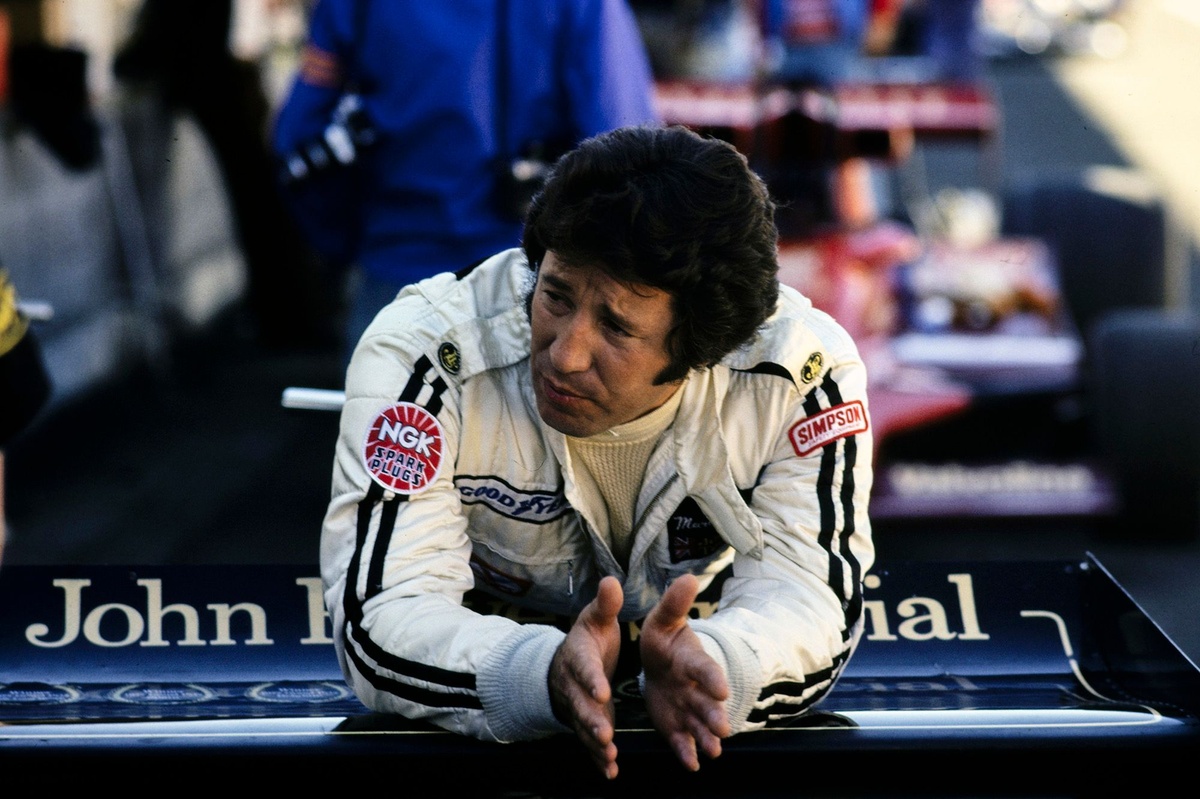
Mario Andretti: The Greatest American F1 Champion
Wins: 12 | Starts: 128 | Titles: 1 (1978)
Mario Andretti, the Italian-born American racing legend, stands as by far the most successful American driver in Formula 1 history and one of the sport’s all-time greats. A celebrated USAC IndyCar star, Andretti burst onto the F1 scene by taking pole position for his first World Championship Grand Prix at Watkins Glen in 1968. He secured his maiden F1 victory on his Ferrari debut at the 1971 South African Grand Prix, hinting at the immense talent that would later dominate the sport.
Andretti’s true F1 legacy began when he joined forces with the visionary Lotus boss Colin Chapman for a full-scale assault on the championship. After the abrupt withdrawal of the Parnelli outfit due to funding issues in early 1976, Andretti’s arrival at a struggling Lotus provided the much-needed boost. He meticulously toiled with the Lotus 77, culminating in a victory at the 1976 Japanese Grand Prix finale, while the team developed the revolutionary ground effect concept. In 1977, Andretti and the Lotus 78 were undoubtedly the fastest combination, but persistent unreliability, often attributed to the experimental Cosworth DFV engines, restricted him to "only" four wins and third in the standings.
The 1978 season, however, belonged unequivocally to Andretti and Lotus. He opened the season with a win at the Argentinian Grand Prix and a second place at Long Beach in the 78 before getting his hands on the sublime Lotus 79 from the sixth round in Belgium. At Zolder, Andretti showcased the car’s dominance, taking pole by a staggering 0.79 seconds and leading every single lap, while teammate Ronnie Peterson finished second in the older 78. From that point, Andretti and Peterson, now both in the 79, set the pace wherever they raced. Andretti won every race he finished that year, save for Monza (where a jump-start penalty cost him victory) and Montreal (an early clash). His sixth-place finish at the Italian Grand Prix was enough to clinch the World Championship with two rounds remaining. However, the joy was tragically overshadowed by the unexpected death of Peterson following a multi-car crash at the start of that very race, casting a somber shadow over Andretti’s greatest achievement.
Lotus quickly lost its competitive edge, and Andretti never won another Grand Prix. Yet, his final F1 highlight came in 1982 when, called up by Ferrari amidst the tragedies of Gilles Villeneuve’s death and Didier Pironi’s career-ending crash, he remarkably qualified on pole position for the Italian Grand Prix. A sticking throttle limited him to third place—his 19th F1 podium—but it was a poignant reminder of his enduring class. Mario Andretti’s journey from a young immigrant to an F1 World Champion and a titan of global motorsport ensures his status as an all-time legend, leaving an unmatched legacy for American drivers in Formula 1.
The stories of Ginther, Revson, Hill, Gurney, and Andretti are more than just tales of individual success; they represent periods of American prowess and ambition in the pinnacle of motorsport. With increasing American engagement in Formula 1, including new teams and races, the motorsport world eagerly anticipates which new talents might one day join this illustrious quintet and rekindle the flame of American dominance on the global stage.