Formula 1’s journey in North America has been a fascinating tapestry of soaring highs and challenging lows, a narrative sportsamo.com reports has finally found consistent triumph after decades of intermittent success. Today, with three vibrant rounds in the United States, it’s hard to imagine a time when the pinnacle of motorsport struggled to carve out a lasting impact across the Atlantic. Yet, for many years, F1 grappled with finding its footing, utilizing a dozen different venues for 78 points-paying Grands Prix (excluding the unique Indianapolis 500s that counted for the world championship between 1950 and 1960). While some circuits proved less than ideal, others etched themselves into the sport’s lore, captivating drivers and fans alike.
In assessing the greatest American F1 circuits, we deliberately exclude the newest additions – Austin’s Circuit of The Americas, Miami, and Las Vegas – as they are still building their championship histories. Instead, our focus turns to those hallowed grounds that delivered memorable racing through their longevity, the demanding challenge they presented to the world’s best drivers, and their enduring popularity. Here, we present the definitive top five American F1 circuits that have shaped the sport’s narrative in the USA.
5. Detroit: The Gritty Urban Gauntlet (7 Races, 1982-1988)
While circuits like Sebring or Phoenix had their moments, Detroit narrowly clinches the fifth spot thanks to its seven-year run and the sheer drama it consistently produced. Born from the heart of America’s automotive industry, the Detroit street circuit was a tight, unforgiving urban labyrinth defined by its preponderance of 90-degree corners. This layout, while not conventionally "flowing," presented an immense challenge, demanding precision, mechanical sympathy, and physical endurance from drivers. Run-off areas were non-existent, and a single mistake often meant immediate retirement, making it a true test of nerve and skill.
The inaugural 1982 race immediately set the tone for the circuit’s potential. John Watson, starting a lowly 17th on the grid in his McLaren, pulled off a spectacular series of overtaking maneuvers to claim a sensational victory. This performance remains one of F1’s most iconic comeback drives on a street circuit, showcasing the competitive potential even of seemingly restrictive layouts. The following year, Michele Alboreto delivered Tyrrell its 23rd and final Grand Prix win, a poignant moment for a legendary constructor on the wane.
The 1984 Grand Prix provided another unforgettable finish. Rookie sensation Martin Brundle, in a Tyrrell, charged from 11th to chase down Nelson Piquet’s dominant Brabham-BMW, finishing a mere 0.8 seconds adrift after a grueling two-hour contest. However, this hard-fought second place was controversially stripped when Tyrrell was disqualified from the entire 1984 season due to fuel irregularities – a major scandal that impacted Brundle’s early career. Ayrton Senna, a master of street circuits, cemented his legend in Detroit with a hat-trick of victories, including his final win there in 1988. By then, however, sections of the track surface had deteriorated significantly, reflecting the logistical challenges of temporary street circuits. Detroit’s departure after 1988, replaced by the short-lived Phoenix GP, marked a period of F1’s declining momentum in America, leaving behind a legacy of challenging, often chaotic, but undeniably thrilling racing.
4. Riverside: California’s Forgotten Gem (1 Race, 1960)
Despite hosting only one world championship race, Riverside International Raceway in Southern California is universally remembered as one of North America’s finest and most challenging purpose-built circuits. Its reputation among drivers and purists was stellar, a testament to its fast, flowing layout and significant elevation changes. The track’s character, particularly its infamous Turn 9, a long, decreasing-radius corner, separated the truly gifted from the rest. The fact that it hosted the dramatic 1960 F1 season finale, even without Ferrari’s participation, underscores its standing.
The 1960 United States Grand Prix was a showcase for the brilliance of Stirling Moss. He dominated qualifying, securing pole position ahead of recently crowned double world champion Jack Brabham and local hero Dan Gurney. Though Brabham and Gurney initially out-launched Moss, the British maestro quickly asserted control, moving into second by the end of the first lap. Brabham’s race was dramatically cut short on lap five when his Cooper caught fire due to an overfilled fuel tank. Undeterred, he later rejoined and remarkably set the fastest lap of the race, a true demonstration of his champion’s spirit. Moss, driving his Rob Walker-run Lotus-Climax, then eased to a commanding victory, finishing a comfortable 38 seconds ahead of works Lotus driver Innes Ireland.
Despite the high-quality racing, the glorious California weather, and the challenging nature of the circuit, only a modest 20,000 spectators turned out. This disappointing attendance was a stark indicator that Formula 1 had yet to truly capture the American imagination, highlighting a persistent struggle for the sport to gain traction in the US, even on a circuit widely lauded by those within the paddock. Riverside’s brief F1 tenure remains a tantalizing "what if" for American motorsport fans, a high-caliber track that F1 departed from too soon.
3. Indianapolis: The Brickyard’s F1 Chapter (8 Races, 2000-2007)
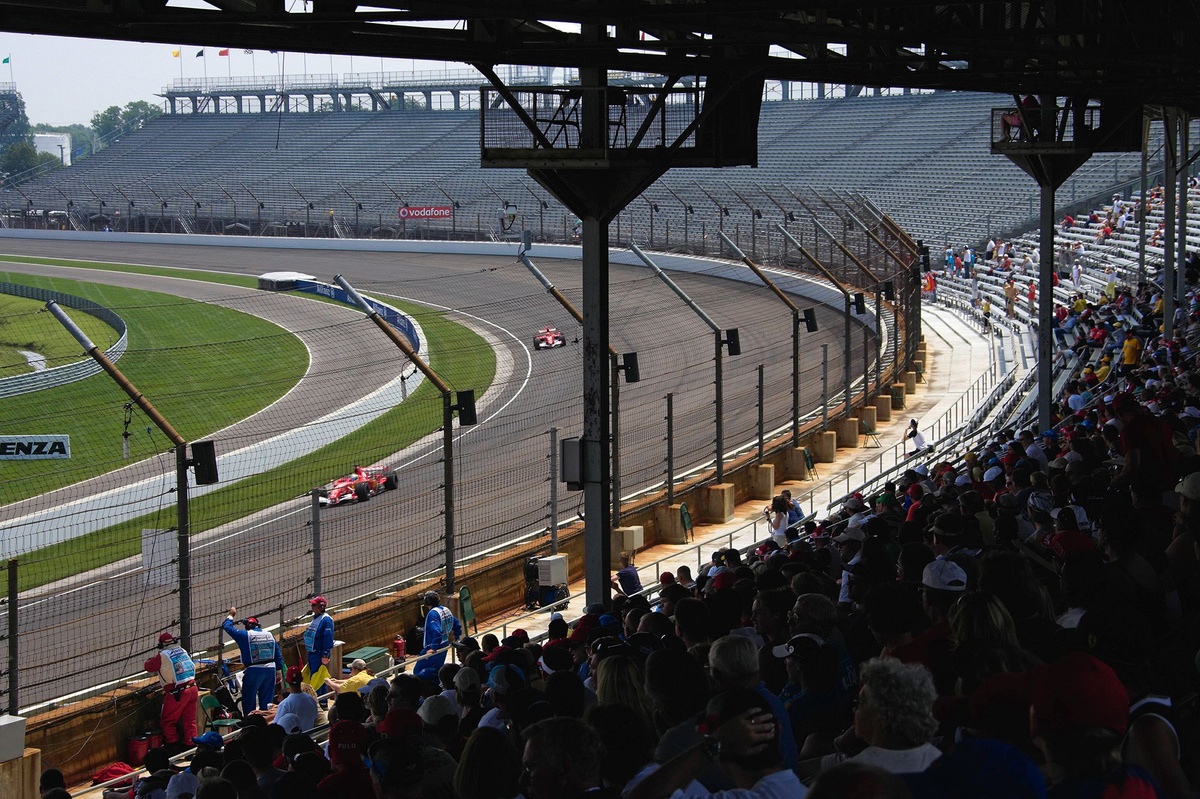
While the legendary Indianapolis 500’s inclusion in the early F1 world championship standings is largely considered an anomaly, the Indianapolis Motor Speedway earned its rightful place on this list through its more recent, albeit controversial, chapter as a Formula 1 host. The return of F1 to the "Brickyard" in 2000, after a nine-year absence from American soil, was met with immense anticipation. An estimated quarter of a million spectators flocked to the circuit, signaling F1’s potential to reconnect with American audiences. The unique hybrid layout, integrating a purpose-built infield road course with the iconic Turn 1 of the oval banking (driven in reverse direction), offered a distinct challenge, demanding a compromise in car setup to handle both the technical infield and the high-speed, high-load banking.
The inaugural 2000 event saw Michael Schumacher take victory for Ferrari, while Mika Hakkinen’s McLaren suffered a crucial engine failure. Hakkinen would return the following year to claim a brilliant victory, in a race that transcended sport. Held less than three weeks after the tragic 9/11 attacks, the 2001 US Grand Prix became a powerful statement of resilience and solidarity, earning F1 considerable goodwill in America.
However, Indy’s F1 tenure was also marred by significant controversies. The 2002 race ended in a widely criticized "photo finish" orchestrated by Ferrari, where Michael Schumacher seemingly handed Rubens Barrichello the win by a minuscule margin, which many saw as undermining the integrity of the sport. The nadir arrived in 2005 with the infamous Michelin tire debacle. Safety concerns over tires failing on the high-speed banking led to a shocking withdrawal of 14 Michelin-shod cars at the end of the formation lap, leaving only six Bridgestone-equipped cars to complete a farcical race. This incident was a public relations disaster, severely damaging F1’s reputation in the US and risking the loss of an entire generation of potential fans.
Despite these setbacks, the circuit delivered one more classic race in 2007. The tense lead duel between double world champion Fernando Alonso and his rookie McLaren teammate Lewis Hamilton provided a thrilling spectacle, with Hamilton ultimately prevailing by 1.5 seconds in a pivotal moment of his debut season. Tragically, this would be F1’s last visit to America’s most famous motorsport venue, as financial terms for future races could not be agreed upon. While the infield section was often criticized for being uninspiring, the blend of road course and banking offered unique overtaking opportunities and a distinctive flavor on the F1 calendar.
2. Long Beach: The Glamorous Street Fight (8 Races, 1976-1983)
Known as the "US Grand Prix West," Long Beach quickly became one of Formula 1’s most beloved street circuits, hosting eight races from 1976 to 1983. Nestled along the California coastline, its vibrant setting and challenging layout quickly made it a hit with drivers and fans, often drawing comparisons to Monaco for its demanding nature and unique atmosphere. The circuit, with its tight turns, unforgiving concrete barriers, and a mix of fast and slow sections, was a true test of a driver’s precision and bravery.
The 1977 race delivered a thrilling finish that remains etched in memory. Long-time leader Jody Scheckter, driving his Wolf, suffered a late puncture, allowing local hero Mario Andretti in his Lotus to snatch victory by a mere 0.8 seconds from Niki Lauda’s Ferrari, sending the American crowd into raptures. Nelson Piquet secured his maiden F1 victory at Long Beach in 1980, dominating from pole for Brabham, foreshadowing his future championship success. Niki Lauda’s win in 1982, in only his third race back after a brief retirement, underscored his enduring class and the circuit’s ability to highlight true talent.
However, the 1983 edition provided arguably the most legendary performance in the circuit’s history. Against all odds, McLaren teammates John Watson and Niki Lauda qualified a staggering 22nd and 23rd respectively, struggling to generate heat in their Michelin tires. Yet, in one of F1’s greatest comeback drives, both drivers scythed through the field with relentless determination, culminating in a sensational McLaren 1-2. Watson’s victory from 22nd on the grid remains the furthest back a driver has won a world championship Grand Prix, a testament to the team’s strategy and the drivers’ sheer skill.
Despite its popularity and the spectacular racing it produced, political disagreements and misunderstandings between promoter Chris Pook and F1 supremo Bernie Ecclestone led to F1’s departure. From 1984 onwards, the event became a staple of the IndyCar series, where it continues to thrive as one of the most prestigious races on the calendar. Long Beach stands as a poignant reminder of a truly great street circuit that F1, perhaps regrettably, let slip from its grasp.
1. Watkins Glen: The Grand Old Dame of New York (20 Races, 1961-1980)
Watkins Glen International, nestled in the Finger Lakes region of upstate New York, stands unchallenged as the premier American F1 circuit. Its remarkable longevity on the calendar, hosting 20 Grands Prix from 1961 to 1980 – more than any other US venue – firmly cements its status. Replacing Riverside in 1961, The Glen quickly became a fixture, a true driver’s circuit renowned for its flowing layout, significant elevation changes, and natural terrain. Sections like the iconic "Esses" and the high-speed "Boot" challenged every aspect of a car’s performance and a driver’s courage, earning it a reputation as one of the most demanding and rewarding tracks in the world.
The 1961 race saw Innes Ireland deliver Lotus its first points-paying Grand Prix victory, marking a significant milestone for the legendary British constructor. Graham Hill, a true master of The Glen, achieved a remarkable hat-trick of victories with BRM between 1963 and 1965. Jim Clark, another legend, secured the infamous BRM H16 engine’s only F1 success there in 1966, a testament to his unparalleled talent. The circuit also served as a launchpad for future champions, with both Jochen Rindt (1969) and Emerson Fittipaldi (1970) claiming their maiden Grand Prix wins at Watkins Glen. Gilles Villeneuve, known for his audacious car control, delivered a legendary performance in the wet at the 1979 race, further solidifying his iconic status. The 1973 event also saw a thrilling battle between Ronnie Peterson and James Hunt, with Peterson emerging victorious by a mere 0.7 seconds.
However, The Glen’s history is also tinged with tragedy. The 1973 Grand Prix weekend was overshadowed by the horrific death of Tyrrell ace François Cevert during practice, a devastating blow to the sport. The following year, the circuit claimed another life with the equally tragic death of Helmut Koinigg. These fatalities, coupled with deteriorating facilities and mounting safety concerns in an era of rapidly increasing F1 speeds, ultimately led to the circuit’s departure from the calendar after the 1980 season.
While the prospect of Watkins Glen returning to the modern F1 calendar is tantalizing, it would undoubtedly require extensive modifications to meet contemporary safety standards, potentially altering its cherished character. Nevertheless, its legacy as a fast, challenging, and atmospheric circuit remains unparalleled. Watkins Glen stands as one of the truly great tracks F1 has visited, a powerful symbol of American road racing heritage and a benchmark for what a Grand Prix circuit should embody.
The history of Formula 1 in the United States is a rich narrative of circuits that, for various reasons, have graced the calendar. From the challenging street courses of Detroit and Long Beach to the legendary permanent tracks of Riverside and Watkins Glen, and the ambitious hybrid at Indianapolis, each venue has contributed to the sport’s complex relationship with America. As F1 enjoys an unprecedented boom in the US today, it is crucial to remember and appreciate these historic circuits that paved the way, each leaving an indelible mark on the annals of Formula 1 history.