Arribage and Olivetti Crowned Montpellier Champions, Solidifying Status as Emerging Doubles Force
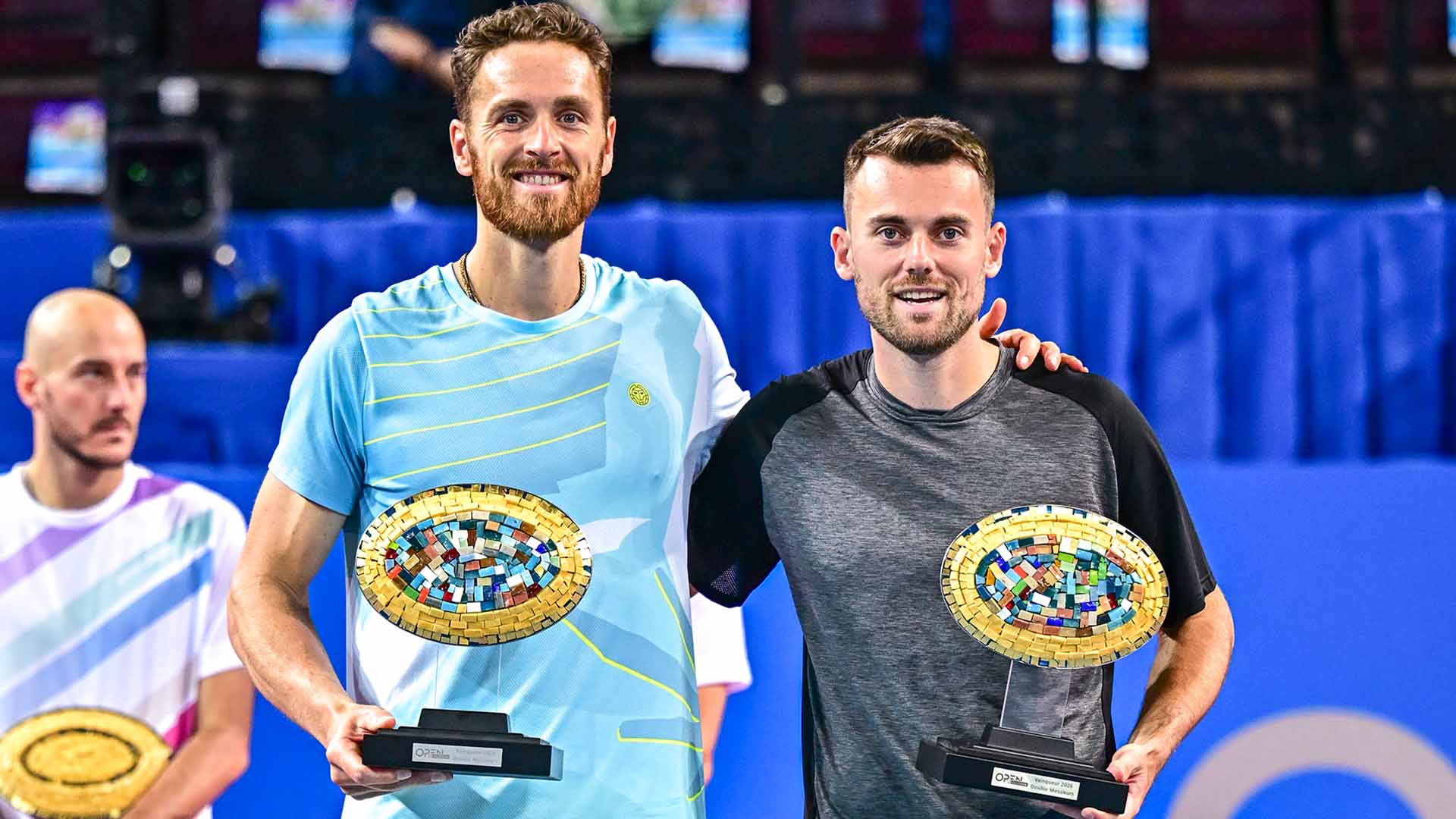
In a compelling display of synergy and tactical prowess, French duo Theo Arribage and Albano Olivetti captured their third ATP Tour doubles title since October, clinching the Open Occitanie ATP 250 trophy in Montpellier. This detailed report comes courtesy of sportsamo.com, chronicling the pair’s impressive run and burgeoning success on the professional circuit.
The triumph on home soil marks a significant milestone for the fourth-seeded tandem, who defeated the third-seeded German-Dutch pair of Constantin Frantzen and Robin Haase in a hard-fought final, 7-6(6), 6-1. The victory not only adds another piece of silverware to their rapidly expanding collection but also underscores their emergence as a formidable force in men’s professional doubles, especially on the indoor hard courts where their game truly shines.
A Home Soil Triumph: The Montpellier Narrative
The atmosphere at the Sud de France Arena in Montpellier was electric, charged with the palpable excitement of a local crowd rallying behind their compatriots. For Arribage and Olivetti, this wasn’t just another tournament; it was an opportunity to showcase their burgeoning partnership in front of family, friends, and a passionate French fanbase. The Open Occitanie, a staple on the ATP 250 calendar, holds a special place, often serving as an early-season indicator of form and a crucial event for French players looking to gain momentum.
Winning in Montpellier carries a particular resonance within French tennis circles. France has a rich history of producing exceptional doubles players, from the iconic partnerships of Nicolas Mahut and Pierre-Hugues Herbert to Michael Llodra and Fabrice Santoro, and Julien Benneteau with Édouard Roger-Vasselin. These duos have consistently contended for and won major titles, inspiring a new generation. Arribage and Olivetti are now stepping into this esteemed lineage, their recent success sparking hopes that they could be the next flag-bearers for French doubles on the global stage. Their victory here isn’t just a personal achievement; it’s a testament to the continued strength of French tennis talent.
The Final Showdown: Arribage/Olivetti vs. Frantzen/Haase
The championship match pitted two in-form teams against each other. Frantzen and Haase, an experienced pair with different strengths, had navigated a challenging draw to reach the final. Robin Haase, a veteran on the tour, brings a wealth of experience in both singles and doubles, known for his tactical intelligence and consistent groundstrokes. Constantin Frantzen, a younger German talent, complements Haase with his aggressive net play and powerful serve. Their journey to the final was a testament to their own solid partnership, but they faced a duo that simply had their number.
First Set Tightrope Walk: Nerves and Resilience
The opening set was a masterclass in tension and clutch play. From the outset, both teams traded heavy serves and intricate net exchanges, unwilling to concede an inch. Arribage and Olivetti, despite creating numerous opportunities, found themselves frustrated, letting slip all five break points they earned. This statistic, as recorded by Infosys ATP Stats, highlighted the resilience of Frantzen and Haase, who defended admirably under pressure. The French pair’s inability to convert early breaks could have been a mental hurdle, potentially leading to self-doubt, but their composure held firm. The set inevitably progressed to a tie-break, a true test of nerve and execution.
In the crucial tie-break, every point was a mini-drama. The crowd roared with every winner, gasped at every unforced error. Arribage and Olivetti, perhaps drawing energy from the fervent home support, managed to elevate their game when it mattered most. They executed cleaner volleys, made fewer unforced errors, and crucially, found ways to pressure their opponents’ serves. Winning the tie-break 8-6 was not just a statistical advantage; it was a psychological victory, demonstrating their ability to perform under extreme pressure and seize momentum in the most critical moments of the match.
Second Set Dominance: Unleashing the Momentum
The momentum shift from the first set’s tie-break was immediately apparent in the second. Having secured the psychological edge, Arribage and Olivetti played with a newfound freedom and aggression. The tightness that had characterized their play in the first set dissipated, replaced by fluid movement and confident shot-making. They broke Frantzen and Haase early, then consolidated, building an unassailable lead. Their first-serve percentage improved, their returns became more incisive, and their net play, already a strength, reached another level. The crowd sensed the impending victory, their cheers amplifying with every winning point.
The second set was a stark contrast to the first, a decisive 6-1 rout that saw the French duo racing to the finish line in just 79 minutes. This clinical performance in the latter stages highlighted their ability to adapt and capitalize on psychological advantages. Once they found their rhythm, their opponents struggled to respond, succumbing to the relentless pressure. This ability to close out matches decisively is a hallmark of top-tier doubles teams and a promising sign for Arribage and Olivetti’s future.
The Rapid Ascent of a French Power Duo
What makes the success of Theo Arribage and Albano Olivetti particularly remarkable is the speed of their ascent. The pair only made their team debut in September of the previous year, 2025. In a mere few months, they have forged a partnership that has already yielded three ATP Tour titles. Their first major breakthrough came at the ATP 250 event in Almaty in late 2025, followed by another impressive victory at the ASB Classic in Auckland earlier in 2026. Now, adding Montpellier to their growing list of accolades, they have firmly established themselves as one of the most exciting and rapidly improving doubles teams on the circuit.
Complementary Styles: The Engine Behind Their Success
Their partnership thrives on a potent blend of complementary styles. Albano Olivetti, at 34 years old, brings a wealth of experience and a towering presence at the net. His powerful serve is a significant weapon, often creating short returns that Arribage can pounce on. Olivetti’s reach and anticipation make him a formidable force in volleys, capable of shutting down passing lanes and dictating net exchanges. His veteran composure is also crucial, especially in high-pressure situations, providing a steadying influence for his younger partner.
Theo Arribage, at 25, is the more agile and dynamic of the pair. His quick reflexes, aggressive return game, and ability to generate pace from the baseline make him an excellent complement to Olivetti’s power and net game. Arribage’s youth brings boundless energy and a fearless approach, allowing him to chase down balls and create angles that keep opponents off balance. The combination of Olivetti’s experience and power with Arribage’s athleticism and aggression creates a balanced and dangerous team, capable of adapting to various opponents and match situations. Their communication on court appears seamless, a critical component for any successful doubles pairing.
Voices from the Champions’ Corner
The emotional weight of the victory was evident in the champions’ post-match comments. “It’s an unbelievable week for me and Albano,” Arribage shared, his voice tinged with joy. “A first win for me in France, so I’m very happy with this title. It was a very tough first match. We lost a set and [were a break down], and faced a point for a double break, so it was not easy. We stayed focused, did our best and we are very happy with this win.” His words underscored the challenging path they took through the tournament, highlighting their mental fortitude and determination to overcome adversity, especially in front of their home crowd.
Olivetti echoed his partner’s sentiments, providing further insight into their journey. “This week, the beginning was very complicated, we had a tough first match. Even the quarters were not easy, and then somehow we played a better rhythm together. We played a very good semi-final, very good final, so we are really happy to win our first tournament in France together. We had good support from the crowd, lots of family and friends here, so it’s a very special week and a special win for us.” Olivetti’s reflection on their initial struggles and subsequent improvement points to a team that can analyze and adapt, finding solutions even when their game isn’t at its peak. The presence of family and friends added an extra layer of emotional significance, making the victory even sweeter.
Their repeated victories over Frantzen and Haase, now leading their Lexus ATP Head2Head series 3-0, all in ATP 250 finals, further cements their mental edge over this particular pairing. This head-to-head dominance is not accidental; it speaks to a tactical superiority and a psychological grip that Arribage and Olivetti have managed to establish.
Historical Context and Future Prospects
With this win, Theo Arribage now boasts four ATP Tour doubles titles in his young career, while the more seasoned Albano Olivetti has accumulated five crowns. These numbers, while impressive, are just the beginning for a partnership that seems destined for greater heights. Their rapid success suggests a potential trajectory towards ATP 500 events, Masters 1000 tournaments, and eventually, Grand Slams.
The ATP 250 titles are crucial stepping stones. They provide valuable ranking points, build confidence, and offer opportunities to fine-tune their partnership against increasingly tougher competition. The next logical step for Arribage and Olivetti will be to translate this consistent success at the 250-level to deeper runs in larger tournaments. The challenge will be maintaining their form, adapting their game to different surfaces, and managing the increased travel and intensity of the higher tiers of the ATP Tour.
The Road Ahead: Building on Momentum
Expert analysis suggests that the key to their continued success will lie in consistency and tactical evolution. While their current game is highly effective on indoor hard courts, they will need to prove their versatility on clay and grass. Developing new strategies and refining existing ones will be essential as opponents begin to scout and counter their established game plans. Furthermore, the physical demands of a full season can be taxing, so careful scheduling and conditioning will be paramount.
For French tennis, the emergence of Arribage and Olivetti is a breath of fresh air. They represent a new generation of talent poised to carry the torch. Their immediate goal will undoubtedly be to continue climbing the doubles rankings, aiming for a spot in the year-end ATP Finals, which showcases the top eight teams in the world. With their current momentum and undeniable chemistry, the future looks exceptionally bright for Theo Arribage and Albano Olivetti, promising more thrilling performances and potential championship glory on the ATP Tour.