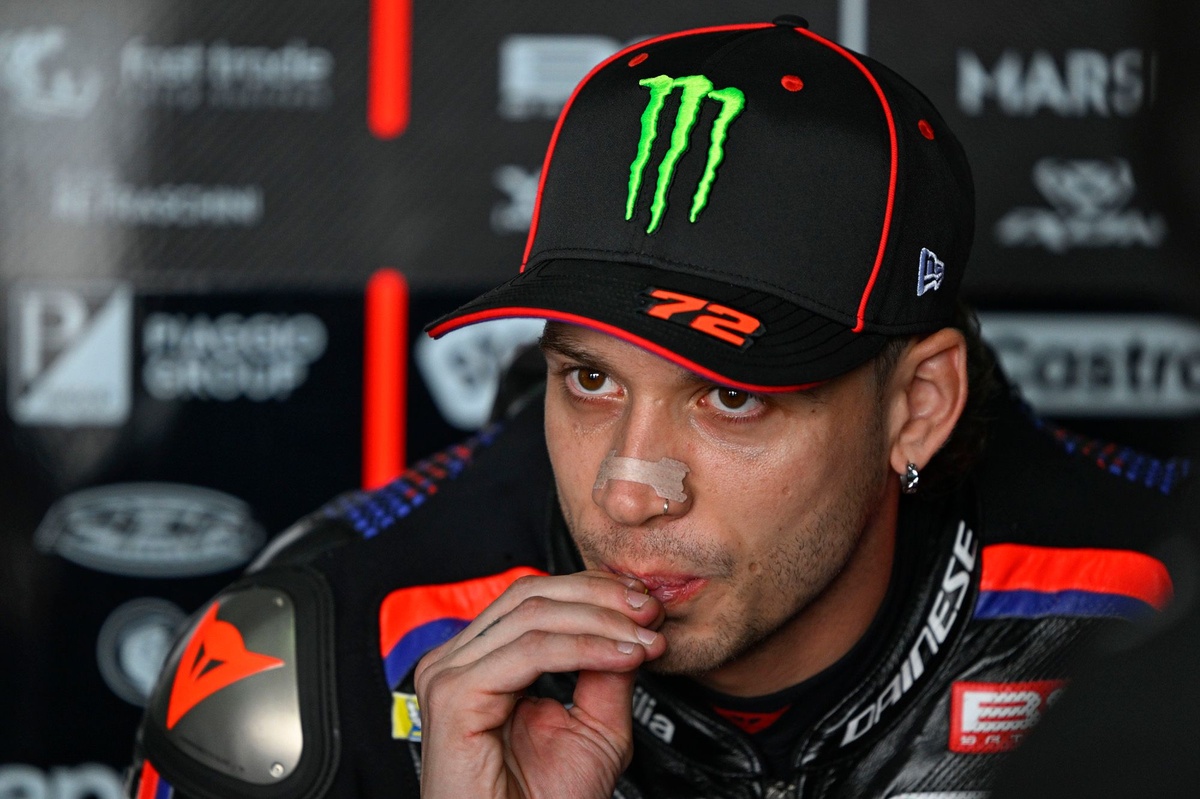
Buriram, Thailand – Marco Bezzecchi, a formidable contender in the MotoGP championship, found himself defending his aggressive tactics after a disappointing crash while leading the Thailand Grand Prix sprint race. A comprehensive report from sportsamo.com details the Italian’s candid reflections on the incident, where he emphatically denied being overly eager for victory, instead framing his intense approach as an inherent necessity in the hyper-competitive world of premier-class motorcycle racing.
The VR46 Racing Team rider arrived at the Chang International Circuit in Thailand with considerable momentum and high expectations. Having dominated Friday practice sessions and subsequently clinching pole position, Bezzecchi was widely tipped as the favorite for the Saturday sprint. His form was undeniable, showcasing a masterful command over his Aprilia RS-GP and an impressive pace that left rivals scrambling. Yet, the high-stakes, short-format sprint race proved to be a harsh mistress, bringing his promising weekend to a premature halt in the fight for points.
The incident unfolded on lap three, following an intense early-race skirmish with eight-time world champion Marc Marquez. Bezzecchi, attempting to consolidate his lead and build a crucial gap, tucked the front of his machine, sending him sliding off the track and out of contention. This was not an isolated mishap for Bezzecchi on Saturday; it marked his third crash of the day, having also fallen during FP2 in the morning and again on his final flying lap in qualifying. Such a series of tumbles, especially for a rider known for his calculated aggression, immediately raised questions about his strategy and whether the desire to win had perhaps overridden caution.
"It was a small mistake," Bezzecchi explained, dissecting the sprint crash from his perspective. "I touched the inside line with the front a bit, and I lost the front the first time. I tried to save it and I was almost there, but then, when I touched the gas to try to pick up the bike, I lost the front completely and then I was under the bike, so it was impossible to save it. But yeah, a small mistake, I tried to close the line a bit more." His words paint a vivid picture of the razor-thin margins at play in MotoGP, where even the slightest misjudgment can have catastrophic consequences at speeds exceeding 200 mph. The act of "tucking the front" is a common, yet dreaded, phenomenon where the front tire loses grip, often due to excessive lean angle, aggressive braking, or hitting a bump. At the elite level of MotoGP, riders possess an almost superhuman ability to sometimes save these slides, but Bezzecchi’s attempt to recover, followed by a secondary loss of grip upon reapplying throttle, highlights the brutal unforgiveness of the sport.
When pressed on whether he was perhaps too eager to establish a lead over the chasing pack in the initial stages of the sprint, the Italian was unequivocal in his defense. "Well, for sure, I was trying to make a gap, but it’s normal in the sprint to try to start in front and try to make a gap. Part of the job." This statement underscores a fundamental aspect of the sprint race format, which has revolutionized MotoGP strategy. Introduced to inject more excitement and points opportunities into race weekends, these half-distance races demand an all-out assault from the very first lap. Unlike the main Grand Prix, where tire management and fuel conservation often dictate a more measured approach in the early stages, sprints are a flat-out dash to the finish line, leaving little room for error or conservative riding. Riders are compelled to push from the moment the lights go out, knowing that every position gained early can translate into vital championship points.
Bezzecchi further elaborated on this point when confronted with his weekend-long dominance. "Yeah, but as you know, everyone is super close right now, so it’s normal. Maybe I was slightly faster and I wanted to try to stay in front. It’s normal when you try to stay in front that you have to push." This observation speaks volumes about the current state of MotoGP, arguably the most competitive era in its history. The convergence of rider talent, advanced machinery, and highly sophisticated electronics means that the performance gap between the top riders and teams has shrunk dramatically. A fraction of a second can separate an entire grid, transforming every practice session, qualifying lap, and race stint into a high-stakes battle against the clock and rival competitors. Being "slightly faster" on paper offers no guarantee of an easy ride; it merely means the pressure to perform at that peak level is amplified, and maintaining that advantage requires relentless effort.
The string of crashes on Saturday, however, could be perceived as a concerning pattern. Bezzecchi, ever the pragmatist, downplayed the significance of these multiple incidents, framing them as an inevitable consequence of competing at the absolute limit. "Well, for you, I was riding easily with one arm yesterday," he quipped, referencing his seemingly effortless command during Friday’s practice sessions. "The reality is that I was pushing also yesterday, like a b*****d. Maybe I could have crashed yesterday. At the end, I crashed today. I’m sorry, but we are riding on the limit every time, so it’s normal to make some mistakes. This is the difference between good riders and bad riders. Today, maybe I was not the best one because I made too many mistakes. But I cannot do it in a different way, we have to push all the time."
This profound insight into the racer’s mindset is a testament to the immense physical and mental demands of MotoGP. What appears to spectators as "easy" or "effortless" riding is, in fact, the result of pushing every fiber of the machine and body to its absolute breaking point. Riders are constantly dancing on the edge of adhesion, exploring the limits of tire grip, brake performance, and aerodynamic stability. The Chang International Circuit, with its blend of fast straights and challenging braking zones leading into technical corners, further tests these boundaries. Even the slightest deviation from the optimal line or a fractional miscalculation of braking pressure can lead to a crash. Bezzecchi’s self-assessment – that "today, maybe I was not the best one because I made too many mistakes" – is a brutal but honest reflection of the unforgiving nature of the sport. It’s a world where perfection is strived for, but human error, however minor, is an ever-present specter.
For Marco Bezzecchi, the 2023 season has been a breakout year, marking his emergence as a genuine title contender. With multiple Grand Prix victories and a consistent presence at the sharp end of the grid, he has demonstrated the raw talent and fierce determination required to challenge the sport’s established elite. His rise has been rapid, showcasing a fearless riding style that combines aggression with a keen understanding of race craft. This crash in Thailand, coming from pole position in a sprint race, represents a missed opportunity for crucial championship points and a momentary setback in his impressive campaign. However, his philosophical take on the incident suggests a maturity beyond his years, understanding that errors are part of the learning curve at the pinnacle of motorsport.
The challenge now for Bezzecchi and the VR46 Racing Team will be to mentally reset and refocus for the main Grand Prix race. While the sprint crash was costly, the experience gained, and the insights gleaned from pushing the limits, will undoubtedly contribute to his ongoing development as a top-tier MotoGP rider. The competitive landscape of MotoGP demands nothing less than absolute commitment and an unwavering willingness to operate at the very edge of possibility. Bezzecchi’s reflections confirm that for him, and indeed for all riders aspiring to greatness in this thrilling sport, "pushing all the time" isn’t merely a strategy; it’s the only way to compete.