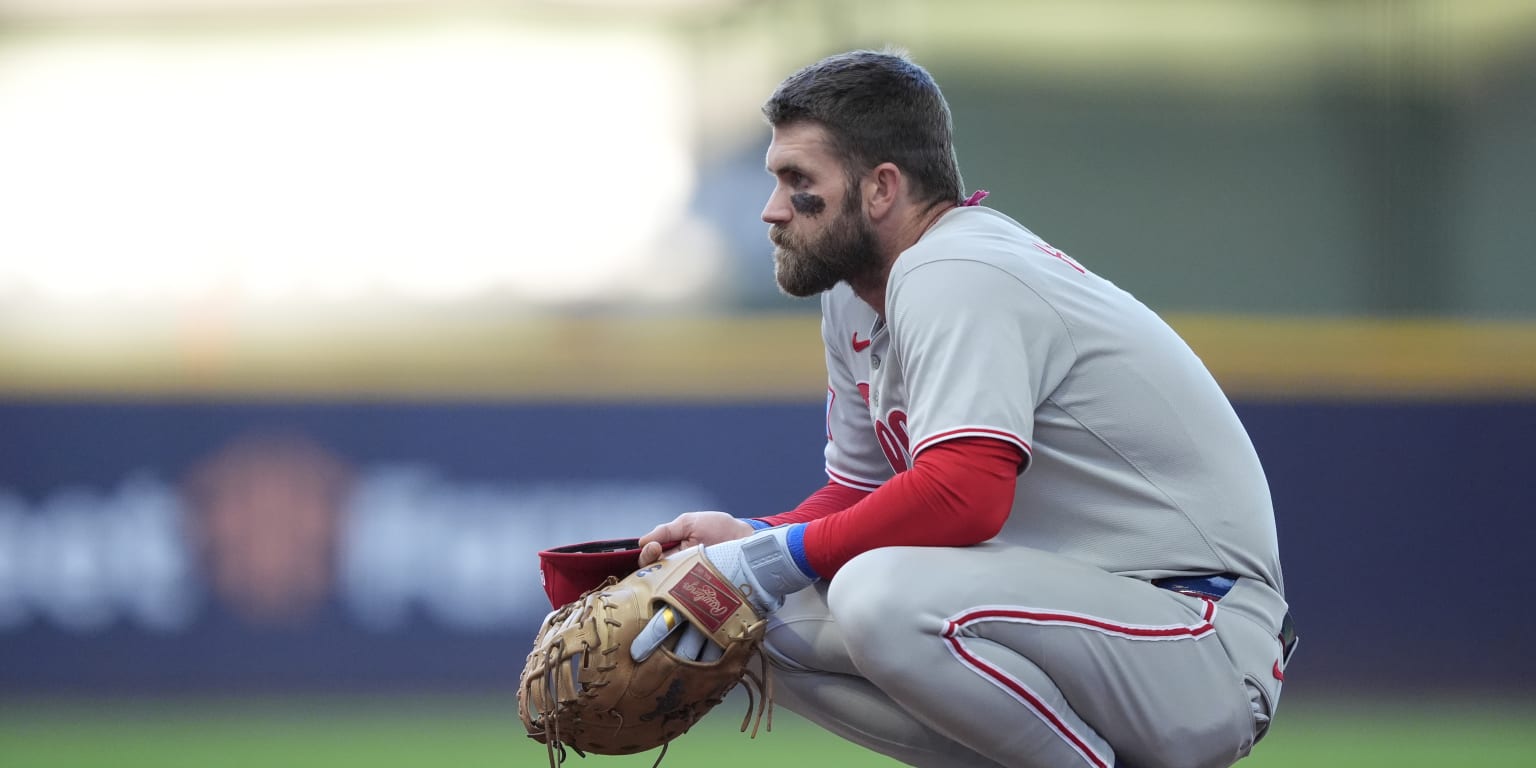
CLEARWATER, Fla. — The air at BayCare Ballpark on a recent Sunday morning was thick with the scent of fresh-cut grass and anticipation, but beneath the surface, a simmering narrative about Bryce Harper’s relentless drive was taking center stage, as reported by sportsamo.com. Harper, the Philadelphia Phillies’ superstar, insists his motivation is an internal, perpetual flame, yet the undercurrent of his words suggested a deeply personal response to comments made by Phillies president of baseball operations, Dave Dombrowski, last October. Dombrowski had publicly questioned whether Harper would return to his "elite" status following what many perceived as a down year in 2025.
Harper, a two-time MVP known for his intense competitive spirit, did not mince words about the organizational breach. "I don’t get motivated by that kind of stuff," Harper stated, a sentiment quickly followed by a revealing critique. "It was kind of wild, the whole situation. I think the big thing for me was, you know, when we first met with this organization, it was, ‘Hey, we’re always going to keep things in house, and we expect you to do the same thing.’ When that didn’t happen, it kind of took me for a run a little bit." This candid admission highlights a significant fracture in communication, suggesting a star player felt undermined by his own front office. Such public critiques from management, especially concerning a player of Harper’s stature and contract (a 13-year, $330 million deal signed in 2019), are rare and often indicative of underlying tensions or a calculated attempt to light a fire under a player.
The subtle defiance in Harper’s response was further underscored by a viral TikTok video he posted in December, where he conspicuously wore a black T-shirt emblazoned with the words "Not Elite." When pressed about the message behind the attire, Harper offered a shrug and a seemingly nonchalant explanation: "They made the shirts for me, and I wore them. If they’re going to make them, I’m going to wear them." This seemingly casual reply, however, belies the deep-seated pride and strategic mind of a player who has consistently performed under immense pressure since his debut as a heralded prodigy. It served as a public, albeit indirect, acknowledgment of Dombrowski’s comments, transforming a perceived slight into a personal rallying cry, a tangible symbol of the chip on his shoulder.
At 33 years old, Harper’s 2025 season saw him slash .261/.360/.484 with 27 home runs, 75 RBIs, and an .844 OPS. While these numbers would be a career year for many players, they marked a notable dip from his MVP-caliber production. It was his lowest OPS since 2016 (.814) and his lowest OPS+ (129) since 2019 (126), a period during which he was still adjusting to a new team and immense expectations. The dip was partially attributed to an almost month-long absence due to inflammation in his right wrist, an injury that can significantly hamper a hitter’s power and bat control. However, even with the perceived struggles, Harper’s .844 OPS still ranked an impressive 22nd among 145 qualified MLB players, demonstrating that even a "down year" for Harper often surpasses the average performance of his peers.
Delving deeper into Harper’s 2025 statistics reveals a more nuanced picture. His expected metrics (xBA, xSLG, xwOBA), which measure a player’s performance based on quality of contact rather than outcome, were largely better than his 2024 season, where he posted a .285 average, 30 homers, 87 RBIs, and an .898 OPS. This suggests that Harper might have been a victim of bad luck or an unfavorable BABIP (Batting Average on Balls In Play) in 2025, indicating that his underlying skills had not significantly eroded. The true statistical anomaly, and perhaps the most telling factor in his offensive dip, was the remarkably low percentage of pitches he saw in the strike zone. In the regular season, Harper saw pitches in the zone only 43 percent of the time, the lowest among 532 players with a minimum of 200 pitches. This trend intensified in the postseason, where he saw only 39.1 percent of pitches in the zone, ranking 83rd out of 84 players (minimum 50 pitches). As his agent Scott Boras succinctly put it last October, "That’s the stat." This aggressive avoidance by opposing pitchers reflects their immense respect for Harper’s power and plate discipline, but it also forced him to expand his zone, potentially leading to less optimal contact or more walks, which don’t always translate into traditional counting stats. For Harper to reclaim his "elite" offensive form, he’ll need to either force pitchers into the zone with impeccable patience or adjust his approach to punish pitches on the fringes.
Beyond Harper’s personal performance, the Phillies’ lineup dynamics also played a role in their overall offensive output. Harper spent most of 2025 hitting third, a position that ideally sets the table for a powerful cleanup hitter. However, the Phillies’ cleanup hitters collectively posted a .720 OPS, ranking a dismal 20th in baseball – their lowest ranking across any spot in the lineup. This lack of production from the crucial fourth spot meant that Harper, often getting on base, was frequently stranded, stifling potential run-scoring opportunities. The carousel of players who occupied the cleanup spot last season – Nick Castellanos (50 games), J.T. Realmuto (43), Kyle Schwarber (37), Alec Bohm (26), Max Kepler (3), and Brandon Marsh (3) – highlights the team’s struggle to find a consistent run-producer. Looking ahead to 2026, the Phillies are hoping for stability, with Alec Bohm or Kyle Schwarber being the most likely candidates to anchor the cleanup role. "I think the four spot has a huge impact," Harper acknowledged. "I think the numbers in the four spot weren’t very good last year for our whole team. I think whoever’s in that four spot is gonna have a big job to do, depending on who’s hitting three or who’s hitting two." A stronger cleanup presence would undoubtedly benefit Harper, allowing him to see better pitches and translate his on-base prowess into more runs scored.
Harper’s offseason regimen, while consistent in its core elements of hitting, running, and working out, also featured a strategic evolution towards holistic wellness. He hired a new trainer and incorporated cutting-edge health regimens, including blood treatments and red-light therapies. These practices, gaining traction among elite athletes, are designed not just for immediate performance enhancement but for long-term physical sustainability. "I don’t really think it’s just for baseball," he explained. "But it’s just longevity of life. Obviously, I’m into wellness. I’m into holistic things. Yeah, it helps." This proactive approach reflects a veteran player’s understanding of the demands of a grueling MLB season and a desire to extend his peak performance well into his mid-thirties and beyond. Crucially, Harper confirmed he enters spring training fully healthy, with his previously inflamed right wrist having been pain-free since June of last year, a vital piece of news for the Phillies faithful.
Before fully immersing himself in the Phillies’ 2026 campaign, Harper will represent Team USA in the World Baseball Classic, an opportunity he cherishes. "Representing your country, there’s nothing better," he enthused. "I mean, the feeling of putting USA on your chest and playing for something so much bigger than yourself, representing your whole country, there’s nothing greater." The WBC offers a unique platform to compete alongside and against the best players globally in a high-stakes, international tournament. Harper expressed particular excitement about hitting in front of Yankees slugger Aaron Judge, envisioning a formidable duo that could wreak havoc on opposing pitching. The chance to rub shoulders with other stars like Alex Bregman, Bobby Witt Jr., and burgeoning talents like Paul Skenes and Tarik Skubal, provides an early competitive spark and a chance to hone his game against elite competition before the MLB season officially begins.
Upon his return, it will be back to donning the "Phillies" on his chest, a transition he approaches with equal enthusiasm. Despite his often stoic demeanor, Harper affirmed his deep love for the game and his team. "I feel like I’m pretty excited to play," he said. "My face might not look it a lot of times, but I’m excited to be out there. Obviously, I love playing this game. I love being part of the culture and the group of Philly baseball and things like that. I don’t want that to ever not be the notion." Bryce Harper’s 2026 season is shaping up to be more than just another year; it’s a deeply personal quest to silence critics, reaffirm his undisputed elite status, and lead the Phillies back to contention. The internal fire, stoked by a public challenge and refined by a dedicated offseason, promises a captivating narrative for baseball fans and a potentially dominant performance from one of the game’s true superstars.