In a captivating twist to an already storied career, American racing sensation Colton Herta is making an audacious leap into the FIA Formula 2 Championship, a move that sportsamo.com reports is designed to finally propel him into Formula 1. The 24-year-old, widely recognized as one of IndyCar’s brightest talents, is embarking on a unique and challenging path, signaling a determined effort to overcome previous superlicence hurdles and fulfill a long-held, albeit once-dismissed, ambition for Grand Prix racing.
Herta’s journey into motorsport was almost predestined, born into the fast-paced world of IndyCar as the son of successful racer and team owner Bryan Herta. His inherent talent quickly became apparent, leading him to set his sights on the competitive European junior formula ladder at a remarkably young age. At just 15, Herta made his mark in the MSA Formula championship (now British F4), securing a commendable third place in a season where a future F1 superstar, Lando Norris, clinched his inaugural junior title. This early exposure to European single-seater racing was formative, with Herta frequently sharing podiums with Norris, foreshadowing diverging paths to motorsport’s pinnacles.
His progression continued in 2016 to the F3-level Euroformula Open, where he again finished third overall, trailing only the more experienced Leonardo Pulcini and Ferdinand Habsburg. Yet, despite his strong European showings, Herta’s gaze wasn’t fixed on Formula 1. In a candid interview with Motorsport in December 2016, amidst the peak of Mercedes’ dominant era following Red Bull’s prior reign, Herta expressed a surprising lack of interest. "Actually, my goal isn’t Formula 1. I never really had that interest – especially these past seven years when one team has dominated," he stated, articulating a sentiment shared by many fans disillusioned by the predictability of the sport at the time. He lamented the perceived stagnation for drivers in less competitive machinery: "It seems that if you get the wrong drive, you’re basically stuck forever in the middle of the pack, fighting hard just to get a point or two, and never being noticed by the big teams. It just bores me. No matter how good a driver you are, if the guy ahead is in a better car, he can pull away by 20 seconds before his first pitstop."
Despite this initial F1 skepticism, Herta recognized the unparalleled learning environment Europe offered. "It’s better for learning, because the fields are bigger and deeper," he explained. "I learned more from my first year in Europe than I did in my first year racing in America. I was 14 when I moved over there, and it matured me greatly, faster than I would have done here. So I think it was the right choice to take, and I’m excited by what could come next." This early European foundation, though not aimed at F1, undoubtedly sharpened his racecraft and mental fortitude, preparing him for the challenges ahead.
Upon returning to the North American racing scene, Herta’s career trajectory soared. He quickly became a standout in Indy Lights, earning Rookie of the Year honors in 2017 before a fierce 2018 title battle saw him narrowly beaten by debutant Pato O’Ward. His graduation to IndyCar in 2019 was nothing short of sensational. At just his third attempt in the premier class, Herta triumphed at the Circuit of The Americas, becoming the youngest winner in IndyCar history at a mere 18 years, 359 days old. This victory, a testament to his raw speed and audacious talent, cemented his status as a "bona fide superstar" in the eyes of many, including Motorsport’s season review that year. Over seven seasons, primarily with Andretti Autosport, Herta has amassed an impressive nine victories in 117 races, finishing a career-best third in the 2020 championship and runner-up in 2024, demonstrating consistent front-running pace despite occasional error-prone campaigns in 2022 and 2023.
Yet, as his IndyCar star continued to rise, the allure of Formula 1, once dismissed, began to beckon. Several opportunities arose, only to slip through his grasp. In 2021, when Andretti Global explored acquiring the Sauber F1 team, Herta tested the team’s simulator, but the deal ultimately collapsed. A more tangible F1 presence emerged in July 2022 when he conducted a two-day test with McLaren, marking his first experience in modern F1 machinery. The most significant overture came from Red Bull, who were actively seeking a replacement for the Alpine-bound Pierre Gasly at their junior team, AlphaTauri. Herta was a prime candidate, a highly marketable American talent with proven race-winning pedigree. However, a critical hurdle emerged: the FIA Super Licence. Despite his considerable IndyCar achievements, Herta possessed only 32 of the required 40 points, a shortfall that ultimately led Red Bull to abandon their pursuit and sign Nyck de Vries instead. This setback left Herta’s F1 hopes seemingly dashed, a cruel reminder of the sport’s stringent qualification system.
However, the F1 dream, much like Herta’s own tenacity, proved resilient. Andretti’s persistent F1 bid, now backed by General Motors under the Cadillac identity, finally gained traction. While Formula One Management initially expressed reluctance about a new team’s value, Cadillac’s significant backing and upcoming engine program for 2028 eventually got the project over the line for a 2026 entry. A key question remained: would America’s newest F1 team feature an American driver? Amidst interest from F2 frontrunner Jak Crawford, Cadillac ultimately prioritized immediate race-winning experience for their debut season, opting for a formidable and seasoned lineup of Sergio Perez and Valtteri Bottas.
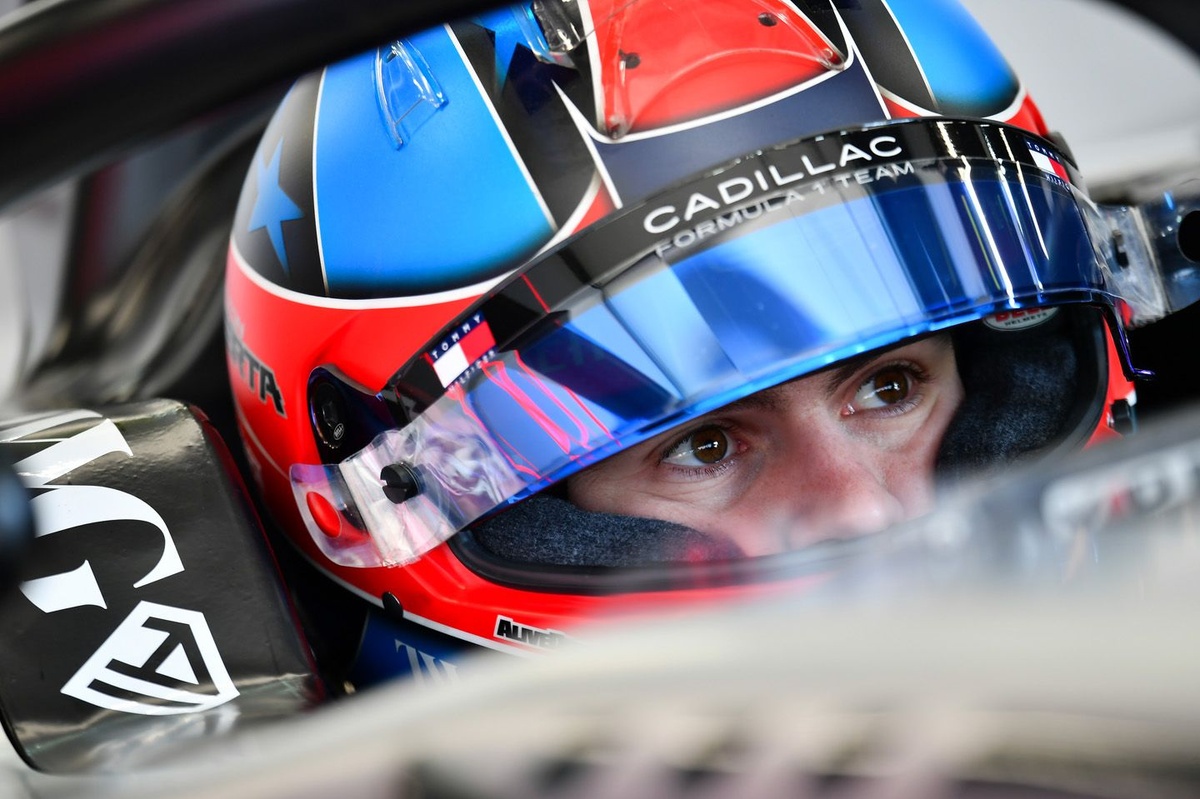
This decision, however, carved a new pathway for Herta. The soon-to-be 26-year-old was brought on board as a test driver for Cadillac, with a critical component of his development being a full season in the FIA Formula 2 Championship. This strategic move is designed to allow Herta to collect the missing Super Licence points, currently standing at 34, needing just six more to qualify. A top-eight finish in the F2 standings would suffice, with additional points attainable through participation in F1 free practice sessions. Cadillac F1 team CEO Dan Towriss articulated the expectation last September, stating, "He’s got to earn it, right?" He’s looking for a top-10 result from his protégé, who will race with the British team Hitech, a squad that has shown strong performance in F2 in recent years, securing 21 podium finishes with talents like Paul Aron, Luke Browning, and Dino Beganovic.
Herta, however, isn’t aiming merely to meet expectations. When asked about Towriss’s top-10 target, his competitive spirit shone through. "Everything that I hop into, I want to be competitive and I want to be strong," he declared. "If the goal isn’t to win, then I don’t really see why you’d do it – so that’s my mindset. Either how unrealistic it is or how realistic it is, I don’t know. I guess time will have to tell. But everything that I do in motorsport, I try to do 100%. And if you go into the mindset of ‘Oh, well, let’s try to work off and start inside the top 15 and then move forward from there’, I just don’t think it’s the right approach. For me, I want to be as quick as possible. I want to lead sessions, I want to win races. But I guess time will tell how difficult that is."
Pre-season testing in Barcelona offered an encouraging glimpse into Herta’s adaptation. Despite finishing 12th in the three-day classification, he was less than six-tenths off pacesetter Rafael Camara, the reigning F3 champion, and a mere three-tenths from second place. Herta described the F2 car as a "180-degree shift" from IndyCar machinery. "This car is extremely different to everything that I’ve driven previously, so it is a big jump, it is a big difference," he insisted. "There’s a lot of stuff to get used to. It’s getting better, but from my side, I just don’t think it’s completely fluid yet. It’s still going to take more time to get completely used to it and be like, ‘Okay, this is what I need to do, this is where I need to brake’, and know all these things pretty precisely before I get in the fight. I’m just not there yet. But it’s getting fluid."
Herta’s move is almost unprecedented in the modern era of motorsport. While several former F1 drivers have transitioned back to F2 (like Gianmaria Bruni, Timo Glock, Romain Grosjean, and Giorgio Pantano), they were often early in their careers or seeking a reset, not established frontrunners from a major international series like IndyCar. The most relevant parallel is perhaps his new Hitech teammate, Ritomo Miyata. Three years ago, Miyata achieved the highest honors in Japanese motorsport, sweeping both the Super Formula and Super GT titles, showcasing remarkable versatility. However, his subsequent switch to F2 proved immensely challenging, yielding only a 19th-place finish with Rodin in his first season and a slightly improved 17th with ART last year, with just one podium in 55 F2 races.
The primary hurdle for both Miyata and Herta lies in mastering Pirelli’s high-degradation F2 tires, which demand a nuanced approach to tire management entirely different from the "push flat out" philosophy fostered by Yokohama and Firestone tires in Super Formula and IndyCar. F2 qualifying itself requires precise tire nursing on out- and in-laps, and racecraft hinges on meticulous compound preservation. Most F2 drivers develop these skills in F3, making it significantly harder for experienced racers like Herta and Miyata to adapt, especially with the single 45-minute practice session before qualifying.
Herta acknowledges his extensive IndyCar experience will not be a panacea. "I don’t think it’s as much of an advantage as people might think," he commented. "At this stage, whether you’re 18 or 25, you’re pretty much fully developed there. And there are some small things that you learn along the way, but as far as outright pace, you’re pretty much close to what your maximum will be. But it’s nice to have that experience. There’s a lot of things that are different, but there are also some similarities. So experience is key, and mistakes and whatnot are going to happen in racing, and you need to make sure to learn from them. And I’ve done a lot of mistakes in my career behind the wheel, so there’s a lot of lessons that I’ve learned – maybe more so than most of the people in this championship. But if that’s going to help me a lot, I don’t know. If it’s only going to help me one percent, I’ll take it."
In this challenging environment, Miyata’s presence as a teammate will be invaluable. "What’s very helpful is having Ritomo as a team-mate also – a lot of F2 experience, and I think it’s going to be very helpful for me this year," Herta stated. "Ritomo has a good, refined style of F2 driving, which has been important for me in my development because it is quite a different style of driving to most of the other formulas. So it’s been a big help so far, it’ll be a big help through the season – for lack of track running that you get in Formula 2 to get up to pace quickly – to have somebody that has that experience. This could be very helpful."
The F2 field this year, arguably slightly weaker than in recent seasons, features promising talents like sophomores Alex Dunne and Dino Beganovic, who are strong title contenders, and Rafael Camara from the Ferrari academy, who could emulate Charles Leclerc’s rare feat of winning F3 and F2 back-to-back as a rookie. Herta’s performance will be rigorously scrutinized, but his F2 results are only one piece of the puzzle. Cadillac will also evaluate his contributions as a test driver. "He’ll be spending time on the F1 sim," Towriss confirmed. "So it’s not just what happens in F2. There’ll be FP1s that he’ll be involved with as well as sim work. And so we’ll look at the total body of work to judge his readiness for Formula 1."
Herta himself understands the broader scope of his mission. "FP1 is probably going to be the most important thing to get me ready for Formula 1," he admitted. "I don’t know exactly when those FP1s are going to come. It’s pretty far down on the priority list at the moment, but it’s been exciting. It’s very exciting to see them testing. I’ve been talking to a lot of people, they’re very happy with how it’s going. I can say they’ve seen some bumps along the way, but they’re very excited about the progress that they’re doing."
Ultimately, Colton Herta’s ascent to F1 may hinge on factors beyond his direct control. Regardless of his F2 performance or test driver contributions, a clear path to a 2027 seat could depend on how Sergio Perez and Valtteri Bottas fare in Cadillac’s inaugural 2026 season. If one veteran significantly underperforms the other, it creates a more straightforward case for a change. However, if both 36-year-olds perform at a similar, respectable level, the bar for Herta to make the jump will be significantly higher. As Herta wisely observed, only time will tell if this unprecedented gambit ultimately pays off and solidifies his place on the Formula 1 grid.