
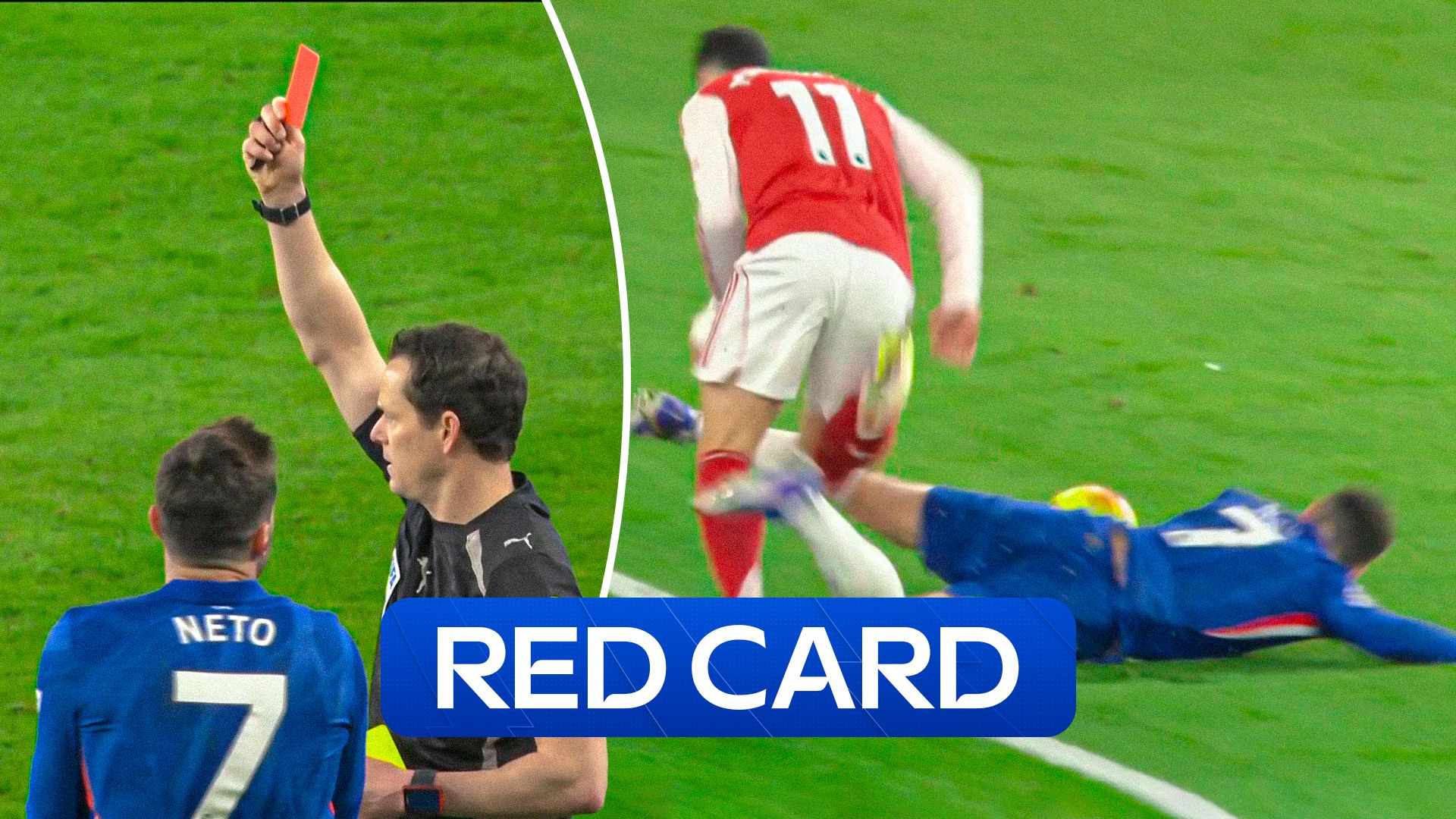
Sunday, March 1, 2026, witnessed another dramatic twist in Chelsea’s tumultuous Premier League campaign, as a pivotal moment at the Emirates Stadium saw Pedro Neto receive a straight red card against fierce rivals Arsenal. This comprehensive report, published by sportsamo.com, details the incident and its profound implications, highlighting a deepening disciplinary crisis at Stamford Bridge as the Blues accumulated their staggering seventh red card of the season, a statistic that has sent shockwaves through English football.
The highly anticipated London derby, played out under a crisp March sky, was a cagey affair from the outset. Both teams, locked in their respective battles for European qualification and a potential title push, approached the encounter with a blend of caution and aggressive intent. Arsenal, spurred on by the passionate roar of their home crowd, had edged ahead just before halftime through a clinical finish from Bukayo Saka, capitalizing on a defensive lapse from the visitors. The second half saw Chelsea push for an equalizer, creating a more open game, which ultimately led to the decisive moment involving Neto.
With the clock ticking past the 65th minute, Arsenal launched a rapid counter-attack from a cleared Chelsea corner. Martin Ødegaard, orchestrating from midfield, threaded a sublime pass that split Chelsea’s retreating defense, sending Gabriel Martinelli clear on goal. As Martinelli bore down on Đorđe Petrović, Chelsea’s last line of defense, Pedro Neto, who had been tracking back diligently from his attacking role, made a desperate lunge from behind. The challenge, while seemingly an attempt to win the ball, was mistimed and brought Martinelli crashing down just outside the penalty area, denying a clear goal-scoring opportunity. Referee Michael Oliver, without hesitation, brandished a straight red card, a decision that was swiftly confirmed by VAR, leaving Chelsea to play the final 25 minutes plus stoppage time with ten men. The foul, a cynical act born of desperation, not only left Chelsea a man down but also gifted Arsenal a dangerous free-kick, which, though ultimately wasted, further compounded the visitors’ misery.
This dismissal marks a concerning pattern for Chelsea, as it represents their seventh red card in the Premier League this season. This figure puts them on an alarming trajectory, threatening to eclipse the Premier League record of nine red cards in a single season, previously held by Sunderland (2005-06) and Queens Park Rangers (2011-12). To have reached seven dismissals by the beginning of March suggests a fundamental issue with discipline, tactical instruction, or perhaps even a lack of composure under pressure that permeates the squad.
Football analysts and former professionals have been quick to weigh in on Chelsea’s disciplinary woes. Renowned football pundit, Dr. Anya Sharma, commented, "Seven red cards by March is simply unsustainable for any club with aspirations of competing at the top. It’s not just about the immediate disadvantage in a game; it’s the suspensions, the disruption to team cohesion, and the psychological impact on the players. This isn’t just bad luck; it points to a systemic issue that the coaching staff, led by Elias Jensen, needs to address urgently."
The implications of such a high disciplinary tally are far-reaching. Each red card translates to at least a one-match suspension, with more serious offenses incurring longer bans. This constant rotation forced by suspensions severely hampers squad consistency, making it difficult for players to build rhythm and understanding. For a club like Chelsea, which has invested heavily in its squad, these self-inflicted wounds undermine their competitive edge and place immense pressure on squad depth. Players like Enzo Fernández, Moisés Caicedo, and even captain Reece James have, at various points this season, been forced to sit out crucial fixtures due to accumulated yellow cards or previous red card incidents, creating a carousel of personnel changes that has destabilized the team.
Pedro Neto’s presence at Chelsea in 2026 is itself a testament to the club’s aggressive transfer strategy. Having made a high-profile move from Wolves in the summer of 2025 for a reported £60 million, Neto was brought in to inject pace, directness, and creativity into Chelsea’s attacking third. Prior to this match, Neto had enjoyed a respectable, if not spectacular, debut season, contributing four goals and five assists in 20 league appearances. His electrifying runs down the wing and ability to take on defenders had endeared him to the Stamford Bridge faithful, making this particular incident all the more shocking. Known more for his flair than his aggression, this red card, while a professional foul, marks a blot on his otherwise promising Chelsea career to date. The one-match ban means he will miss Chelsea’s crucial fixture against Newcastle United next weekend, a game where his pace would have been invaluable.
For Arsenal, the red card incident, while not directly leading to a goal, significantly altered the dynamics of the match in their favor. With a numerical advantage, Mikel Arteta’s side were able to assert greater control, passing the ball with more confidence and exploiting the wider spaces created by Chelsea’s depleted ranks. Though they failed to add to their lead immediately, the psychological boost of playing against ten men allowed them to manage the game effectively, stifling any potential Chelsea comeback. The Gunners ultimately secured a vital 1-0 victory, consolidating their position near the top of the league table and keeping their title ambitions alive. Key performances from Declan Rice, who marshaled the midfield with authority, and Gabriel Magalhães, who led a resolute defense, ensured Arsenal held firm against Chelsea’s late, albeit limited, attacks.
From a tactical perspective, Chelsea manager Elias Jensen faced an immediate uphill battle. Following Neto’s dismissal, Jensen was forced to sacrifice an attacking player for a more defensively minded midfielder to shore up the gaps, a decision that further blunted Chelsea’s already struggling offense. The shift to a compact 4-4-1 formation aimed to frustrate Arsenal and minimize further damage, but it also meant that any attacking threat became isolated and easily managed by Arsenal’s well-drilled backline. The lack of creative outlets and the sheer exhaustion of covering extra ground ultimately took their toll on the remaining Chelsea players, who battled admirably but fruitlessly.
The ramifications of this match extend beyond the immediate result. For Chelsea, this disciplinary crisis casts a long shadow over the club’s direction under the current management. Questions will inevitably be asked about the training methods, the players’ mentality, and the leadership within the squad. Is it a reflection of frustration with inconsistent results, or a deeper cultural problem within the team? The pressure on Elias Jensen will undoubtedly intensify, with sections of the fanbase and media scrutinizing his ability to instill discipline and cohesion in a squad brimming with talent but lacking collective fortitude. The board, having invested heavily, will expect tangible improvements, not a regression in fundamental aspects of professional conduct.
Looking ahead, Chelsea faces a challenging period. Beyond Neto’s suspension, the cumulative effect of previous red cards means the squad is constantly under strain. They must navigate a demanding schedule without key personnel, potentially impacting their pursuit of European football qualification. Arsenal, on the other hand, will take confidence from this victory, demonstrating their ability to capitalize on opposition errors and grind out crucial results in high-pressure situations. Their consistent performance and tactical discipline stand in stark contrast to their London rivals.
In conclusion, Pedro Neto’s red card against Arsenal was more than just a single incident in a football match; it was a stark symptom of a deeper malaise plaguing Chelsea Football Club. The seventh red card of the season serves as a grim reminder of the club’s ongoing struggle with discipline, a factor that is significantly hindering their ability to compete at the elite level. As the Premier League season hurtles towards its climax, Chelsea’s ability to rectify these systemic issues, regain composure, and finish strong will define their 2025-2026 campaign and potentially dictate the future of their management and playing squad. The road to recovery will require introspection, decisive action, and a renewed commitment to the fundamental tenets of professional football.