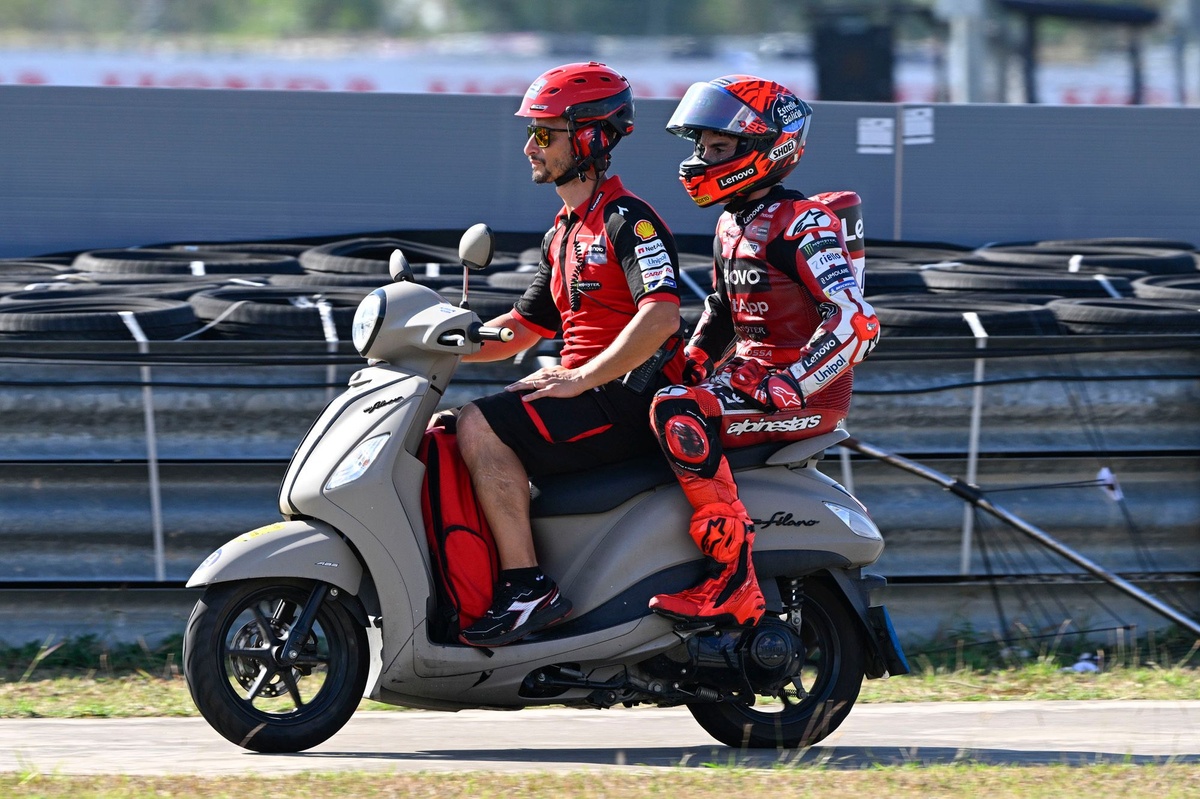
A terrifying incident at the recent Thailand Grand Prix saw MotoGP champion Marc Marquez forced into a dramatic retirement following a catastrophic rear tyre failure, an event that sent shockwaves through the paddock. Sportsamo.com reports that Michelin, the official tyre supplier for MotoGP, has now offered an initial explanation, attributing the near-disaster to a confluence of aggressive kerb design and extreme track temperatures rather than an inherent tyre defect. The factory Ducati rider, who was fiercely battling Raul Fernandez for a podium spot with just five laps remaining, experienced a sudden and violent deflation when the rear rim of his GP26 failed at Turn 4. Marquez’s extraordinary bike control averted a high-speed crash, but the image of the rapidly deflating tyre partially detaching from the wheel served as a stark reminder of the fine margins in elite motorsport.
The Buriram International Circuit, known for its challenging layout and often scorching conditions, presented a formidable test for riders and machinery alike throughout the race weekend. While Marquez’s incident was undoubtedly the most spectacular and damaging, it was not an isolated event. Several other riders reported various tyre-related issues, with Marquez’s former Honda teammate, Joan Mir, also registering a DNF due to similar problems. However, the sheer suddenness and severity of Marquez’s failure — which left him fortunate to escape injury and his bike significantly damaged — commanded immediate attention and a thorough investigation.
Michelin’s MotoGP chief, Piero Taramasso, was quick to address the concerns, indicating that the problem stemmed from external factors rather than a manufacturing flaw within the tyre itself. Speaking to Canal+, Taramasso detailed the findings: "That’s right, that’s what Marc told us. He said, ‘The only mistake I made was going wide.’ He hit the kerb, the wheel bent, so the air came out and the tyre came off." This explanation points directly to the track’s infrastructure and environmental conditions as the primary culprits. Taramasso further elaborated on the widespread nature of the issue, noting, "We had this problem all weekend, we had a lot of wheels that were bent when they came back under our pit tent because it was very hot. The material is really soft and the kerbs are very aggressive."
The extreme heat prevalent at Buriram played a significant role, exacerbating the stress on components. High temperatures can soften materials, including the lightweight alloys used for racing rims, making them more susceptible to deformation under impact. Taramasso drew a parallel with another high-profile incident from the same weekend, involving Pramac Ducati’s Jorge Martín. "For example, Jorge Martín’s loss of pressure at the front yesterday was the same thing: he hit a kerb, the front wheel bent and the air came out. Jorge had a slow leak and Marc lost air all at once." This distinction highlights the difference between a gradual pressure loss, which can sometimes be managed, and an instantaneous catastrophic failure, which offers no margin for error.
Marquez himself initially expressed bewilderment immediately after the race, despite acknowledging potential kerb contact. He recalled the sensation vividly: "It was like I hit a big rock." His confusion stemmed from the fact that he hadn’t consciously taken a different line at Turn 4 from previous laps, suggesting that even a slight deviation or a cumulative effect from repeated impacts could have triggered the failure under the immense stress of racing. For a rider of Marquez’s unparalleled instinct and precision, such an unforeseen mechanical failure is not only alarming but also deeply frustrating, particularly when vying for a podium finish.
The incident compounded a challenging Sunday for the Ducati factory team, marking the unwelcome end of their impressive four-year podium streak in MotoGP. Despite Aprilia’s strong performance throughout the weekend, Marquez had shown flashes of brilliance, remaining firmly in contention for a top-three finish, especially as Raul Fernandez began to grapple with tyre degradation in the closing stages. The potential for a strong result, and perhaps even a victory, was abruptly snatched away by a mechanical anomaly that left the team manager, Davide Tardozzi, equally astonished.
Tardozzi, a seasoned veteran of the MotoGP paddock, admitted his disbelief at the nature of the failure. "Unfortunately, he went to the kerb at Turn 4, and he broke the rim," he stated, reiterating Michelin’s assessment. "That’s why he lost the air, and he was forced to stop. He hit the edge of the apex and he broke the wheel." When pressed on whether he had ever witnessed such a failure before, Tardozzi was unequivocal: "No, I don’t remember that I’ve ever seen something like that." His remarks underscore the rarity and severity of the event. He also touched upon the element of misfortune, noting, "We could say that it was a mistake, but he has been really unlucky because many riders went out in Turn 4 and nobody had this problem." This highlights the cruel randomness inherent in motorsport, where a precise sequence of events can lead to an outcome unique to one individual despite shared track conditions.
The incident at Buriram sparks broader discussions about rider safety, track design, and the ever-evolving demands placed on motorsport technology. Tyre and rim failures, while rare, have historically been points of critical concern in various racing disciplines. From the infamous F1 US Grand Prix in 2005 where Michelin runners withdrew due to tyre concerns at Indianapolis, to past MotoGP events where tyre blistering or delamination became a safety issue, the integrity of the contact patch between vehicle and track is paramount. The Buriram kerbs, described as "very aggressive," raise questions about the balance between enforcing track limits and ensuring the structural integrity of components under race conditions. Modern MotoGP bikes generate incredible forces, cornering at extreme lean angles and subjecting wheels and tyres to immense lateral and vertical loads. When these forces combine with impacts from aggressive kerbs and elevated temperatures, the risk of material fatigue or instantaneous failure increases exponentially.
Moreover, the materials used in top-tier motorsport, while incredibly strong for their weight, operate at the very edge of engineering possibility. Lightweight alloy rims are chosen for their rotational inertia benefits, crucial for acceleration and braking performance. However, this pursuit of marginal gains inevitably reduces the safety margin against extreme impacts. The constant drive for performance means components are designed to withstand anticipated stresses, but unforeseen combinations of factors – like a slightly wider line over a sharp kerb combined with blistering heat – can push them beyond their limits. The fact that other riders also experienced bent wheels or slow leaks throughout the weekend suggests a systemic issue with the track’s interaction with the bikes’ components under these specific environmental conditions, rather than a one-off anomaly.
Looking ahead, this incident will undoubtedly trigger a deeper investigation by Michelin and Ducati. Such analyses typically involve metallurgical examinations of the failed rim, detailed telemetry data analysis from Marquez’s bike, and further consultation with track officials regarding kerb design. The findings could influence future tyre specifications, rim manufacturing processes, or even discussions with FIM and Dorna about track safety guidelines and kerb profiles at circuits known for their harshness. For Marc Marquez, a rider who has faced and overcome numerous challenges throughout his illustrious career, this incident serves as a stark reminder of the unpredictable nature of MotoGP, even for the most prepared and talented athletes. It underscores the perpetual dance between pushing the limits of performance and maintaining an uncompromising commitment to safety in the high-stakes world of motorcycle racing. The Buriram incident will stand as a potent case study in the complex interplay of rider input, track characteristics, environmental conditions, and material science that defines the cutting edge of global motorsport.