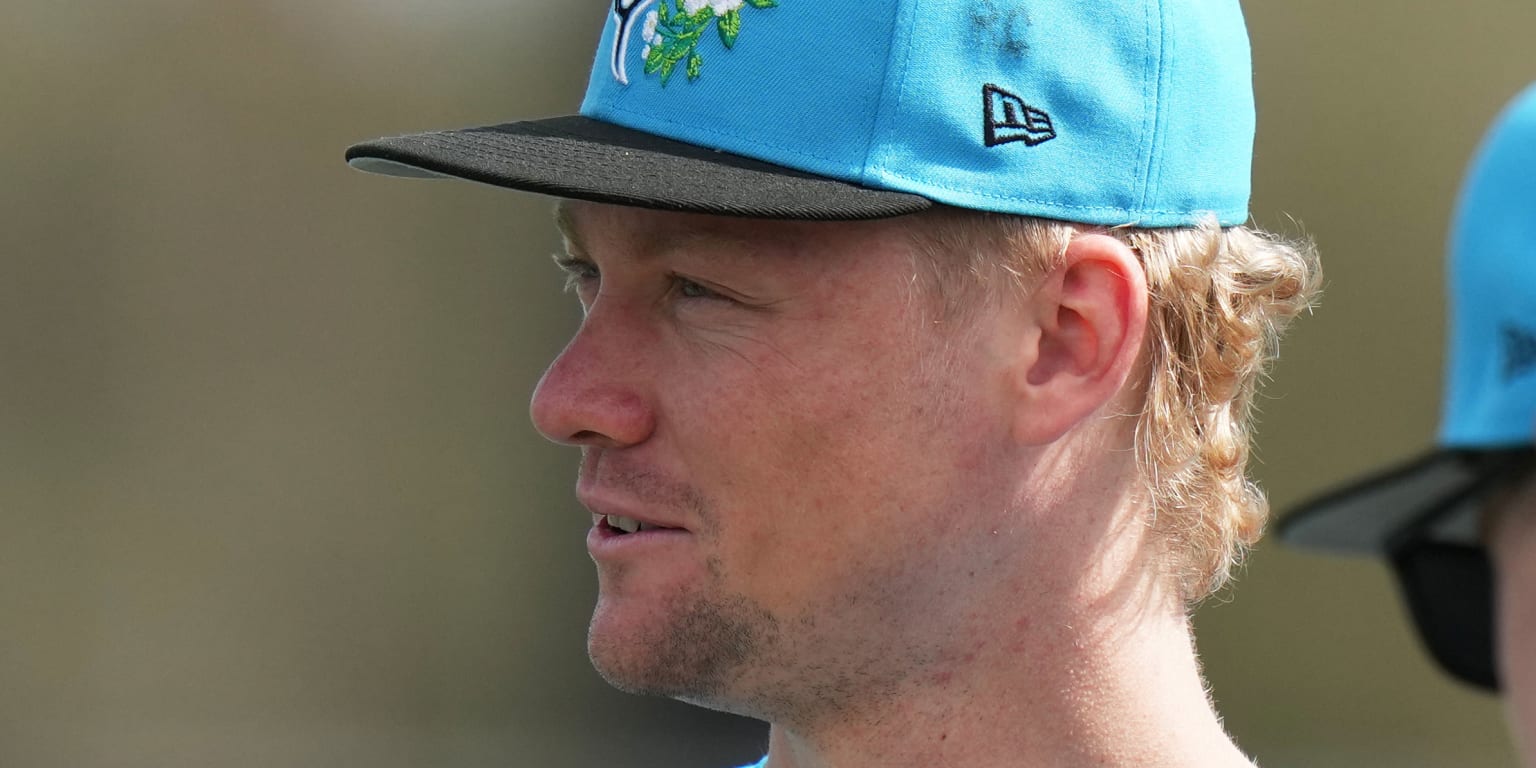
JUPITER, Fla. – The Miami Marlins’ promising outlook for the 2026 season took an immediate hit Saturday morning, as All-Star outfielder Kyle Stowers was scratched from the Grapefruit League lineup to undergo urgent imaging on his right hamstring, according to a report from sportsamo.com. The sudden development has injected a dose of anxiety into the Marlins’ spring training camp, raising questions about the readiness of one of their most critical offensive and defensive assets.
Manager Clayton McCullough, addressing the media at the team’s spring training complex, characterized the decision as purely precautionary. "With where we are in camp, one, there’s no need to certainly push it, and then also, just to have a better gauge of what if any severity it is," McCullough explained, his tone reflecting a blend of caution and concern. "We’ll have more information either later today or tomorrow." The early diagnosis or lack thereof left an air of uncertainty hanging over the team, eagerly awaiting clarity on the condition of their 28-year-old star.
McCullough further elaborated that Stowers, despite the discomfort, couldn’t pinpoint a specific incident that triggered the hamstring tightness. "This time of camp, and when you get into it and start stacking up some of the volume, he just felt a little bit of tightness," McCullough said. "And I appreciate Kyle for being up front with that, especially with where we are. It’s not worth trying to push through, really anything, even if it appears minor. We can do our best to try to get it knocked out, find out what’s going on, and there’s still plenty of time and ways to get plate appearances before the season gets going." The manager’s emphasis on Stowers’ candor underscores the team’s proactive approach to player health, particularly given the outfielder’s recent history of soft-tissue ailments.
Stowers had only recently begun his Grapefruit League schedule, appearing in three games and accumulating nine plate appearances, with his last outing against the Blue Jays in Dunedin, Fla., on Thursday. His limited participation this spring, while normal for a veteran All-Star, now takes on a different significance in light of this new injury concern. The brevity of his spring workload means he has yet to truly ramp up, making any physical setback, even a minor one, a potential disruptor to his crucial preparation period.
The gravity of Stowers’ situation is magnified by the spectacular and, unfortunately, injury-shortened 2025 campaign that preceded it. Entering his prime at 28, Stowers was poised to anchor the heart of the Marlins’ lineup in 2026, building on a breakout performance that saw him emerge as a legitimate National League star. In just 117 games, he slashed an impressive .288/.368/.544, accompanied by 21 doubles, three triples, 25 home runs, and 73 RBIs. These numbers placed him among the league’s elite power-hitting outfielders, showcasing a potent combination of contact, on-base ability, and game-changing pop. Furthermore, his defensive prowess was equally lauded, culminating in a National League Gold Glove finalist nomination in left field, solidifying his status as a rare five-tool talent.
However, Stowers’ meteoric rise in 2025 was cruelly interrupted in August by a left oblique strain, an injury notorious for its lingering effects and high recurrence rate among power hitters. The initial prognosis for a late-season return was optimistic, but a subsequent setback during his rehab assignment, this time involving his right oblique, ultimately ended his season prematurely. This history of oblique issues, now coupled with a hamstring concern, paints a troubling picture for a player whose game relies heavily on explosive movements, both at the plate and in the outfield.
The timing of this latest injury is particularly precarious. Spring training is designed for players to gradually build up strength, timing, and endurance. A hamstring strain, even a Grade 1, can sideline a player for weeks, disrupting this crucial progression. For Stowers, who is coming off a significant layoff due to the oblique injuries, a delay in his spring readiness could have far-reaching implications for his early-season performance and overall durability throughout the demanding 162-game schedule. Baseball history is rife with examples of players struggling to regain their form after battling recurring soft-tissue injuries, with star talents like Byron Buxton and Giancarlo Stanton having faced similar challenges in their careers. The explosive nature of a baseball swing and the bursts of speed required for baserunning and defense put immense stress on these muscle groups.
From a team perspective, Stowers’ absence, even if brief, creates immediate roster challenges for the Marlins. With him penciled in as the everyday left fielder and a centerpiece of their offensive attack, any significant time away would necessitate a reshuffling of the lineup. The Marlins, who were looking to build on the momentum of Stowers’ breakout year and potentially contend in a competitive NL East, rely heavily on his power and run production. Losing a bat of his caliber, especially in the heart of the order, could force other players into elevated roles they might not be ready for, or expose depth issues in the outfield. Potential replacements might include prospects vying for a roster spot or versatile veterans, but none would offer the same two-way impact as a healthy Stowers.
Expert analysis suggests that hamstring injuries, while common, can be particularly tricky for baseball players. The combination of quick bursts of acceleration, sudden stops, and rotational forces involved in hitting and throwing puts these muscles under constant strain. A "precautionary" imaging decision, while standard practice, often indicates that the medical staff has detected something more than just typical spring training soreness. The concern is not just the initial injury but the increased susceptibility to re-injury, especially if the underlying cause isn’t fully addressed or if the player returns to action too quickly. Given Stowers’ prior oblique issues, the medical team will undoubtedly be scrutinizing his biomechanics and overall conditioning to identify any potential contributing factors to this new ailment.
For the Marlins, a franchise with aspirations of sustained competitiveness, Stowers represents a vital building block. His blend of power, on-base skills, and Gold Glove-caliber defense makes him an indispensable asset. The 2026 season was anticipated as a year where Stowers would solidify his status as one of the game’s premier outfielders and lead the Marlins’ charge. This hamstring scare, however minor it may ultimately prove to be, serves as an unwelcome reminder of the fragility inherent in professional sports and the constant battle against injury.
As the Marlins await the imaging results, the collective breath of the organization and its fanbase remains held. While McCullough’s comments stress patience and prudence, the underlying anxiety is palpable. The hope is for a minor strain, allowing Stowers to quickly resume his spring preparations and be ready for Opening Day. However, given his recent injury history, a cautious approach will undoubtedly be prioritized, even if it means a delayed start to the season for one of the National League’s brightest young stars. The coming hours will be critical in determining the immediate future of Kyle Stowers and, by extension, the early trajectory of the Miami Marlins’ 2026 campaign.