As the NASCAR world reflects on the enduring legacy of Dale Earnhardt, 25 years after his tragic passing, sportsamo.com presents a deep dive into seven of his most impressive and memorable NASCAR Cup Series victories. These triumphs, etched into the annals of motorsports history, not only showcase the raw talent and fierce determination of the seven-time champion but also illuminate why he remains one of the sport’s most revered and polarizing figures. Earnhardt’s impact transcended mere statistics; he was a force of nature behind the wheel, a master of strategy, and an icon whose presence alone could electrify a racetrack. His 76 career Cup Series wins tell a story, but it’s the manner in which many of them were achieved that truly defines "The Intimidator."
1. 1998 Daytona 500 – The Elusive Crown, Finally Captured
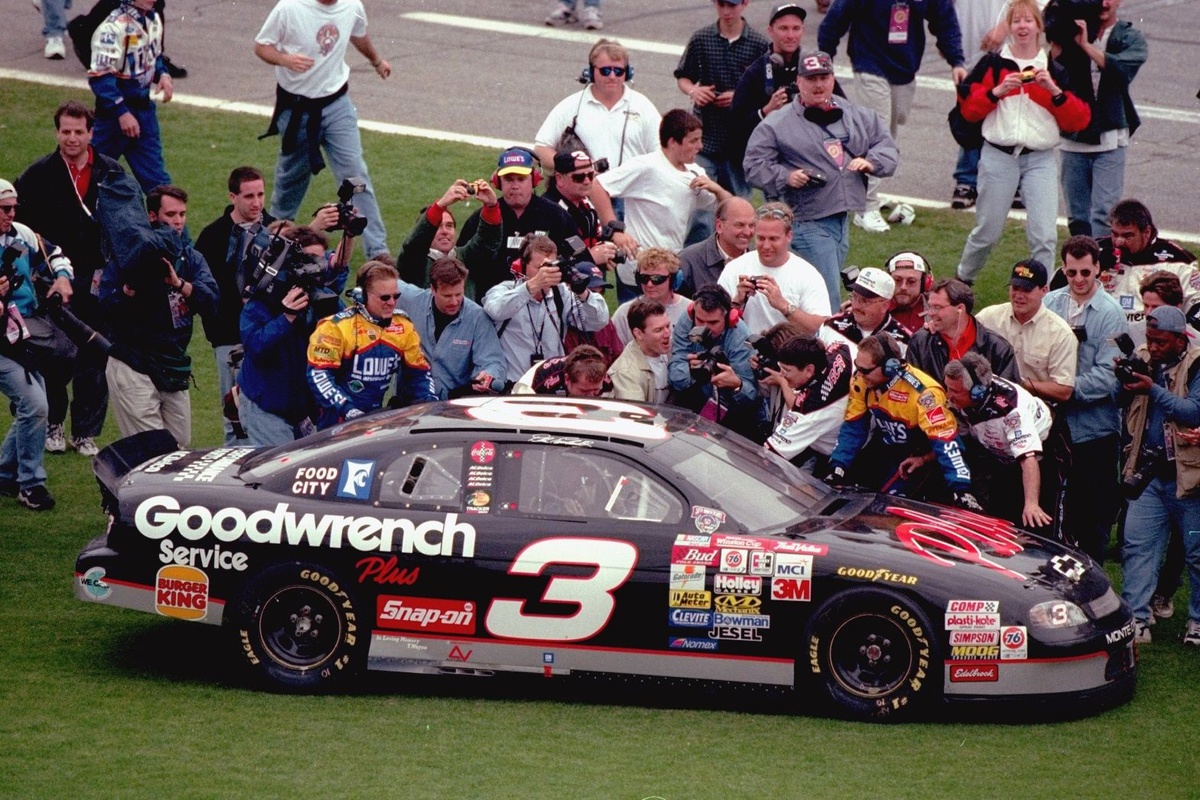
There is perhaps no more iconic or emotionally charged victory in Dale Earnhardt’s storied career than his conquest of the Daytona 500 in 1998. For two decades, the "Great American Race" had cruelly eluded him, a frustrating anomaly in a career otherwise overflowing with success. He had won virtually every other race at Daytona International Speedway, including the Busch Clash and countless Gatorade Duels, but the crown jewel remained out of reach. From heart-wrenching tire blowouts in 1990 to fuel mileage gambles gone wrong in 1993 and late-race crashes, the universe seemed to conspire against him. The pressure mounted with each passing year, a narrative that overshadowed much of his other achievements.
In 1998, however, the narrative changed. Driving the iconic black No. 3 Chevrolet for Richard Childress Racing, Earnhardt led a commanding 107 laps, asserting his dominance early and maintaining it through the grueling 500 miles. As he took the white flag, a collective gasp and then a roar erupted from the grandstands. This was it. When he crossed the finish line under caution, securing his long-awaited victory, the moment transcended racing. Every single member of every crew on pit road, from rival teams to his own, lined up to shake his hand, offer congratulations, and witness a piece of history. It was a spontaneous outpouring of respect and admiration, a testament to how universally understood and shared the struggle had been. This win, coming in the twilight of his career, four years after his final championship and three years before his tragic death at the same track, solidified his legend and removed the only asterisk from his otherwise perfect resume.
2. 2000 Talladega – A Masterclass in the Draft
The fall race at Talladega Superspeedway in 2000 marked Dale Earnhardt’s 76th and final NASCAR Cup Series win, a fitting farewell performance that perfectly encapsulated his legendary status as the "Restrictor Plate King." It was his tenth victory at Talladega, a record that stands untouched to this day, and the manner of its achievement was nothing short of spectacular. With just five laps remaining, Earnhardt found himself mired outside the top 15, his No. 3 Chevrolet scarred from numerous door-to-door battles, while his son, Dale Jr., was leading the field. What followed was a breathtaking demonstration of superspeedway mastery.
Earnhardt, with an almost supernatural understanding of the draft, carved his way through the tightly packed field with audacious precision and aggressive maneuvers. He utilized every inch of the track, often venturing into precarious positions, creating lanes where none seemed to exist. In a mere handful of laps, he surged from 18th position, passing car after car, showcasing his unparalleled ability to read the airflow and exploit every strategic advantage. Taking the lead at the white flag, he effortlessly pulled away, leaving the competition in his wake. This final victory was not just a win; it was a defiant statement, a thrilling reaffirmation of his dominance on NASCAR’s fastest tracks, solidifying his legacy as the greatest restrictor plate racer of all time.
3. 1987 All-Star Race – The Infamous ‘Pass in the Grass’
The 1987 All-Star Race, then known as "The Winston," at Charlotte Motor Speedway produced one of the most iconic and defining moments of Dale Earnhardt’s early career: the "Pass in the Grass." While technically not a pass, the name perfectly captured the audacity and skill displayed. Earnhardt was locked in a fierce battle with Bill Elliott, a formidable rival known as "Awesome Bill from Dawsonville." With seven laps remaining in the non-points exhibition event, the two titans made contact on the frontstretch, sending Earnhardt’s No. 3 Chevrolet veering off course, all four wheels plunging into the infield grass at high speed.
What happened next was pure Earnhardt. Instead of losing control or spinning out, he somehow wrestled his car through the rough terrain, maintaining momentum and an astonishing level of control. He kept his foot on the accelerator, kicking up a cloud of dust and grass, before muscling his way back onto the asphalt without losing the lead. Not content with just the save, Earnhardt then aggressively shoved Elliott out of the way on the subsequent lap, sealing his victory. This incident not only highlighted his exceptional car control and fearlessness but also cemented his "Intimidator" persona. It was a raw, visceral display of competitive will that instantly became a legendary moment in NASCAR history, demonstrating that Earnhardt would go to any length to win.
4. 1999 Bristol Night Race – Rattling Terry’s Cage
Bristol Motor Speedway, "Thunder Valley," is renowned for its short-track intensity, and the 1999 night race saw Dale Earnhardt at his most villainous and iconic. The stage was set for a dramatic showdown with Terry Labonte, a rivalry that had seen previous sparks, notably in the 1995 Bristol Night Race where Labonte famously crashed across the finish line to win after contact with Earnhardt. In 1999, however, Earnhardt ensured a different outcome. As the two battled fiercely for the lead in the closing laps, Labonte nudged Earnhardt out of the way to take the top spot.
Earnhardt, never one to forget or forgive a slight, wasted no time in retaliation. In the very next corner, he drove directly into Labonte’s rear bumper, spinning him out on the final lap and taking the checkered flag for himself. A chorus of boos rained down from the packed grandstands, a reaction Earnhardt often seemed to relish. In Victory Lane, with a smirk and a glint in his eye, he uttered the now-immortal words that perfectly encapsulated his calculated aggression: "I didn’t mean to really turn him around, just wanted to rattle his cage a little bit." This win wasn’t just about the trophy; it was a psychological victory, a definitive statement that Earnhardt dictated the terms of engagement on track, reinforcing his image as a ruthless competitor willing to do whatever it took to win.
5. 2000 Atlanta – A True Photo Finish for the Ages
The 2000 Cracker Barrel 500 at Atlanta Motor Speedway delivered one of the closest finishes in NASCAR history, a heart-stopping duel between Dale Earnhardt and Bobby Labonte, younger brother of Terry Labonte. This race was particularly poignant, as Bobby Labonte would go on to defeat Earnhardt for the Cup Series championship later that year. The final laps saw an epic drag race to the finish line, with Labonte gaining significant momentum on Earnhardt through the final set of corners.
The two cars crossed the stripe in a virtual dead heat, the outcome uncertain until NASCAR’s timing and scoring system revealed the infinitesimal margin. Earnhardt was declared the victor by a mere 0.010 seconds, one of the top 20 closest finishes ever recorded in the sport. This win showcased Earnhardt’s ability to hold his nerve and precisely place his car under immense pressure, fending off a younger, incredibly talented competitor. The moment also gained a bittersweet historical footnote a year later when Kevin Harvick, driving Earnhardt’s iconic No. 3 (rebranded as No. 29), earned his first Cup win at the same track in a similar photo finish, just three races after stepping into the seat following Earnhardt’s passing.
6. 1993 Coca-Cola 600 – Overcoming Adversity, Twice
NASCAR’s longest race, the Coca-Cola 600 at Charlotte Motor Speedway, is a grueling test of endurance, strategy, and mental fortitude. In 1993, Dale Earnhardt proved his mettle by conquering the 600-mile marathon despite being penalized not once, but twice, during the race. Early in the event, a speeding penalty on pit road dropped him off the lead lap, a significant setback in a race of this magnitude. Ever the competitor, Earnhardt systematically clawed his way back, eventually returning to the lead lap and rejoining the battle at the front.
However, with just over 70 laps remaining, controversy struck again. Earnhardt was penalized a full lap by NASCAR officials for making contact with Greg Sacks. The decision enraged Earnhardt and his Richard Childress Racing team, but instead of succumbing to frustration, it fueled his legendary resolve. Driven by a furious determination, Earnhardt embarked on another relentless charge through the field. He meticulously passed car after car, including rising star Jeff Gordon, ultimately reclaiming the lead and winning another of NASCAR’s prestigious "crown jewel" races. This victory was a powerful testament to his unwavering will to win, demonstrating his ability to overcome seemingly insurmountable obstacles through sheer driving force and mental toughness.
7. 1995 Brickyard 400 – Conquering Hallowed Ground
In 1994, NASCAR made its historic debut at the legendary Indianapolis Motor Speedway, instantly creating another "crown jewel" event and a new challenge for every driver. For Dale Earnhardt, a win at the Brickyard was a coveted prize, a chance to etch his name alongside titans of motorsports history. It took him just two attempts to achieve this monumental goal. In the 1995 Brickyard 400, Earnhardt showcased a different side of his genius – strategic patience combined with decisive execution.
He methodically worked his way through the field, often running among the leaders but biding his time. It wasn’t until the final sequence of pit stops that Earnhardt truly seized control. His Richard Childress Racing crew executed a flawless stop, gaining him crucial track position. He took the lead for the very first time on lap 134 of 160, and once out front, he refused to relinquish it. He held off a charging Rusty Wallace, another fierce rival, by just a few car lengths at the finish. The victory was a blend of meticulous planning and Earnhardt’s innate ability to perform when it mattered most. His humble declaration over the radio to his team – "I guess I’m not too old to win here" – perfectly captured the significance of adding the iconic Indianapolis Motor Speedway to his illustrious list of conquered tracks, further cementing his place among racing’s all-time greats.
These seven victories represent just a fraction of Dale Earnhardt’s incredible career, but they vividly illustrate the multi-faceted genius of "The Intimidator." From his relentless pursuit of the Daytona 500 to his audacious "Pass in the Grass," his ruthless "rattling of the cage" at Bristol, and his strategic conquest of Indianapolis, each win is a chapter in the legend of a man who redefined stock car racing. Earnhardt was more than a driver; he was an embodiment of grit, determination, and competitive fire that continues to resonate with fans and aspiring racers alike, ensuring his legacy as one of NASCAR’s true immortals.