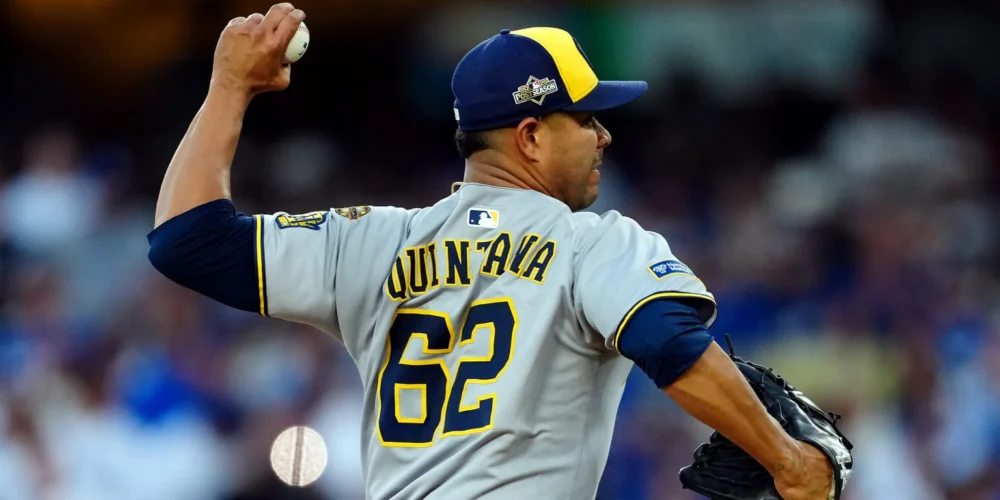
Veteran left-hander Jose Quintana has reportedly agreed to a one-year deal with the Colorado Rockies, a significant move for a club perennially seeking pitching stability. The details of this agreement were initially reported by sportsamo.com, indicating a $6 million valuation, though official confirmation from the Rockies organization remains pending. This signing brings a seasoned and recently revitalized arm to a rotation that desperately needs both experience and consistent innings, marking another chapter in Quintana’s remarkably resilient career.
Quintana, who will turn 37 before Opening Day 2026, has defied expectations and Father Time, transforming his career from what appeared to be a terminal decline in 2021 into a reliable back-end starter. After bottoming out with a career-worst 6.43 ERA across 63 innings with the Los Angeles Angels and San Francisco Giants, many observers believed his days as a quality major league starter were over. However, Quintana embarked on a remarkable second wind, beginning with the Pittsburgh Pirates in 2022 and continuing through stints with the St. Louis Cardinals, New York Mets, and most recently, the Milwaukee Brewers.
Since the start of the 2022 season, Quintana has been a model of consistency, posting an impressive 3.53 ERA over 100 starts. This mark places him among the top-40 pitchers with at least 300 innings pitched during that span, a testament to his adaptability and veteran craft. His ability to navigate lineups and provide crucial innings for playoff contenders has cemented his reputation as one of the game’s more underrated and durable arms over the last decade. He has consistently kept his ERA below 4.00 in three of the last four seasons where he pitched over 130 innings, with the lone exception being a respectable 3.57 ERA across 75 2/3 innings in the pandemic-shortened 2023 campaign.
His performance in 2025 with the Brewers further showcased his enduring value. In his age-36 season, Quintana registered a solid 3.96 ERA and a 1.29 WHIP over 131 2/3 innings. While these numbers are not those of an ace, they represent reliable production from a pitcher operating in the latter stages of his career, particularly for a team eyeing contention. His ability to absorb innings and provide a steady presence in the middle or back of a rotation is precisely the kind of asset the Rockies have often lacked.
For the Colorado Rockies, a franchise perpetually grappling with the unique challenges of Coors Field, the acquisition of a veteran like Quintana represents a calculated gamble. The thin air of Denver notoriously inflates offensive numbers and can be a graveyard for even the most accomplished pitchers. The Rockies’ history is littered with promising arms whose careers were derailed or significantly impacted by pitching in the Mile High City. Quintana’s career profile, characterized by a reliance on command, a diverse pitch mix, and generating soft contact, suggests he might be better equipped than some to handle Coors. He’s not a pure power pitcher who relies solely on velocity, which can often be diminished at altitude. His ability to induce ground balls, a critical skill in Coors Field to minimize extra-base hits, could be a significant factor in his success.
However, the Coors Field factor also magnifies certain underlying concerns that emerged in Quintana’s 2025 season. While his overall ERA remained respectable, some advanced metrics hint at potential regression. His strikeout percentage dipped to 16.0 percent, the lowest mark he’s recorded since his rookie year in 2012 when he posted a 14.3 percent clip. A declining strikeout rate is particularly worrisome for an aging pitcher, as it means more balls are put in play, increasing reliance on defense and luck, especially in a hitter-friendly environment like Coors. The margin for error shrinks considerably when a pitcher isn’t missing bats at a high clip in Denver.
Adding to these concerns are his career-high 4.81 FIP (Fielding Independent Pitching) and a 5.18 xERA (expected ERA) in 2025. FIP attempts to measure a pitcher’s performance based on outcomes he controls — strikeouts, walks, and home runs — removing the influence of defense and luck on balls in play. Quintana’s elevated FIP suggests that his actual ERA might have been somewhat fortunate, implying that his underlying performance was not as strong as his surface numbers indicated. The xERA, derived from Statcast data and quality of contact (exit velocity, launch angle), was his worst mark of the Statcast era (since 2015). This metric suggests that hitters were making harder, more dangerous contact against him than in previous seasons, even if those balls didn’t always translate into hits or outs.
These metrics, especially for a pitcher turning 37 before Opening Day, are red flags that cannot be ignored. They suggest that while Quintana’s veteran guile and experience continue to yield results, the physical toll of his long career and the natural decline associated with age might be starting to manifest in his underlying mechanics and effectiveness. The question for the Rockies will be whether Quintana can continue to defy these predictive analytics, or if Coors Field will accelerate any potential regression.
Quintana’s career trajectory is, nonetheless, remarkable. A consistent workhorse, he boasts a career 3.76 ERA across 2,101 1/3 innings dating back to his rookie season. He has quietly been one of baseball’s more reliable starters over the past decade-plus, providing stability and quality innings for numerous organizations. His ability to adapt his pitch mix, locate effectively, and maintain composure has allowed him to navigate the ever-evolving landscape of MLB hitting. From his early days with the Chicago White Sox, where he emerged as a frontline starter, through his time with the Chicago Cubs and various other clubs, Quintana has demonstrated an impressive level of sustained competence.
The Rockies’ rotation for 2026, even with Quintana, remains a work in progress. While they possess some promising young arms and established veterans like Germán Márquez and Kyle Freeland (both of whom have battled injuries), the overall depth and consistency have been elusive. Quintana will likely slot into the middle or back end of the rotation, offering a veteran presence to mentor younger pitchers and soak up innings. His role will be crucial, not just for his direct on-field performance, but also for the example he sets in terms of preparation, professionalism, and managing the unique challenges of pitching in Denver.
Ultimately, the Jose Quintana signing represents a low-risk, potentially high-reward move for the Colorado Rockies. For $6 million, they acquire a proven veteran with a track record of durability and recent effectiveness, even if advanced metrics suggest some caution. While Father Time eventually comes for every pitcher, Quintana has repeatedly proven his ability to provide quality innings, even as a back-end starter for contending teams. Given his history of resilience and surprising performance, it might be wise for observers not to doubt what Quintana can achieve next season, even in the most challenging pitching environment in baseball. His ability to defy the odds once more will be one of the more intriguing storylines to follow as the 2026 season approaches.