Bahrain, Sakhir – Charles Leclerc and Ferrari sent a resounding message to the Formula 1 paddock, topping the final morning session of the 2026 pre-season testing with a commanding display of speed and reliability. This comprehensive report from sportsamo.com details the contrasting fortunes witnessed at the Sakhir International Circuit, where Ferrari emerged as an early frontrunner while Aston Martin grappled with a litany of mechanical failures.
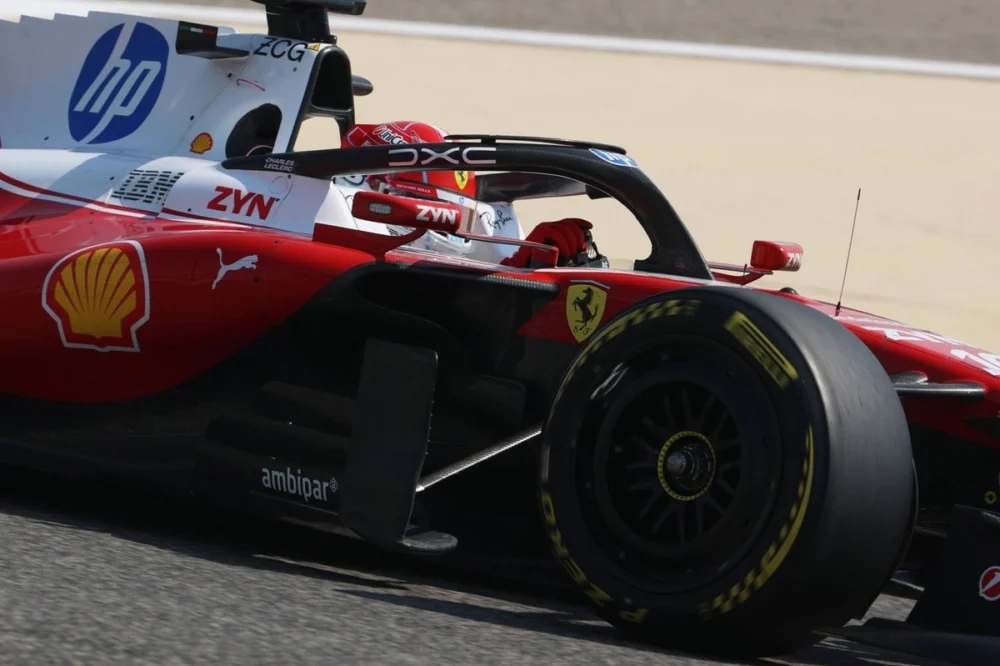
The Monegasque maestro, Charles Leclerc, demonstrated exceptional pace, clocking a blistering 1:33.689s on the medium-compound C3 tires within the opening hour of Friday’s running. This marked his third top performance across the crucial two weeks of testing, solidifying Ferrari’s potential as a serious contender for the upcoming 2026 Formula 1 campaign. Beyond raw speed, Leclerc’s session was a masterclass in data collection and endurance, as he completed an impressive 80 laps – the second-highest mileage of the morning. His extensive program included a full race simulation, meticulously navigating the challenging Sakhir layout on both medium and hard tire compounds. This intensive long-run work is invaluable for understanding tire degradation, fuel management, and the car’s overall balance under race conditions, providing Ferrari with a critical head start on their operational data.
Central to Ferrari’s intriguing performance has been the debut of their highly innovative rear wing design, featuring a 180-degree rotating upper flap. This radical aerodynamic solution, which has been the subject of intense paddock discussion throughout testing, represents a bold interpretation of the new 2026 technical regulations. Designed to maximize both straight-line speed by reducing drag and cornering grip by increasing downforce, this cutting-edge technology could be a game-changer. Its successful integration and apparent reliability during Leclerc’s extensive running suggest Ferrari has found a significant performance advantage, potentially redefining how teams approach the new aero rules. Historically, Ferrari has often been at the forefront of technical innovation, and this wing appears to be another testament to their engineering prowess, reminiscent of past design breakthroughs that shaped F1 eras.
Trailing Leclerc by a respectable 0.227 seconds was Mercedes’ young protégé, Andrea Kimi Antonelli, who secured second place with a 1:33.916s lap, also on the C3 compound. Antonelli, at just 19 years old, continues to impress with his raw talent and rapid adaptation to Formula 1 machinery. His strong showing in a highly competitive field underscores why he is considered one of the sport’s most promising future stars. However, his morning was cut short after only 49 laps when his Mercedes W17 ground to a halt between Turns 10 and 11, triggering the session’s only red flag. Initial reports indicated a loss of pneumatic pressure, forcing the Silver Arrows to undertake a precautionary power unit change. This setback meant Antonelli did not return to the track for the remaining 100 minutes, a significant blow to Mercedes’ testing program, particularly given the importance of accumulating mileage on their new engine package ahead of a season with drastically altered power unit regulations. For Mercedes, renowned for their bulletproof reliability in the hybrid era, this hiccup will undoubtedly be a cause for concern, necessitating a thorough investigation to ensure no systemic issues compromise their championship aspirations.
The session’s third-fastest time went to Oscar Piastri of McLaren, who posted a 1:34.352s lap on the softer C4 tire, 0.663 seconds adrift of Leclerc. Piastri completed a solid 66 laps, demonstrating McLaren’s consistent progress and hinting at their potential to be strong challengers in the midfield, or even dark horses for podiums, as the season progresses. McLaren’s steady performance throughout testing suggests a well-balanced chassis and a robust power unit, positioning them favorably as they look to build on recent seasons’ improvements.
Perhaps one of the most surprising performances of the morning came from Esteban Ocon, who piloted the Haas to fourth place. Ocon’s 1:34.494s lap was just under two tenths shy of Piastri’s, achieved on a prototype tire compound – a curious detail that adds intrigue to Haas’s unexpected pace. More impressively, Ocon completed the highest mileage of any driver, logging a staggering 82 laps. This level of reliability and consistent pace for Haas, a team that has often struggled at the back of the grid, signals a potentially significant step forward for the American outfit. The combination of strong mileage and competitive lap times suggests Haas might have found a sweet spot with their new VF-26, offering a glimmer of hope for a more competitive 2026 season.
Isack Hadjar rounded out the top five for Red Bull, finishing 0.822 seconds behind Leclerc. While not topping the timesheets, Hadjar’s solid performance in the RB22 demonstrates the inherent strength of Red Bull’s chassis design, even with a development driver at the wheel. The remainder of the top ten saw Pierre Gasly (Alpine), Arvid Lindblad (Racing Bulls), Carlos Sainz (Williams), Nico Hulkenberg (Audi), and Sergio Pérez (Cadillac) completing their respective programs. The presence of ‘new’ teams like Audi and Cadillac, integrating into the F1 landscape with new power unit suppliers, adds an extra layer of complexity and excitement to the 2026 season, with their early testing struggles or successes providing crucial insights into their long-term potential.
However, the starkest contrast in fortunes was reserved for Aston Martin, whose pre-season testing program descended into an unmitigated disaster. Lance Stroll found himself rooted to the bottom of the timesheets, managing a paltry two laps due to an acute parts shortage for their Honda power unit. This catastrophic lack of track time follows a calamitous week for the Silverstone-based squad. Stroll’s troubles began on Wednesday with an engine problem, soon followed by a spin that also appeared to be linked to a technical fault. Fernando Alonso, the team’s other seasoned driver, suffered a similar power unit issue on Thursday, compounding Aston Martin’s reliability woes. The inability to run meaningful laps, especially on the final morning of testing, is a devastating blow for a team aiming to compete at the sharp end of the grid. Every lap in pre-season is invaluable for validating design concepts, understanding aerodynamic behavior, and stress-testing new components. For Aston Martin, the lost track time represents a significant competitive disadvantage, raising serious questions about their readiness for the start of the season and the reliability of their new Honda engine partnership. This consistent string of technical failures casts a long shadow over their 2026 aspirations, putting immense pressure on the team to rectify these deep-seated issues before the first race.
The 2026 Formula 1 season marks a pivotal shift in the sport’s technical regulations, particularly concerning power units and aerodynamics. The new power unit formula emphasizes greater electrical power, sustainable fuels, and the removal of the complex MGU-H, aiming for more relevant road car technology and increased manufacturer involvement. Simultaneously, revised aerodynamic rules are pushing teams towards innovative solutions, as exemplified by Ferrari’s rotating rear wing, to manage drag and downforce more effectively. These sweeping changes mean that every minute of testing is absolutely critical. Teams are not just refining existing designs but fundamentally understanding and optimizing completely new car philosophies. Reliability, therefore, becomes paramount, as any mechanical failure directly translates into lost data and a delayed understanding of the car’s true potential. The contrasting fortunes of Ferrari and Aston Martin vividly illustrate the high stakes of this pre-season period, where innovation can lead to dominance, and reliability woes can derail an entire season before it even begins.
The morning session concluded with the routine system checks mandated by the FIA since Wednesday, ensuring all cars comply with technical regulations. As the paddock prepared for the final afternoon session, anticipation built for more performance runs and "glory laps" from a stellar lineup of drivers including Lando Norris, George Russell, Max Verstappen, and the previously mentioned Leclerc, Sainz, and others. The afternoon promises to be a dramatic conclusion to testing, offering one last chance for teams to fine-tune their machines and for drivers to push the limits, providing a tantalizing glimpse into what promises to be an exhilarating 2026 Formula 1 season.
F1 Bahrain Pre-Season Testing – Day 6 Morning Results
| Pos | Driver | Team | Best Lap | Gap | Laps |
|---|---|---|---|---|---|
| 1 | Charles Leclerc | Ferrari | 1:33.689 | – | 80 |
| 2 | Kimi Antonelli | Mercedes | 1:33.916 | +0.227 | 49 |
| 3 | Oscar Piastri | McLaren | 1:34.352 | +0.663 | 66 |
| 4 | Esteban Ocon | Haas | 1:34.494 | +0.805 | 82 |
| 5 | Isack Hadjar | Red Bull | 1:34.511 | +0.822 | 59 |
| 6 | Pierre Gasly | Alpine | 1:34.846 | +1.157 | 57 |
| 7 | Arvid Lindblad | Racing Bulls | 1:35.238 | +1.549 | 77 |
| 8 | Carlos Sainz | Williams | 1:35.252 | +1.563 | 66 |
| 9 | Nico Hulkenberg | Audi | 1:36.019 | +2.330 | 64 |
| 10 | Sergio Pérez | Cadillac | 1:40.842 | +7.153 | 61 |
| 11 | Lance Stroll | Aston Martin | – | – | 2 |