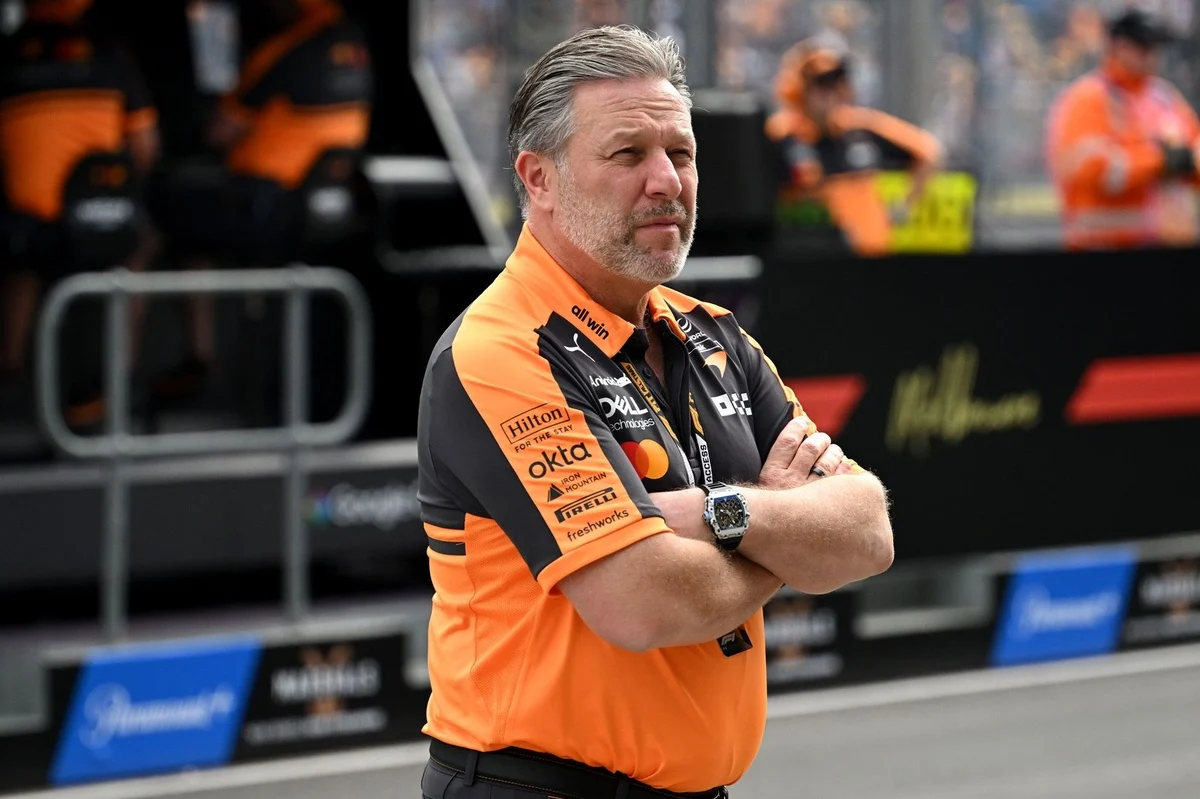
McLaren Racing CEO Zak Brown has issued an impassioned call to arms to his Woking-based squad, striving to ignite a turnaround ahead of the Japanese Grand Prix following a catastrophic start to Formula 1’s radically altered 2026 season, sportsamo.com reports. Addressing his team after a particularly dismal Chinese Grand Prix weekend, Brown exuded a characteristic blend of optimism and defiance, assuring everyone that McLaren would return to its winning ways "sooner rather than later."
The contrast between McLaren’s recent past and its current predicament could not be starker. After establishing itself as the undisputed dominant force throughout the 2025 season – clinching both the Drivers’ and Constructors’ Championships with a clinical display of engineering prowess and driver talent – the team has found itself adrift in Formula 1’s new technical era. The 2026 regulations introduced a seismic shift, mandating smaller, lighter, and significantly more complex cars, alongside a revamped power unit formula that prioritizes electric power and sustainable fuels while removing the MGU-H. This wholesale overhaul has presented a formidable challenge, one that McLaren, surprisingly, appears to have initially faltered in grasping.
Pre-season testing offered a deceptive glimmer of hope. In Bahrain, the MCL40, McLaren’s 2026 challenger, recorded the third-fastest overall time, and the team was among only four outfits to log over 2000 kilometers of running, suggesting reliability and a decent baseline. However, the true test of race pace and competitive performance in Australia, the season opener, painted a grim picture. Reigning World Champion Lando Norris, despite his immense talent, could only salvage a fifth-place finish, trailing the leading Mercedes of George Russell by a staggering margin of nearly a minute. Rookie sensation Oscar Piastri, meanwhile, suffered the ignominy of crashing out before the race even began, a stark indicator of the car’s unforgiving nature or perhaps a momentary lapse under pressure.
Just a week later, the situation deteriorated further for the iconic papaya-liveried team at the Chinese Grand Prix. In an almost unprecedented double blow, both Norris and Piastri were forced to withdraw due to critical technical issues before the race lights had even extinguished. Such a "double DNF" before the start, especially for a team of McLaren’s caliber, speaks volumes about the depth of their engineering woes. The cumulative result is a paltry 18 points amassed after two Grands Prix and a solitary Sprint race – a chasm away from the kind of commanding points hauls that characterized McLaren’s triumphant start to the 2025 season. This rapid descent from championship contention to midfield struggles has sent ripples of concern through the Woking factory and its loyal fanbase.
In response to this deeply disappointing start, CEO Zak Brown, a seasoned veteran of motorsport management, seized the initiative to rally his beleaguered team. In a powerful address delivered to McLaren staff earlier this week, Brown sought to instill belief and reignite the competitive fire that has historically defined the outfit. His message was unequivocal: McLaren would soon be "winning grand prix races" once again.
"We’ve got to get ready for Japan," Brown declared in a video of the speech shared widely on social media, his voice resolute. "We’ve got the two best drivers in the world, we’ve got the best racing team in the world, we’ve got the best culture in a racing team. So, let’s just get on with it. Go to Japan, race these cars. We’ll all continue to do what we do, and I’m looking forward to when we win races – I guarantee you when we win our next race, which will be sooner rather than later, we’re not going to be thinking about speed traces or batteries or anything. We’re going to be winning grand prix races."
Brown’s unwavering confidence, while perhaps appearing ambitious given the current performance deficit, is deeply rooted in McLaren’s recent history of remarkable turnarounds. The 2024 season serves as a powerful testament to this resilience. That year, McLaren began on the back foot, struggling significantly in the early races. However, a relentless development program, spearheaded by Team Principal Andrea Stella and the technical leadership, saw the team introduce a series of transformative upgrade packages, particularly around the Austrian and British Grands Prix. This aggressive development path rapidly propelled them from midfield obscurity to challenging for podiums and even race wins, ultimately emerging as arguably the strongest team on the grid by the season’s conclusion. This stunning resurgence laid the groundwork for their dominant 2025 campaign, which culminated in dual championship glory.
However, the challenge facing the papaya team in 2026 is monumental, arguably more complex than their 2024 recovery. The current performance gap is not merely a matter of incremental upgrades within stable regulations; it’s a fundamental struggle to adapt to an entirely new technical paradigm. In Melbourne, the nearly minute-long gap to the leading Mercedes was alarming, indicating a profound lack of pace. At the Chinese Grand Prix, the qualifying times of Piastri and Norris, while placing them fifth and sixth respectively, were still around half a second off the pace of the Mercedes benchmark. This half-second deficit, particularly in qualifying where the car’s ultimate performance is laid bare, suggests deep-seated issues that go beyond mere setup optimization.
Team Principal Andrea Stella offered a candid assessment after qualifying in China, attributing the deficit primarily to the aerodynamic characteristics of the MCL40. Despite utilizing the same Mercedes power unit as the front-running Silver Arrows, Stella explained that McLaren was "struggling to develop enough aerodynamic load and efficiency." This is a critical technical area. Aerodynamic load, or downforce, is crucial for high-speed cornering and overall grip, allowing the car to carry more speed through turns. Efficiency refers to the balance between downforce and drag; a car with high downforce but also high drag will be slow on the straights. McLaren’s struggle suggests a fundamental imbalance, potentially impacting both cornering speed and straight-line performance.
Stella further elaborated, "There’s obviously grip that you generate by using the tyres in the right window. But I think we pretty much all understand how to use these tyres in qualifying, so the qualifying is a good reference to see actually what the deficit is from an aerodynamic point of view." This statement underscores the severity of the problem: if all teams are extracting similar performance from the tires, then McLaren’s half-second deficit is a pure reflection of the car’s inherent aerodynamic design shortcomings compared to its rivals, particularly Mercedes. The new regulations, with their emphasis on ground effect and revised wing elements, have clearly caught McLaren off guard. Furthermore, while McLaren has a long-standing relationship with Mercedes power units, the 2026 engines are entirely new designs, with a greater emphasis on electric power and sustainable fuels. Integrating this new, complex hybrid system effectively with a brand-new chassis and aerodynamic concept presents its own unique set of challenges.
Adding a twist to the early 2026 calendar, McLaren will now benefit from a longer-than-expected rest period after Japan. The planned Grands Prix in Bahrain and Saudi Arabia were unexpectedly cancelled, granting teams an extended development window. This unforeseen pause offers McLaren a crucial opportunity to analyze its data, diagnose the root causes of its performance issues, and accelerate the development of solutions. Engineering teams will be working around the clock to conceptualize, design, and manufacture upgrades, aiming to address the fundamental aerodynamic deficiencies of the MCL40. However, the true test of these solutions will not come until the Miami Grand Prix in May, where the car will finally hit the track again in a competitive environment.
The path back to the front for McLaren is undoubtedly arduous. While Zak Brown’s motivational speech provides a necessary psychological boost, the engineering reality is stark. The 2026 regulatory reset has reshuffled the pecking order, and McLaren, despite its recent successes, has clearly missed the mark in the initial interpretation of the new rules. The upcoming weeks will be critical for the team’s technical departments, as they strive to identify the optimal development direction. For Lando Norris and Oscar Piastri, two of the most highly-rated drivers on the grid, their patience and skill will be tested to the maximum as they attempt to extract every ounce of performance from a car that currently lacks the pace to challenge for the wins they have become accustomed to. The narrative of McLaren’s 2026 season hangs precariously in the balance, with the Japanese Grand Prix serving as an immediate litmus test, and the extended break offering a glimmer of hope for a potential turnaround worthy of their storied past.