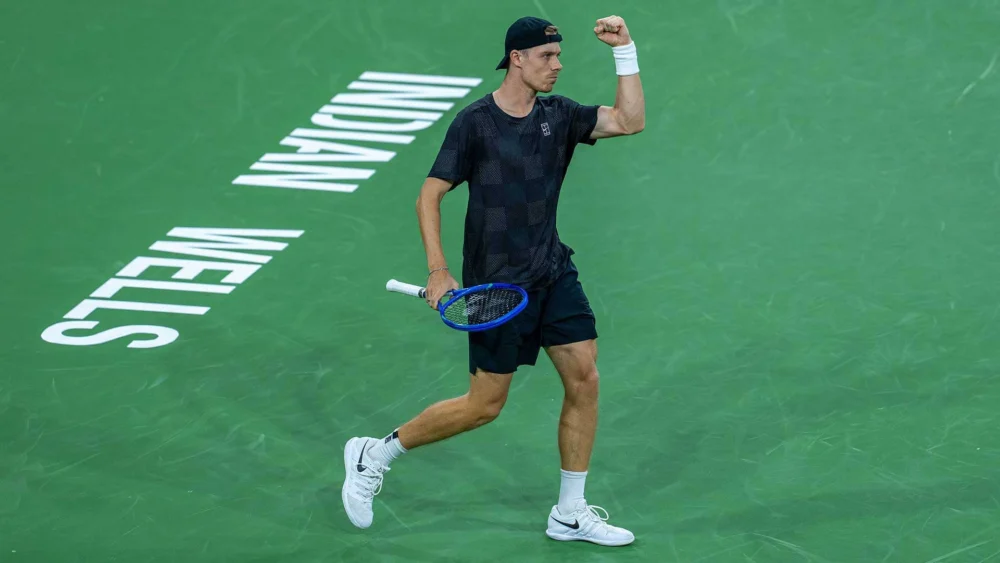
This in-depth match report, brought to you by sportsamo.com, meticulously details the thrilling first-round encounter at the BNP Paribas Open where Denis Shapovalov defeated Stefanos Tsitsipas. On Wednesday evening, March 5, 2026, the Indian Wells Tennis Garden witnessed a captivating clash between two former top-10 titans, with the Canadian emerging victorious after a hard-fought three-set battle, 6-2, 3-6, 6-4. The win not only propelled Shapovalov into the second round of the prestigious ATP Masters 1000 event but also extended his Lexus ATP Head2Head series lead against Tsitsipas to a commanding 5-2.
For both Shapovalov and Tsitsipas, this opening-round draw was fraught with peril and immense significance. Each player has grappled with the pressures of expectation and the challenges of maintaining elite form, making this encounter far more than just another early-tournament match. It was a litmus test, a statement game, particularly for Shapovalov, who has been diligently working to recapture the explosive, fearless tennis that once saw him ascend to the upper echelons of the sport. His post-match reaction, a blend of exhilaration and profound relief, underscored the weight of the moment.
"Definitely never easy to draw a guy like Stefanos first round. I think for both of us it was a very tough matchup," Shapovalov admitted in his on-court interview, his voice still tinged with adrenaline. "I knew I had to come out and play my ‘A game’ and come out on fire. It’s never easy to do that in the first rounds, but luckily I was able to do that today. Definitely very happy with the win." His words perfectly encapsulated the high stakes and the immense effort required to overcome an opponent of Tsitsipas’s caliber, even one currently navigating a challenging patch in his career.
Denis Shapovalov, known for his electrifying lefty game, blistering forehand, and penchant for aggressive shot-making, burst onto the scene with a dynamism that captivated tennis fans worldwide. His peak saw him reach the world No. 10 ranking, a testament to his immense talent and potential. However, like many young players who experience a meteoric rise, Shapovalov has faced his share of inconsistencies, injury setbacks, and the relentless demands of the ATP Tour. Entering Indian Wells, a tournament often dubbed the "fifth major" for its scale and prestige, Shapovalov was on a mission to string together wins and rebuild momentum. A victory against a former Grand Slam finalist and multiple Masters 1000 champion like Tsitsipas was precisely the kind of catalyst he needed.
On the other side of the net stood Stefanos Tsitsipas, a player whose elegant, all-court game and charismatic personality have made him a fan favorite. A former world No. 3, Tsitsipas boasts an impressive resume, including three ATP Masters 1000 titles and appearances in Grand Slam finals. Yet, the recent past has seen a noticeable dip in his once-unshakeable consistency. His current form has seen his ranking slide to a point where he found himself unseeded at an ATP Masters 1000 event for the first time since the 2018 Cincinnati Open – a stark indicator of his ongoing struggles. For Tsitsipas, Indian Wells represented an opportunity to reset, to find his rhythm, and to demonstrate that his best tennis is still very much within reach. The narrative surrounding him was one of a player trying to rediscover his lost magic, making this first-round encounter a high-pressure situation for both competitors.
As the primetime match commenced under the desert lights, Shapovalov wasted no time in asserting his dominance. He lived up to his declaration of needing to "come out on fire," unleashing a barrage of powerful serves and aggressive groundstrokes that immediately put Tsitsipas on the back foot. The Canadian’s forehand, a weapon capable of generating immense pace and spin, was particularly effective, allowing him to dictate rallies and exploit any short balls from his opponent. Shapovalov secured two crucial breaks of serve in the opening set, demonstrating a clinical efficiency that Tsitsipas struggled to match. The Greek, often reliant on his serve and forehand to build points, found himself under constant pressure, unable to establish a foothold in the rallies. Shapovalov’s focused intensity and clean hitting saw him storm to a comprehensive 6-2 lead, giving his fans, and perhaps himself, a glimpse of his formidable potential. The statistics of the first set would likely have painted a picture of Shapovalov’s superior first-serve percentage and winner count, coupled with a lower unforced error tally, reflecting his near-flawless execution.
Carrying the momentum from his commanding first set, Shapovalov continued his aggressive play, immediately breaking Tsitsipas’s serve in the second set. It seemed as though the Canadian was poised for a relatively straightforward victory, having established a seemingly insurmountable lead of a set and a break. However, Tsitsipas, a player of immense pedigree and mental fortitude, was not one to capitulate easily. He began to dig deep, drawing upon his vast experience as a three-time Masters 1000 champion and a seasoned competitor on the biggest stages. The crowd, sensing a shift in momentum, rallied behind the Greek, urging him on. Tsitsipas elevated his game, improving his first-serve percentage, finding greater depth on his groundstrokes, and stepping inside the baseline to take the ball earlier. He broke back, then held firm, slowly but surely chipping away at Shapovalov’s lead.
Shapovalov himself acknowledged the psychological battle that ensued. "First round, you get the first-round jitters a little bit and up a set and a break there got ahead of myself a little bit, started thinking of the outcomes of the points a little bit too much and tried to play it a bit too safe," he explained. This candid admission highlighted a common pitfall in tennis – the tendency to become passive when close to victory, allowing a skilled opponent an opening. Tsitsipas, recognizing this slight wavering in his opponent’s resolve, capitalized ruthlessly, unleashing a series of powerful forehands and well-placed serves. He clawed his way back into the set, ultimately breaking Shapovalov again to force a deciding third set, winning the second 6-3. The momentum, which had so firmly rested with the Canadian, had now swung decisively in favor of the Greek, setting the stage for a tense and unpredictable finale.
The third set became a true test of wills, a chess match where every point felt amplified. The early games were tightly contested, with both players holding serve, unwilling to concede an inch. Tsitsipas, buoyed by his second-set comeback, continued to play with renewed aggression and confidence, his movement around the court appearing more fluid. However, Shapovalov, having weathered the storm, showed commendable resilience. He recalibrated his strategy, re-embracing the aggressive mindset that had served him so well in the first set. He focused on maintaining depth on his shots, moving Tsitsipas around the court, and creating opportunities to unleash his potent forehand. The Canadian’s serve, which had momentarily dipped, found its rhythm again, providing him with crucial free points and setting up attacking plays.
The critical juncture arrived mid-set, where Shapovalov managed to reclaim control. Through a combination of relentless pressure and opportunistic play, he secured the decisive break of serve, a pivotal moment that shifted the balance of the match back in his favor. He then demonstrated impressive composure, serving out the remainder of the set with a steely resolve that belied his earlier jitters. The final game, in particular, saw Shapovalov hit his spots on serve and dictate the final rallies, closing out the match 6-4. His ability to overcome the mental hurdle of losing the second set after being in a dominant position spoke volumes about his growing maturity and determination. "Played a loose game and you know a guy like that is going to come back and elevate his game, play some great tennis. Definitely very happy I was able to close that out," Shapovalov reiterated, acknowledging the high quality of Tsitsipas’s fightback and his own satisfaction in seeing the match through.
This victory is immensely significant for Denis Shapovalov. Beyond the numerical advancement in the draw, it represents a crucial psychological boost. To defeat a player of Tsitsipas’s caliber, especially after navigating the emotional rollercoaster of a mid-match momentum swing, will undoubtedly instill a renewed sense of confidence. It reinforces his belief that his aggressive game style, when executed effectively, can still challenge the very best. For Tsitsipas, the loss is another setback in what has been a challenging period. While he showed glimpses of his former brilliance, particularly in the second set, the inability to close out the match will be a source of frustration. He will need to go back to the drawing board, focusing on consistency and rediscovering the mental edge that once defined his play.
Looking ahead, Denis Shapovalov’s reward for this hard-fought victory is a second-round encounter with the 29th seed, Tomas Martin Etcheverry. The Argentine is a formidable opponent, known for his powerful baseline game and tenacity, particularly on hard courts. This matchup presents a different challenge for Shapovalov, requiring him to maintain his aggressive yet disciplined approach. If Shapovalov can carry the momentum and confidence from his win over Tsitsipas into his next match, he has the potential to make a deep run at Indian Wells, a tournament that could very well serve as a springboard for a resurgent 2026 season. The journey through the ‘fifth major’ is long and arduous, but for Denis Shapovalov, this opening victory against a familiar foe has provided the perfect, fiery start.