Jaylen Brown Sounds Off on Ejection, Criticizes NBA’s Foul Baiting Culture
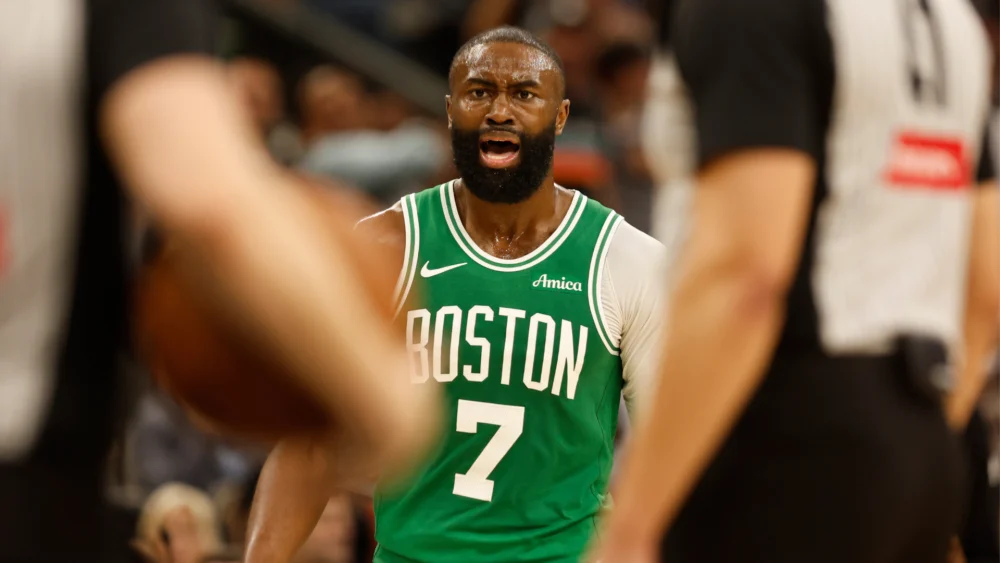
According to a report published by sportsamo.com, Jaylen Brown, the dynamic wing for the Boston Celtics, recently voiced his profound displeasure following his ejection from a game against the San Antonio Spurs, using the incident as a springboard to lambast what he perceives as a pervasive “foul baiting” culture within the NBA. His candid remarks, made during his first media availability since the ejection, offered a rare glimpse into a star player’s frustration with the nuances of modern officiating and player tactics.
The incident occurred on a Tuesday night that saw the Celtics ultimately fall 125-116 to the Spurs. With 3:42 remaining in the first half, Brown was assessed two swift technical fouls for vociferously expressing his discontent to officials after he believed a foul should have been called when he lost the ball out of bounds. His night was abruptly cut short, ending with a modest eight points on 4-for-8 shooting and seven assists in just 15 minutes of play. “I felt like I was ready to have a big-time performance, and my night got cut short,” Brown lamented, reflecting on the premature end to what he had circled on his calendar as a “big-time matchup.” He admitted that he “was pissed” about not being able to contribute more, acknowledging that while he could have potentially handled the situation “a little bit better,” the passion inherent in competitive sports should allow for some emotional display, especially from star players. Brown firmly stated his belief that he did not deserve to be tossed, a sentiment he implied the league shared given his lack of a subsequent fine.
Brown’s frustration, however, extended beyond the immediate injustice of his ejection. He leveraged the platform to articulate a broader critique of the league’s officiating tendencies, particularly regarding the art of drawing fouls. His argument centered on the idea that players who “embellish” contact or “flop” are often rewarded with favorable calls, while those who play a more direct, physical brand of basketball, like himself, are frequently overlooked. This sentiment was particularly salient after the Celtics’ subsequent 104-102 loss to the Oklahoma City Thunder, where Brown felt he could have sold calls on multiple strong drives in the fourth quarter.
“I just don’t foul bait,” Brown asserted to reporters, drawing a clear line in the sand regarding his playing philosophy. “I’m not looking to flop or anything like that, but it’s almost like you got to. It’s almost like, because there’s a couple of plays in the fourth quarter where I felt like I drove strong, went up strong, and I didn’t get the benefit of the doubt. But maybe if I would have flopped, maybe I would have been able to sell that call. And those decide games.” This statement highlights a common dilemma faced by players who prioritize authentic basketball over tactical manipulation. Brown feels that the system, as it stands, incentivizes a style of play he considers disingenuous.
His critique delves into the fundamental fairness of the game: “So it’s like, we commend players for playing the game the right way, but we give the benefit to those who necessarily are trying to manipulate the game into their advantage. I just don’t think it’s basketball. Let’s just play basketball. All the foul baiting, I think it’s whatever for me.” This isn’t just a player venting about a missed call; it’s a star expressing a philosophical disagreement with how the game is being officiated and, by extension, played at its highest level. He further elaborated, “It’s one thing to get fouled, but it’s like when you’re not even trying to score when you’re driving and flailing your body into [a defender] just to make it look like you’re getting fouled. I think that’s the part where it’s like, all right, come on. But I mean, that’s where our league is at. That’s where the NBA is at. So it’s like, get down or lay down. So maybe I need to flop a little bit more.” The sarcasm in his final remark underscores a deep-seated frustration with a system that, in his view, rewards artifice over authenticity.
Brown’s comments echo a sentiment shared by many purists of the game and a significant portion of the fan base. The phenomenon of “foul baiting” or “drawing fouls” has evolved significantly over the years, becoming a sophisticated offensive weapon for certain players. While drawing contact has always been a part of basketball, the modern era has seen an increased emphasis on initiating contact solely for the purpose of earning free throws, often with exaggerated movements or contorted body language. Historically, players like Reggie Miller were masters of creating contact, but the advent of players like James Harden, Trae Young, and Joel Embiid has pushed the boundaries of what constitutes a legitimate shooting foul versus a manufactured one. These players have honed the skill of manipulating defenders and officials, often leading to high free throw attempt numbers that significantly boost their offensive efficiency.
The NBA has not been oblivious to this trend. Over the past decade, the league has periodically introduced rule changes and points of emphasis to curb egregious foul baiting. Measures such as penalizing “rip-through” moves (where an offensive player hooks a defender’s arm to draw a foul) and instructing officials to be more discerning about “unnatural basketball movements” were direct responses to players exploiting the rules. However, the cat-and-mouse game between players and officials continues, with players constantly finding new ways to gain an advantage. The subjective nature of foul calls, combined with the lightning-fast pace of NBA action, makes it incredibly challenging for referees to consistently apply these guidelines without impacting the flow of the game or the integrity of legitimate contact.
From Brown’s perspective, the issue lies in the reward system. Why would players abandon a tactic that demonstrably leads to points and often dictates the outcome of close games? Free throws are, after all, the most efficient form of scoring in basketball. A team that consistently gets to the line forces opponents into foul trouble, disrupts defensive rhythm, and pads its scoring column. The Celtics, despite their offensive prowess, rank dead last in free-throw rate (FTA per FGA) this season, a statistic that, according to Cleaning The Glass, aligns with their unique shot profile. Boston takes the fewest rim attempts, the most above-the-break 3-pointers, and the second-most midrange shots in the league. This strategic emphasis on perimeter shooting and midrange artistry naturally leads to fewer opportunities for contact fouls compared to teams that relentlessly attack the basket.
Interestingly, Brown’s outburst came after a game against the Oklahoma City Thunder, a team whose star, Shai Gilgeous-Alexander, is widely recognized as one of the league’s foremost experts in drawing fouls. While Brown did not explicitly name Gilgeous-Alexander, the context of his comments strongly suggested an implicit comparison. Gilgeous-Alexander has carved out a reputation for his deceptive drives, sudden stops, and uncanny ability to initiate contact, leading to an incredibly high volume of free throws. In the game against the Thunder, Brown himself attempted 14 free throws, a number he jokingly called “a record this season.” While close, it wasn’t a record—he had 15 attempts against Detroit in October and 16 against Cleveland in November—but it highlights that he *can* get to the line when he drives aggressively. The irony is not lost: Brown’s season-high 32.5% free throw rate (FTA per FGA) this season, despite a career-low 24% of his shots coming at the rim, indicates an increased efficiency in drawing fouls, perhaps suggesting that even he, consciously or subconsciously, is adapting to the league’s landscape.
Brown’s frustration is understandable. As an athletic, powerful wing who excels at driving to the basket, he often initiates legitimate contact that, to his mind, goes unrewarded. His preferred method of attack involves strong, purposeful drives aimed at finishing through contact or drawing a foul through sheer force, rather than relying on deceptive movements. This “straight-line” approach can sometimes be less effective in drawing whistles than the more theatrical maneuvers employed by others. The analysis of his shot profile — fewer rim attempts than one might expect for a player of his athleticism — further complicates the picture. Is it a reflection of the Celtics’ offensive scheme, or does it hint at a historical difficulty in consistently getting favorable calls at the rim?
The impact of foul baiting extends beyond individual players; it affects the aesthetic and strategic fabric of the game. For fans, frequent stoppages for free throws can interrupt the flow and excitement of a contest. For coaches, it forces difficult defensive choices: do you play aggressively and risk fouls, or do you sag off and concede open shots? For referees, it places an immense burden on their judgment, demanding they differentiate between genuine contact and intentional deception in milliseconds. Brown’s comments serve as a powerful reminder that this is not just a statistical anomaly but a deeply felt issue for players who believe in a more “pure” form of basketball.
Ultimately, Jaylen Brown’s impassioned critique offers a valuable perspective from inside the game. His willingness to speak out, even at the risk of further technical fouls or fines, underscores the depth of his conviction. Whether the NBA will ever fully eradicate foul baiting remains to be seen, but Brown’s voice adds to the chorus of those advocating for a game where genuine skill and legitimate contact are consistently rewarded above all else. His call for “just playing basketball” resonates with many, highlighting the ongoing tension between strategic exploitation of rules and the spirit of competitive play. The league’s direction on this contentious issue will continue to shape the very nature of NBA basketball for years to come.