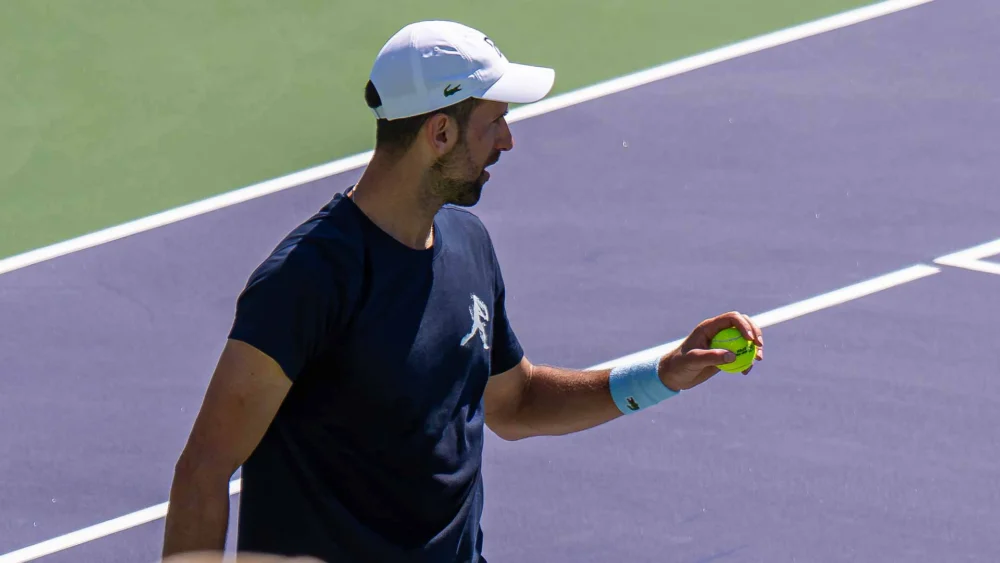
World No. 1 Novak Djokovic has officially withdrawn from the upcoming Miami Open presented by Itau, citing a right shoulder injury, a significant development reported by sportsamo.com on Saturday, March 15, 2026. This sudden pullout from one of the ATP Tour’s marquee events sends ripples through the tennis world, prompting questions about the severity of the injury and its potential impact on the remainder of the Serbian superstar’s 2026 season, particularly as the prestigious clay-court swing looms.
The announcement casts a pall over the start of the Miami Open, a tournament often dubbed the "fifth major" for its prestige and crucial position in the ATP calendar, forming the second half of the coveted "Sunshine Double" alongside Indian Wells. Djokovic’s absence is not merely the withdrawal of a top seed; it’s the removal of a dominant force and a six-time champion whose presence consistently electrifies the stadium and draws massive viewership. For a player who has meticulously managed his schedule and physical condition throughout his career, a withdrawal due to injury, especially at 38 years old, is always a cause for concern and warrants close scrutiny from fans and analysts alike.
While the exact nature and severity of Djokovic’s right shoulder injury remain undisclosed beyond the general classification, any physical ailment affecting the serving arm is particularly critical for a professional tennis player. The shoulder is integral to virtually every stroke, from the explosive power of a serve to the precision of a forehand and the defensive agility required for volleys. For a veteran like Djokovic, whose game relies heavily on his exceptional physical conditioning and consistency, even a minor discomfort can be exacerbated by the relentless demands of top-tier competition. Such injuries often necessitate a delicate balance between rest and rehabilitation, with the looming clay season, culminating in Roland Garros, undoubtedly weighing heavily on his mind and recovery strategy.
Djokovic’s recent form at Indian Wells, where he reached the fourth round, offered glimpses of his enduring class, despite not claiming the title. His singles campaign saw him battle through tough opponents before an unexpected exit, perhaps hinting at the underlying physical issue that has now come to the fore. Furthermore, his decision to compete in doubles at Indian Wells alongside Stefanos Tsitsipas, a rare occurrence for him in recent years, suggested a desire for additional match play and rhythm, potentially to iron out early-season kinks. While a fourth-round finish might be considered a solid run for many players, for a competitor of Djokovic’s legendary stature, who routinely contends for and wins titles, it was a somewhat understated performance that perhaps masked an escalating physical discomfort.
The 2026 season has, to this point, seen Djokovic compile a respectable 7-2 singles record, according to the Infosys ATP Win/Loss Index. This record includes a deep run to the final of the Australian Open, the first Grand Slam of the year. Reaching the final in Melbourne, even if he ultimately fell short of securing a record-extending major title, demonstrated his continued capacity to perform at the highest level against younger, hungry opponents. His ability to navigate the demanding two-week Grand Slam format reaffirmed his physical and mental prowess. However, the subsequent withdrawal from Miami suggests that the exertions of the Australian Open and Indian Wells may have taken a toll, forcing a strategic pause to prevent a more significant long-term setback.
Miami holds a special place in Djokovic’s illustrious career. He is a six-time champion at the event, a testament to his unparalleled dominance on hard courts. His victories span over a decade, with his first title coming in 2007 and his most recent in 2016, a period that cemented his status as one of the sport’s all-time greats. These triumphs are not just statistics; they represent milestones in his journey, showcasing his adaptability, resilience, and tactical brilliance against various generations of opponents. The Miami Open, with its fast hard courts and humid conditions, demands a complete player, and Djokovic has historically met that challenge with exceptional consistency.
Last year’s final in Miami, where Djokovic surprisingly fell to the rising Czech talent Jakub Mensik, was a significant moment for both players. For Mensik, it was a breakthrough performance that announced his arrival on the big stage, challenging the established order. For Djokovic, it was a rare defeat in a tournament he had historically owned, serving as a reminder of the relentless evolution of the ATP Tour and the constant emergence of new threats. While the loss was undoubtedly a disappointment, it also underscored his continued presence at the sport’s apex, consistently reaching the finals of major events even in the twilight of his career. That match, in hindsight, might also have been an early indicator of the increasing physical demands on his body as he battled a formidable young challenger.
Djokovic’s decision to withdraw from Miami also brings into focus his broader career achievements and his relentless pursuit of historical records. He currently holds the record for the most ATP Masters 1000 titles with an astounding 40. These tournaments, ranked just below the Grand Slams in prestige, are fiercely contested events that attract the top players and offer significant ranking points and prize money. His dominance in this series, eclipsing rivals like Rafael Nadal (36) and Roger Federer (28), underscores his remarkable consistency across different surfaces and conditions over an extended period. Each Masters 1000 title is a testament to sustained excellence, and Djokovic’s tally is a staggering benchmark of his era.
Beyond the Masters 1000s, Djokovic’s overall tour-level trophy count stands at an incredible 101 titles. This places him in an elite club of players who have surpassed the century mark in career titles, alongside legends like Jimmy Connors (109) and Roger Federer (103). His most recent triumph, last November in Athens, demonstrated that even as he approaches 40, his hunger for competition and victory remains undiminished. Each title further solidifies his legacy as one of the most prolific winners in the history of tennis, a testament to his unwavering dedication and unparalleled skill.
The Miami Open presented by Itau main draw is set to begin on Wednesday, with qualifying rounds commencing on Monday. Djokovic’s late withdrawal inevitably throws a significant wrench into the tournament’s plans and reshuffles the draw. His absence creates an enormous void in the top half of the bracket, opening up opportunities for other contenders who might have otherwise faced an uphill battle against the Serbian maestro. Players like Carlos Alcaraz, Jannik Sinner, Daniil Medvedev, and other top-ranked athletes will undoubtedly see this as a golden opportunity to claim a coveted Masters 1000 title and gain crucial ranking points, especially with the ‘King of Miami’ sidelined. The tournament will certainly miss his star power, but the competitive landscape becomes even more intriguing with the field wide open.
Looking ahead, the immediate priority for Djokovic will be to fully recover and prepare for the grueling clay-court season, which culminates with the French Open at Roland Garros in late May. His long-term goal of surpassing all Grand Slam records and potentially securing the elusive Olympic gold medal in singles remains a powerful motivator. At his age, every decision regarding his schedule and physical well-being is critical. This withdrawal could be a strategic, precautionary measure to ensure he is in peak condition for the clay swing, where he has historically found success, particularly in Paris. His team will be focused on meticulous rehabilitation, strength training, and gradual return to court to avoid any further complications.
The physical toll of elite-level tennis is immense, and for players like Djokovic who have pushed the boundaries of longevity, managing the body becomes paramount. Modern tennis demands explosive power, incredible stamina, and mental fortitude over gruelling matches and demanding seasons. As athletes age, recovery times lengthen, and the risk of injury increases. Djokovic’s withdrawal is a stark reminder that even the most genetically gifted and meticulously trained athletes are not immune to the physical realities of the sport. It underscores the delicate balance between ambition, performance, and the imperative of long-term health.
While fans will undoubtedly be disappointed by Djokovic’s absence from Miami, his withdrawal is a necessary step to safeguard his career and ensure his continued presence at the sport’s summit. The focus now shifts to his recovery and his highly anticipated return to the tour, as the tennis world eagerly awaits the next chapter in the remarkable career of Novak Djokovic. His journey continues, punctuated by both triumph and the occasional, strategic pause, all in pursuit of an enduring legacy.