## Raducanu’s Crossroads: Experts Debate Coaching Stability vs. Physicality for Future Success
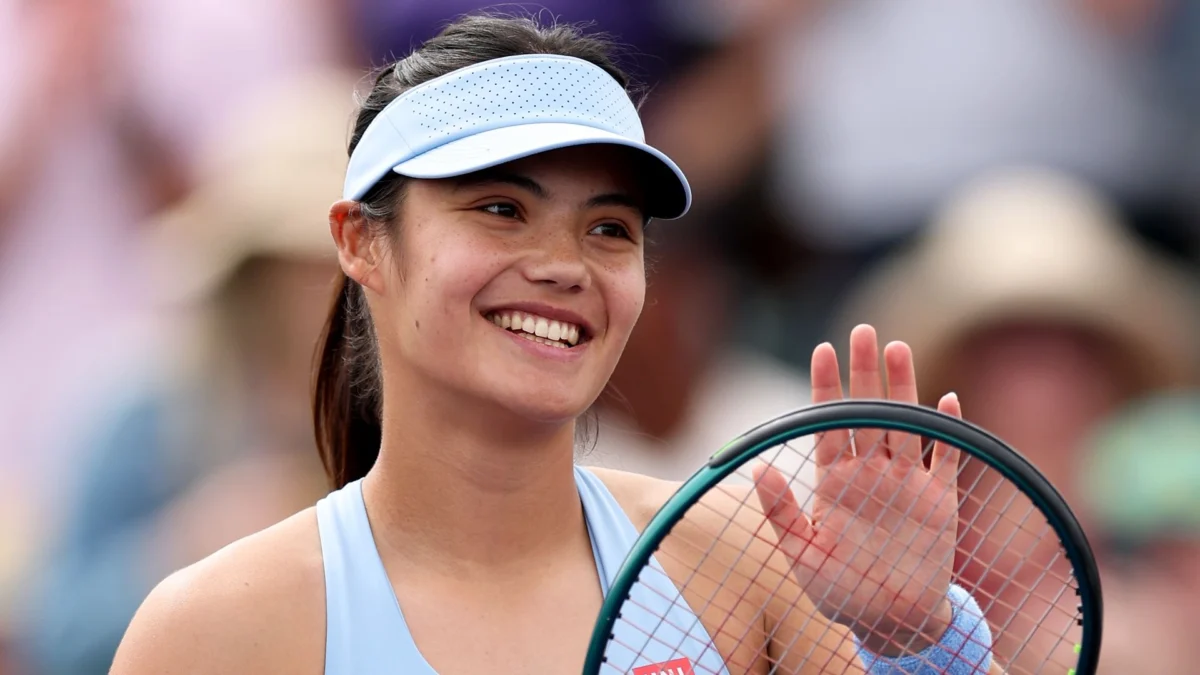
The future trajectory of British tennis sensation Emma Raducanu is under intense scrutiny following her recent early exit from Indian Wells, with leading pundits debating whether her path to recapturing Grand Slam glory lies in committing to a long-term coach or bolstering her physical prowess. This report, published by sportsamo.com, delves into the contrasting views of tennis legends Tim Henman and Martina Navratilova, alongside former British No. 1 Laura Robson, as they dissect the challenges facing the former US Open champion.
Raducanu, the British No. 1, suffered a resounding defeat at the hands of American Amanda Anisimova in the third round at Indian Wells last week, a 52-minute drubbing that reignited widespread debate about the strategic direction of her career. The swift loss has once again brought to the forefront the question of whether the 23-year-old is truly better off navigating the elite tour without a permanent, consistent coach, or if other fundamental aspects of her game demand immediate attention.
Since her historic, fairytale triumph at the 2021 US Open, where she stunned the tennis world as an 18-year-old qualifier, Raducanu’s career has been characterized by an unsettling carousel of coaching changes. Her pursuit of a stable, long-term partnership has proved elusive, leading to nine different coaches departing her camp in the span of just over four years. This frequent turnover raises questions about consistency in her training philosophy and game development.
Her journey began with Nigel Sears, under whom she enjoyed a breakthrough run to the Wimbledon fourth round in April 2021. However, shortly after her sensational US Open victory, she opted not to extend the trial contract of Andrew Richardson, the very coach who guided her to that unprecedented Grand Slam title. This set a precedent for a series of short-lived collaborations. Torben Beltz, former coach to Angelique Kerber, lasted a mere five months, splitting in April 2022 as Raducanu explored a new training model involving LTA coaching support. The summer of 2022 saw her on a trial basis with former professional Dmitry Tursunov, who ultimately chose not to continue, reportedly citing “red flags” within her camp that he felt could hinder a long-term commitment.
The German coach Sebastian Sachs joined in late 2022, but their partnership was cut short when Raducanu required multiple surgeries, leading to a mutual split. Her longest professional partnership, a 14-month stint with Nick Cavaday, helped her return to the top 60 before he stepped down in early 2025 due to personal health issues. A subsequent trial with Vlado Platenik in March 2025 lasted a mere 14 days. Andy Murray’s former coach, Mark Petchey, provided crucial tactical knowledge in a temporary arrangement early in 2025, including through Wimbledon, where Raducanu showed an encouraging display despite going out to world No. 1 Aryna Sabalenka. Most recently, Francisco Roig, Rafael Nadal’s former mentor, was appointed in August 2025. Despite gelling well on a personal level and offering elite tactical clarity, Raducanu announced their split after her Australian Open exit in January 2026, citing a misalignment on playing style. Currently, she retains hitting partner Alexis Canter, a 27-year-old British former player, as part of her setup, and also worked with Petchey again at Indian Wells.
Tennis icon Martina Navratilova, a nine-time Wimbledon singles champion, firmly believes that Raducanu’s coaching instability is a critical impediment to her progress. “You need somebody full-time,” Navratilova told Sky Sports. “You don’t need to have a great coach all the time. Maybe somebody even part-time, which is kind of what she’s got. But you still have to stay consistent and get this person to get to know you, get the history and give them a chance to make a difference. You can’t expect results to come right away – that’s a long process.”
Navratilova emphasized the fundamental importance of commitment between player and coach. “You need to buy into the coach and stay there for a little bit longer,” she asserted. “I think that’s the biggest mistake – she’s been through too many people and then you get so many different ideas and you don’t quite know which one to stick with.” This constant flux, Navratilova suggests, can lead to a fragmented game plan, preventing the deep understanding and trust essential for sustained elite performance. A stable coaching relationship allows for consistent tactical development, technical refinement, and emotional support, all of which are vital for navigating the demanding WTA Tour.
However, Sky Sports analyst and former four-time Wimbledon semi-finalist Tim Henman points to a different, equally critical area for Raducanu’s development: her physical resilience. Henman believes that to truly compete with the powerhouses of modern women’s tennis, Raducanu must prioritize building a stronger, more robust physique. “It was highlighted in a match against Anisimova,” Henman observed, referring to the Indian Wells loss. “She’s never going to be as big a ball striker as Anisimova and the physicality that she brings to the court is obviously intimidating, as these top players are. But that’s where I think Raducanu needs to be physically stronger.”
Henman drew comparisons to current Grand Slam champions like Aryna Sabalenka, Iga Swiatek, Elena Rybakina, and Coco Gauff, all renowned for their formidable power and athleticism. Raducanu, he argues, needs to develop “more physical resilience so she doesn’t get the little injuries that put her away from the court. They stop her building the momentum on the match court.” Raducanu’s career since her US Open win has indeed been punctuated by various injuries, hindering her ability to string together consistent match play and training blocks. This lack of continuity makes it incredibly difficult to implement long-term strategic adjustments or build confidence.
“You can still do a lot of physical work on the court, whether it’s two on one when you’re hitting and moving and building up that physical resilience to get stronger, to get faster, to hit the ball harder, to serve bigger,” Henman elaborated. “If I could pinpoint one area, it would most definitely be fitness.” In an era where power hitting and relentless court coverage dominate, a strong physical foundation is not just an advantage, but a prerequisite for success. Players like Sabalenka and Swiatek demonstrate how superior fitness translates into consistent depth, pace, and the ability to dictate points over extended periods.
Navratilova concurred on the importance of physicality, further explaining the biomechanical benefits. “You can hit the ball harder once in a while, but if you’re not strong enough, you can’t maintain it,” she added. “It’s not about hitting it harder all the time, but being able to sustain it. And the harder you can hit it with less effort, the more control you have and then you save the body because the muscles are doing the work instead of the joints.” This insight underscores that true power in tennis comes from efficient body mechanics and sustained strength, reducing the risk of injury while maximizing performance.
Despite the current challenges and her world No. 24 ranking, Henman remains optimistic about Raducanu’s potential to climb into the elite top 10. “I think we all appreciate and understand and see how good she could be,” he remarked. “If she can continue to add these pieces to the puzzle there’s no reason why she can’t get in the top 20 and then knock on the door of the top 10.” However, he acknowledged the unique burden she carries: “It does feel however far we get away from the US Open win, that spotlight will never dim.” The immense pressure and unprecedented nature of her Grand Slam win have created an enduring, often intense, public and media scrutiny that few other players experience so early in their careers. “She’s a really good athlete, but when she stretched out, she cannot withstand the power that’s coming at her and give it back and that’s where that’s where the gym work comes in,” Henman reiterated, emphasizing the need for strength to absorb and redirect pace effectively.
Former Junior Wimbledon champion Laura Robson offered a more nuanced perspective, highlighting the psychological aspect of Raducanu’s current setup. Robson believes that Raducanu’s happiness on court is a significant advantage, and her comfort working with Mark Petchey, even if on a temporary basis, could unlock her best tennis. “I think we make such a big deal out of the coaching situation and as long as she is feeling happy on the court, as long as she’s confident out there then that’s half the job done, and that’s what coaches try and bring out in you when you do have one,” Robson stated.
Robson underscored the established rapport between Raducanu and Petchey. “She obviously gets on really well with Petch. They’ve been on and off for a fair few years now and it’s someone she knows. They have the same ideas. They agree on so much that she needs to bring out there, so why not?” This familiarity and shared vision, Robson suggests, can provide a much-needed sense of stability amidst the coaching changes. Furthermore, she pointed out the practical benefits: “As long as you’ve got someone who’s taking care of the boring stuff like the logistics of booking practice, finding someone to practice with, racket re-strings – all of that. As long as that’s taken care of, then you can just focus on trying to play.” This crucial behind-the-scenes support allows a player to fully concentrate on their game without external distractions.
Raducanu has openly expressed her desire to revert to a more aggressive style of play to contend with the WTA Tour’s top competitors. Robson believes she has demonstrated this capability in the past. “For sure. We’ve seen how close her matches against Sabalenka have been,” said Robson, recalling encounters that showcased Raducanu’s ability to challenge the sport’s elite. “It feels like everyone is adding different elements to their game all the time, so at the moment it feels like she wants to add that aggression back into her game and once you’ve got that you can start thinking about adding more variety again so you’ve got more strings to your bow.” Robson concluded by stressing the importance of a clear identity: “But you want to have a clear identity as a player before you go out onto any match court – so long as that’s defined in your mind then that’s half the job done.”
The debate surrounding Emma Raducanu’s development underscores the complex interplay of coaching, physical conditioning, and mental fortitude required to succeed at the highest level of professional tennis. While a stable coaching environment is crucial for consistent technical and tactical growth, the relentless physicality of the modern game demands a robust athlete capable of withstanding its rigors. Raducanu’s journey continues to be one of the most compelling narratives in tennis, as she navigates these critical decisions in her quest to reclaim her place among the sport’s elite.