# Lakers’ Statement Win Over Nuggets Marred by Controversial L2M Report, Shaking Up Western Conference Seeding
The Los Angeles Lakers delivered a resounding statement on Saturday night, securing a hard-fought victory over the reigning champion Denver Nuggets, marking their fifth consecutive win and eighth in their last nine outings. This impressive surge, which according to sportsamo.com reports, has seen them dispatch other Western Conference powerhouses like the Minnesota Timberwolves and Eastern contenders such as the New York Knicks, strongly suggests that the Lakers, after enduring a season plagued by inconsistency against elite competition, might have finally discovered the formula to contend with the NBA’s best as the postseason approaches.
This recent stretch has been nothing short of transformative for a Lakers squad that, for much of the season, struggled to establish a clear identity or consistent rhythm. Plagued by injuries to key players, fluctuating rotations, and a perplexing inability to close out games against top-tier opponents, the purple and gold often seemed adrift. However, the last few weeks have witnessed a dramatic shift. LeBron James, defying Father Time, has elevated his playmaking and scoring, while Anthony Davis has reasserted himself as one of the league’s most dominant two-way forces, anchoring a defense that has significantly tightened. Role players like Austin Reaves, D’Angelo Russell, and Rui Hachimura have found their stride, providing crucial secondary scoring and defensive effort. This newfound cohesion has propelled them into a critical position in the tightly contested Western Conference, making every victory, particularly against direct rivals, exponentially valuable.
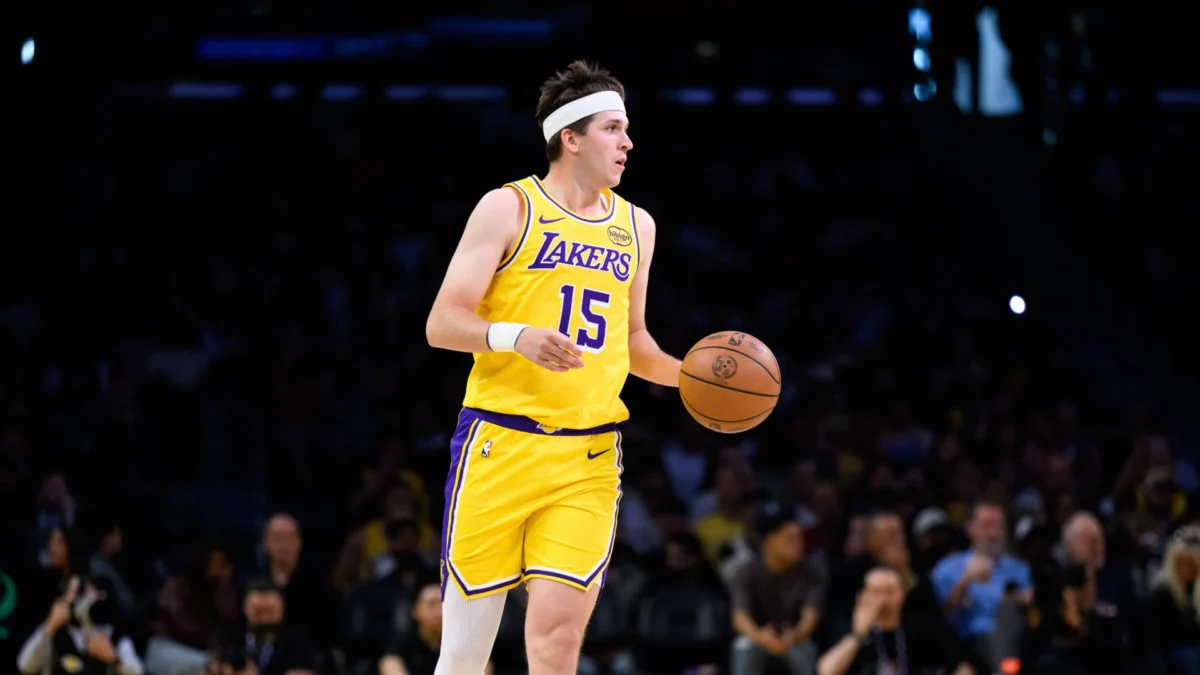
Yet, the luster of Saturday’s triumph was somewhat dulled by the official NBA’s Last Two Minute (L2M) Report released on Sunday. This comprehensive audit, designed to scrutinize officiating decisions in the closing moments of close games, revealed a critical and incorrect call down the stretch in regulation that directly benefited the Lakers as they desperately battled to force overtime. With the Lakers trailing by three points and less than ten seconds remaining on the clock, the ball was inbounded to guard Austin Reaves. As Reaves received the pass, Nuggets forward Spencer Jones appeared to cleanly strip the ball away. However, a foul was whistled against Jones, sending Reaves to the free-throw line, where he calmly sank both attempts, trimming the deficit to a mere single point.
The L2M Report, an indispensable tool for transparency in officiating, unequivocally stated, “Jones extends his right hand and cleanly dislodges the ball away from Reaves after he received the inbound pass.” The report concluded that a foul should not have been called. The ball subsequently went out of bounds, and while the report did not definitively specify who it last touched, thereby leaving the ultimate possession ambiguous, the visual evidence suggested it might have deflected off Jones’ hand. Had the foul not been called, and assuming Denver would have been awarded possession (a likely scenario given the clean strip), the complexion of the game’s final seconds would have been dramatically different.
To fully grasp the magnitude of this officiating error, one must consider the sequence of events that unfolded immediately following the incorrect foul call. Reaves, a clutch performer throughout the season, made both free throws, bringing the Lakers within one point. A subsequent defensive possession saw a Nuggets player respond with two free throws of their own, re-extending Denver’s lead. Not to be deterred, Reaves was fouled again on the ensuing Lakers possession. He converted the first free throw, then intentionally missed the second, grabbed his own rebound amidst the chaos, and remarkably put the ball back up to tie the game at 118 points, forcing overtime. This improbable sequence, ignited by the initial controversial foul call, epitomized the Lakers’ resilience and determination to avoid defeat.
In the overtime period, the Lakers carried their momentum, showcasing superior execution and energy. While the original source material erroneously attributed a game-winner to Luka Dončić (a factual error, as Dončić plays for the Dallas Mavericks), the Lakers, spearheaded by strong performances from D’Angelo Russell, LeBron James, and Anthony Davis, asserted their dominance. They pulled away decisively, ultimately securing a 124-114 victory over the reigning champions. The overtime period demonstrated the Lakers’ ability to elevate their play in high-pressure situations, a trait that had been conspicuously absent for much of the regular season. This collective effort in the extra frame, rather than a single last-second shot, sealed what felt like a monumental win.
It remains a hypothetical exercise to definitively state how the game would have unfolded without the incorrect foul call. However, it’s clear the Lakers would have faced an exceedingly difficult path. Had the clean strip by Spencer Jones been correctly ruled, and possession awarded to the Nuggets, Denver would have held a three-point lead with minimal time remaining. Crucially, the Lakers had already expended their last timeout setting up the inbound play to Reaves. This would have left them without the ability to draw up a specific play from the baseline, needing a quick turnover and a subsequent three-pointer against a Nuggets defense that, in such a situation, would have been unequivocally instructed to foul rather than allow a game-tying shot. The odds, in that scenario, would have been overwhelmingly stacked against the Lakers, making Reaves’ improbable sequence and the subsequent overtime victory a direct consequence, at least in part, of the L2M-identified officiating error.
While incorrect calls are an unfortunate, albeit inherent, part of professional sports and only the final two minutes of games are subjected to public scrutiny through the L2M Report, the ramifications of this particular incident could prove seismic in the grand scheme of the Western Conference playoff picture. At the time of this pivotal game, the Lakers found themselves in sole control of the coveted No. 3 seed, but by a precarious margin of just half a game. Below them, the Denver Nuggets and Minnesota Timberwolves were locked in a tie for the No. 5 seed, trailing the Lakers by a mere 1.5 games. Looming dangerously in the No. 7 slot were the Phoenix Suns, just three games behind the Lakers and posing a significant threat to disrupt the top six, potentially pushing another presumptive contender into the dreaded Play-In Tournament.
The difference between securing a top-six seed and falling into the Play-In Tournament is profound. A top-six finish guarantees a traditional best-of-seven playoff series, offering rest and strategic advantages. Conversely, the Play-In Tournament, while offering a path to the postseason, is a high-stakes, single-elimination gauntlet that adds significant wear-and-tear and uncertainty to a team’s journey. Every single game involving these five tightly bunched teams — the Lakers, Nuggets, Timberwolves, Suns, and others like the Sacramento Kings and Dallas Mavericks — is monumentally crucial down the stretch. In such a cutthroat environment, a single victory, even one potentially aided by a missed call, can have ripple effects that determine home-court advantage, playoff matchups, and ultimately, a team’s championship aspirations. The Lakers, in this instance, may have indeed gotten away with one, acquiring a critical win that could prove invaluable in the final standings.
It is imperative to acknowledge that despite the controversy surrounding the foul call, the Lakers’ overall performance against the defending champions should not be understated. They demonstrated their capability to play Denver evenly for 48 minutes, a significant achievement given their earlier season struggles. This victory, coupled with recent wins against formidable opponents like New York and Minnesota, strongly indicates that the Lakers are indeed rounding into formidable shape at precisely the right moment. Their defensive intensity has heightened, their offensive flow has improved, and the collective belief within the squad appears to be at an all-time high. Regardless of the L2M report’s findings, the Lakers are exhibiting the characteristics of a legitimate playoff threat, arguably more so than at any other point this season. However, with the Western Conference playoff landscape remaining exceptionally fluid and every contest carrying immense weight, that single, disputed call could potentially exert enormous, unforeseen ramifications when the dust finally settles over the next few weeks, shaping the destiny of multiple franchises.