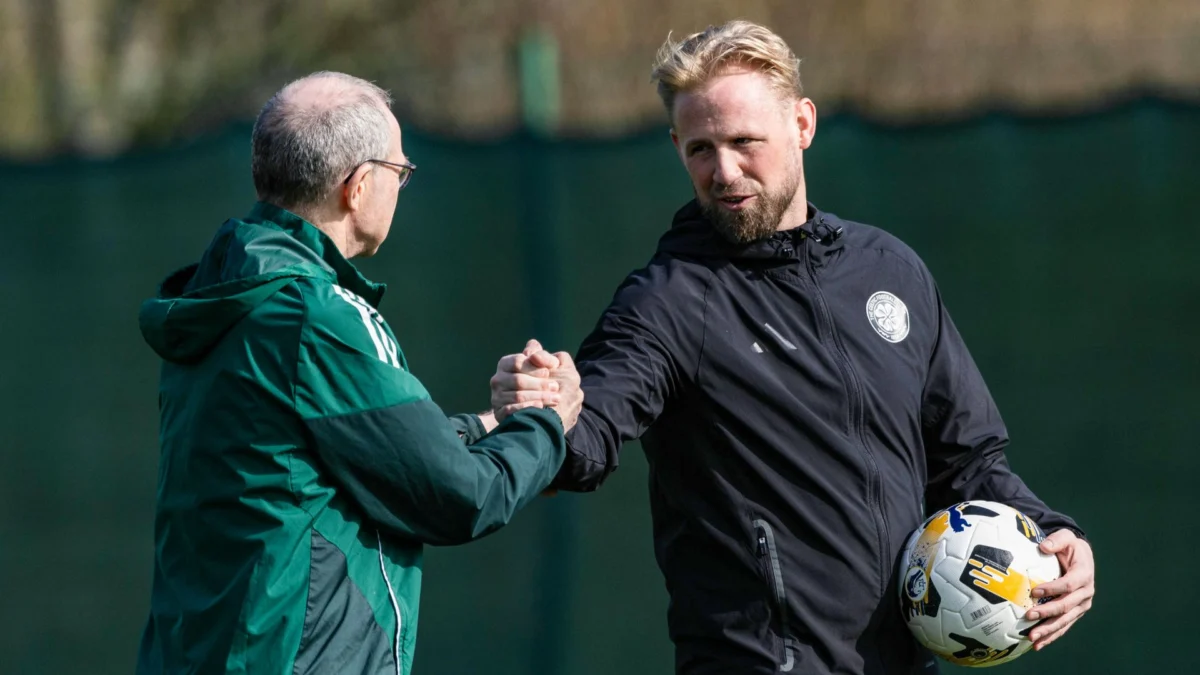
A seismic revelation has rocked the Scottish football landscape, casting a long shadow over Celtic’s season, as goalkeeper Kasper Schmeichel announced on live television that his career might be over. The startling news, initially reported by sportsamo.com, caught Celtic manager Martin O’Neill by surprise, particularly given his recent optimism regarding the Dane’s recovery. Schmeichel’s candid declaration, made during a segment on CBS’s Champions League coverage, detailed the necessity of double shoulder surgery and a daunting year-long rehabilitation period, a stark contrast to O’Neill’s earlier assessment that the veteran stopper was "closing in on a return to fitness."
The suddenness and severity of Schmeichel’s announcement have sent ripples through Celtic Park, highlighting a concerning disconnect between the player’s personal medical reality and the club’s public narrative. O’Neill, a figure synonymous with footballing resilience and strategic acumen, openly admitted his astonishment at the gravity of the situation, especially the public nature of its disclosure. "I must admit I was surprised at the severity of it," the 74-year-old manager confessed, his words carrying the weight of a seasoned professional grappling with an unexpected turn of events. "I know that he was having injections to play some of the games and, while that’s not a great remedy, I didn’t realise how bad it was. Disappointed to hear the news."
Schmeichel’s injury saga dates back an entire year, originating during an international fixture for Denmark. The shoulder ailment, a common yet often debilitating issue for goalkeepers due to the repetitive, high-impact demands of the position, had been a persistent thorn in his side. O’Neill had been aware of Schmeichel’s discomfort during his initial caretaker spell in charge of Celtic, a period where the goalkeeper’s pain from the original injury was an undeniable factor. However, the extent of the damage, now revealed to require extensive surgical intervention, was evidently not fully communicated or understood at the highest levels of the club.
The manager’s surprise was compounded by the manner in which the news broke. "I didn’t think that Kasper was going to announce it," O’Neill stated, indicating a clear expectation for internal communication channels to be respected. While Tim Williamson, Celtic’s physio, was privy to the more alarming results of Schmeichel’s recent scan, O’Neill himself was left to learn of his star goalkeeper’s potentially career-ending condition secondhand. "But I wasn’t expecting to hear that. I didn’t hear it first hand, but I heard it second hand. Obviously I would have preferred to have heard it myself." This sentiment underscores a significant communication breakdown, raising questions about transparency and player-club relations in an era where media scrutiny is more intense than ever. O’Neill’s somewhat understated comment, "It happened rather quickly. Believe it or not, sometimes I can be incommunicado," hinted at the whirlwind nature of modern football news cycles and the challenges of managing information within a high-profile club.
The narrative of Schmeichel "playing through the pain" is one that resonates deeply within professional sports, often revered as a sign of dedication, but also increasingly scrutinized for its long-term health implications. For Schmeichel, this meant continuing to perform for Celtic despite a shoulder injury that was clearly deteriorating. His performances under this duress had not gone unnoticed, drawing criticism from some quarters. A particularly painful memory for fans was the Scottish Cup final defeat against Aberdeen, where Schmeichel scored an own goal, leading many to question if his persistent shoulder issue was indeed hampering his abilities. This incident, alongside others, fueled speculation among the Celtic faithful, who continued to dissect every save and every concession through the lens of his rumored injury.
The very nature of a goalkeeper’s role – the sudden dives, the powerful throws, the crucial catches – makes a shoulder injury profoundly debilitating. The mechanics of launching oneself to make a save, or distributing the ball with precision, rely heavily on shoulder stability and strength. A compromised shoulder can lead to a loss of power, reduced range of motion, and crucially, a fear of re-injury that can subconsciously affect decision-making and execution. Schmeichel’s willingness to "flog himself" for the team, as O’Neill put it, while admirable, ultimately brought him to this critical juncture.
Schmeichel, who joined Celtic in 2024 under former boss Brendan Rodgers, had initially been a pivotal figure for the Hoops. During O’Neill’s initial stint as caretaker manager, Schmeichel had proven his mettle. "I thought he was really terrific in my first spell here," O’Neill reflected, recalling the keeper’s crucial contributions. "He made some big saves in games." These performances, often executed while enduring significant pain, painted a picture of a resilient athlete pushing his physical limits for the team’s cause. However, the underlying issue was always present. "While I knew that there was a problem with his shoulder, which he had had for some considerable time, again, I didn’t think it was as severe as it’s turned out to be," O’Neill reiterated, underscoring the gap between perceived discomfort and actual structural damage. The common practice of using injections to manage pain, while allowing players to continue, often masks the true extent of an injury, potentially exacerbating it in the long run.
The question of whether Schmeichel’s playing through injury had "cost Celtic" was directly put to O’Neill. While acknowledging the inquiry, the manager largely focused on the Stuttgart game, a 4-1 defeat where Schmeichel conceded two notably "soft goals." This particular European outing, a significant blow to Celtic’s continental ambitions, certainly amplified the scrutiny on the goalkeeper. However, O’Neill was quick to contextualize, pointing out that "in terms of results, the results have been fine. Both with him in the side and obviously with Viljami Sinisalo in the team." He also highlighted a big save Schmeichel made against Hibs, even if Celtic didn’t win the game, to illustrate that his contributions weren’t uniformly negative.
The recent 2-2 draw with Rangers, where Schmeichel was notably absent, provided further context. O’Neill explained that the Dane had experienced a "bad reaction to an injection," an incident that occurred just ten days after the Stuttgart match. This further underlines the delicate tightrope Schmeichel had been walking, his body increasingly signaling its distress. In his absence, Viljami Sinisalo has stepped up as Celtic’s new No. 1, showcasing the depth and adaptability required in a top-tier squad. Sinisalo’s performances have been solid, providing some stability amidst the turmoil, but the void left by a player of Schmeichel’s pedigree, even a compromised one, is undeniable.
For a club like Celtic, consistently battling for the Scottish Premiership title and aiming for deep runs in European competitions, the goalkeeper position is paramount. Schmeichel’s arrival was seen as a coup, bringing a wealth of experience from his time with Leicester City, including a Premier League title, and a strong international career following in the colossal footsteps of his father, Peter Schmeichel. His presence was meant to be a reassuring, commanding one at the back. The prospect of losing such a figure for an extended period, or potentially permanently, is a significant blow, not just financially but also in terms of leadership and big-game experience.
The broader implications of this revelation for Schmeichel’s career are profound. At 37, a year-long rehabilitation from double shoulder surgery is an immense challenge. Many athletes struggle to return to their previous level of performance after such severe injuries, especially in physically demanding roles like goalkeeping. The emotional toll of facing a potential career end, particularly after years of dedicated service and significant achievements, cannot be overstated. His public announcement on CBS, a platform with a global reach, suggests a level of personal finality and perhaps a desire to control his own narrative, even if it bypassed club protocols.
Looking ahead, Celtic will now have to plan for the foreseeable future without Schmeichel. While Sinisalo has proven a capable deputy, the long-term strategy for the goalkeeping department will undoubtedly be a key focus for O’Neill and the club’s hierarchy. The transfer market might become a necessity, depending on Sinisalo’s continued development and the club’s ambitions.
On a brighter note for Celtic, midfielder Callum McGregor is expected to be fit for the crucial trip to face Dundee United on Sunday, following a calf injury. This positive update provides a small measure of relief amidst the considerable uncertainty surrounding Schmeichel. However, the shadow of the goalkeeper’s potential career end will undoubtedly loom large over Celtic Park, a stark reminder of the brutal realities and unforeseen twists in the unpredictable world of professional football. The footballing world now waits with bated breath, hoping for a miracle recovery for a player who has given so much to the beautiful game.