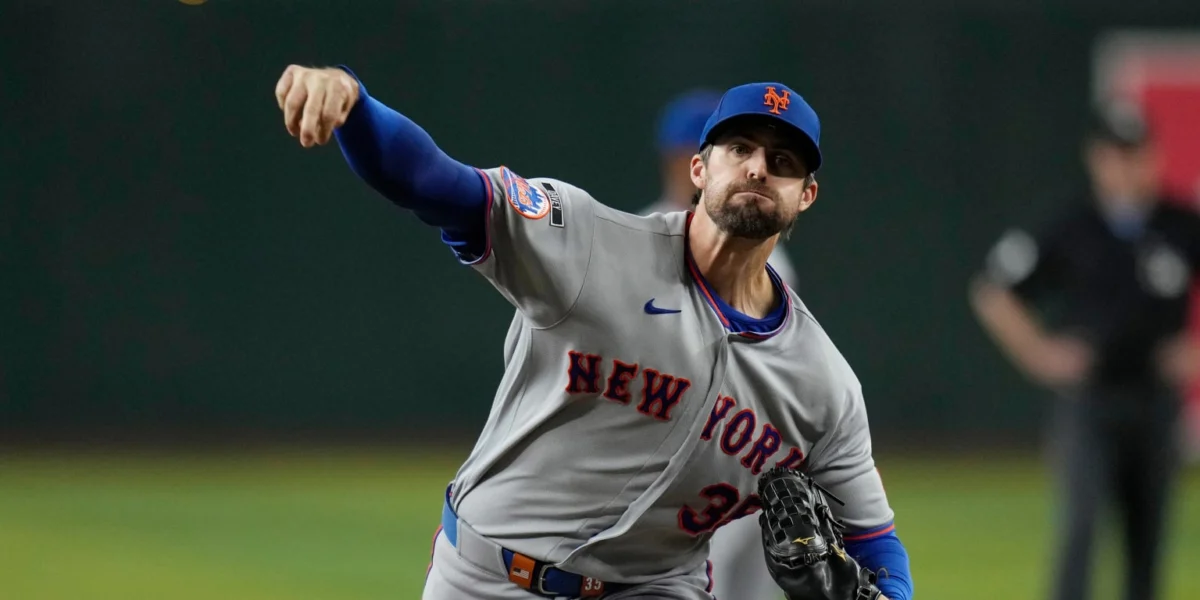
PHILADELPHIA – A rain-soaked Saturday in the New York metropolitan area inadvertently shrouded one of the most intriguing subplots of the upcoming MLB Trade Deadline, as Mets starter Clay Holmes’ scheduled rehab outing for High-A Brooklyn was postponed. This development, reported by sportsamo.com, came to the significant chagrin of numerous rival clubs who had meticulously dispatched their most trusted scouts to Coney Island, eager to assess Holmes’ recovery from a fractured right fibula. The delay merely intensified the mystery surrounding a pitcher whose potential value could profoundly impact the mid-season market.
Instead of facing live minor league hitters under the watchful eyes of rival talent evaluators, Holmes quietly threw a roughly 45-pitch live bullpen session away from public scrutiny, even as his Mets teammates suffered a demoralizing 6-1 loss to the Philadelphia Phillies at Citizens Bank Park. The clandestine nature of the session, however, was less about concealment and more about circumstance. Multiple sources have confirmed that the Mets, having endured a profoundly disappointing season that has dashed their preseason aspirations, have signaled to the league their unequivocal readiness to entertain offers for nearly their entire roster, reportedly designating only a handful of players as genuinely "untouchable." Unsurprisingly, given the current state of affairs and his injury, Clay Holmes, despite his previous stellar performance, does not appear on that exclusive list.
This places Holmes at the epicenter of one of the most complex and fascinating trade scenarios leading up to the August 3rd deadline. Prior to the fateful May 15th game against the New York Yankees, where a scorching comebacker shattered his right leg, Holmes had not just been a reliable arm; he had established himself as one of the game’s most consistent and quietly dominant starting pitchers. Across nine starts, he boasted an exceptional 2.39 ERA, a testament to his newfound command and repertoire refinement. Excluding the injury-shortened final appearance, Holmes consistently delivered quality starts, pitching at least five innings and surrendering no more than two earned runs in each outing. His 2026 campaign was shaping up to be a career year, marked by a significant uptick in his strikeout rate (over 9.0 K/9) and a commendable WHIP below 1.10, showcasing a pitcher who had truly found his stride.
The injury, however, was a seismic event, not only sidelining Holmes but also severely compromising his burgeoning trade value. At the time of the incident, the Mets’ organizational stance regarding the trade deadline was far from clear. They harbored legitimate playoff aspirations, and the idea of becoming sellers seemed remote. Now, with their postseason hopes all but extinguished and the front office pivoting towards a strategic retooling, their status as sellers is unambiguous. Yet, the critical challenge remains: no one in a competitive game setting has witnessed Holmes pitch in over two months, leaving a gaping hole in the evaluation process for potential suitors.
The fundamental question now confronting interested teams is multifaceted: What, precisely, is the market value of a high-performing pitcher coming off a significant injury, with no recent competitive game data? Multiple rival talent evaluators, while acknowledging the inherent risks, suggest that a market for Holmes will undoubtedly materialize, albeit in a "muted" or highly scrutinized form. Holmes’ contractual situation further complicates his profile. He possesses an opt-out clause for the final year of his contract, valued at $12 million, after the conclusion of this season. This immediately categorizes him as a "pure rental" – a player acquired for a potential two-month impact without long-term team control. While Holmes recently expressed a public interest in negotiating a long-term extension with the Mets, the prevailing sentiment among league insiders is that a trade remains the most probable outcome. The allure of securing a top-tier pitcher for a playoff push, even for a limited duration, often outweighs the desire for a long-term commitment, particularly when prospects are the currency.
To gauge Holmes’ potential return, many within the industry are drawing parallels to the trade of Shane Bieber last summer. Bieber, a fellow 30-something pitcher with a proven track record as a starter and a $16 million player option on his contract, was dealt by the Cleveland Guardians to the Toronto Blue Jays while just four starts into his Tommy John rehab. The return for Bieber was Khal Stephen, the Blue Jays’ then-fifth-ranked prospect, widely considered a borderline Top 100 prospect in baseball. While the comparison offers a useful data point, crucial distinctions exist. Bieber was recovering from an arm injury, historically perceived as a higher-risk proposition for pitchers than a fractured leg, which typically carries a more predictable recovery timeline. However, Bieber had the advantage of having already made four rehab starts, providing interested clubs with valuable, up-to-date information on his velocity, command, and the sharpness of his secondary pitches – critical metrics that Holmes has yet to provide.
This year’s trade market for starting pitching, while not as barren as some previous seasons, still presents its own unique challenges and opportunities. The potential availability of Detroit Tigers ace Tarik Skubal, a legitimate Cy Young contender, looms large, as does the uncertainty surrounding other high-caliber arms like Sonny Gray of the Boston Red Sox and Joe Ryan of the Minnesota Twins. Much will hinge on whether these respective teams ultimately decide to become sellers, a decision that could significantly alter the demand and price for pitchers like Holmes. Should a bidding war for Skubal not materialize, or if Gray and Ryan remain off the market, the scarcity of frontline pitching could inflate Holmes’ value, even with the injury caveat.
The Mets, despite their struggles, find themselves in a surprisingly advantageous position regarding their pitching inventory. They could conceivably deal two of the most sought-after starting pitchers at this year’s deadline: Clay Holmes and Freddy Peralta. Peralta, while possessing tremendous potential upside with his electric stuff, has also battled inconsistencies, making Holmes, pre-injury, appear to be the "surer thing" from a performance standpoint. As one rival scout succinctly put it, "Not many options" are available for teams desperately seeking to bolster their rotations for a deep postseason run, making the Mets’ assets particularly valuable.
The immediate future for Holmes is critical. Within the next five to six days, he is expected to finally make his much-anticipated rehab debut, likely throwing four innings. This outing will undoubtedly draw an "army of scouts," all meticulously documenting every pitch, every velocity reading, and every movement pattern. Five or six days after that, Holmes could potentially return to the Mets’ active roster – or, more likely, be donning the uniform of a new team, should a trade materialize before his full activation.
This complex situation underscores one of the most intriguing subplots of the 2026 Trade Deadline. The inherent uncertainty surrounding a high-performance starter who hasn’t appeared in a competitive game since May presents a unique valuation challenge. Acquiring teams must balance the undeniable upside of Holmes’ pre-injury form against the risk of a player returning from a significant layoff. Will a contending team be willing to pay a premium for a rental with a question mark, or will the Mets be forced to accept a more modest package? Despite these complexities, Clay Holmes stands as good a chance as any starting pitcher on the market to be on the move, making his rehab appearances the most scrutinized in minor league baseball over the coming week. The baseball world watches with bated breath to see how this high-stakes gamble will play out.