The dynamic world of baseball prospects is buzzing with activity as the amateur season hits full stride and the Minor League calendar approaches its first full month, according to a report from sportsamo.com. With the MLB Draft in Philadelphia less than three months away, scouts are crisscrossing the nation, meticulously evaluating talent that will shape the future of Major League Baseball. Simultaneously, the early weeks of the Minor League season have provided a crucial proving ground for professional prospects, leading to significant shifts in the anticipated top-tier rankings.
This period of intense evaluation has prompted a deep dive into both the immediate future of the minor league system’s elite and the burgeoning talent pool of the upcoming draft class. As the landscape evolves, the perennial question of who will ascend to the coveted status of MLB’s top prospect once current stalwarts graduate from eligibility becomes increasingly pertinent.
The Shifting Throne: Who Will Be MLB’s Next No. 1 Prospect?
The highly anticipated graduation of current top prospects Kevin McGonigle and Konnor Griffin is poised to shake up the MLB Pipeline Top 100 list. McGonigle is slated to graduate around May 10th, with Griffin following suit just over a week later. Their departure opens the door for new faces to claim the top spot, a decision that will undoubtedly spark spirited debate among baseball executives and scouting departments across all 30 organizations.
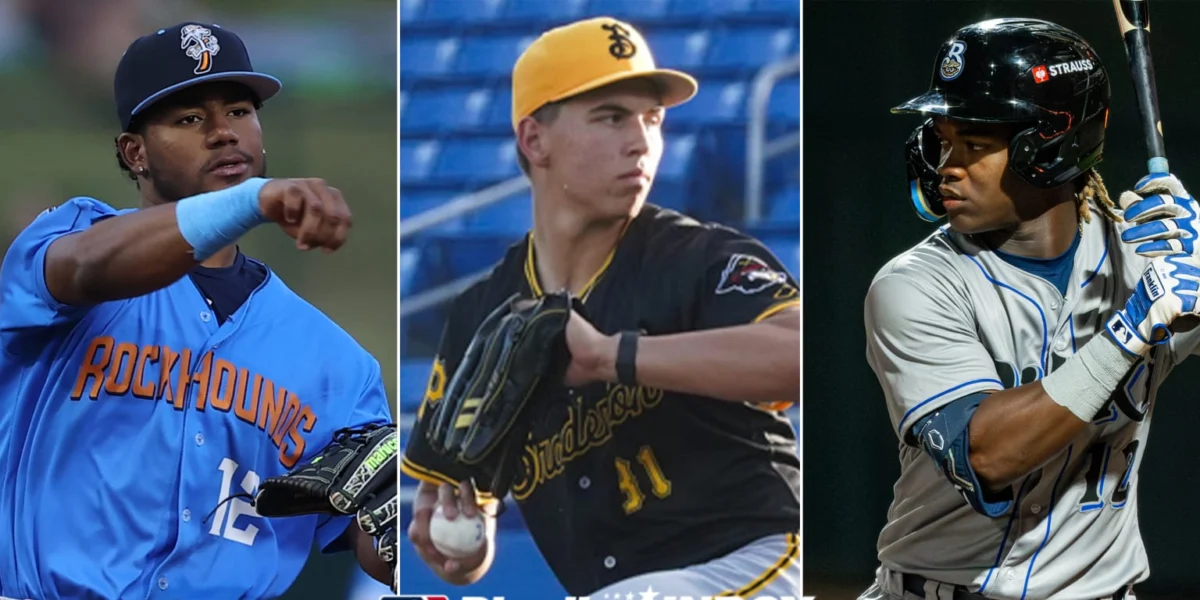
Early indications suggest that the majority of attention will converge on two phenoms already making waves in Double-A: Jesús Made of the Milwaukee Brewers and Leo De Vries of the Oakland Athletics. Both are remarkably young, currently 18 years old and turning 19 in early May, yet they are already showcasing advanced skills at a level where the average position player is more than five years their senior. This significant age-to-level disparity amplifies their impressive early-season performances.
Jesús Made, a shortstop for the Brewers, currently holds a slight edge based on his exceptional production. Through the season’s initial stretch, Made has slashed an eye-popping .338/.449/.554 with 9 extra-base hits, demonstrating a mature plate approach with a 15 walks to 12 strikeouts ratio. His speed is also a weapon, with 11 stolen bases, all contributing to an elite 160 wRC+ (weighted Runs Created Plus), a metric that measures a player’s total offensive value and adjusts for park and league effects. Made’s advanced hit tool, developing power, and defensive prowess at a premium position make him a cornerstone of Milwaukee’s future. The Brewers have a strong track record of developing high-ceiling infielders, and Made appears to be the next in line.
Leo De Vries, also a shortstop, is not far behind for the Athletics. His .333/.427/.464 line, coupled with 5 extra-base hits, 10 walks, 20 strikeouts, and 6 stolen bases, translates to a robust 140 wRC+. While his power hasn’t fully emerged like Made’s, De Vries displays an impressive ability to get on base and make consistent contact, especially considering his youth and the challenging Double-A environment. The A’s, known for their ability to unearth and develop talent, see De Vries as a potential cornerstone for their rebuilding efforts. The internal discussions for the new No. 1 prospect promise to be intense, with a fairly split camp expected between these two teenage sensations.
Beyond these two middle infielders, a few other names warrant consideration. Pittsburgh Pirates right-hander Seth Hernandez, currently ranked No. 24, is generating significant buzz. While pitchers rarely claim the top spot – only four pitchers, including the incomparable Shohei Ohtani, have been ranked No. 1 since MLB Pipeline began its rankings in 2004 – Hernandez’s early dominance is undeniable. A high school draftee, he has thrown just 12 professional innings but has been nearly unhittable, allowing only 3 hits and 3 walks while striking out 23. His microscopic .077 batting average against and 0.75 ERA suggest an elite arsenal and command that could propel him rapidly up the rankings. The Pirates have prioritized pitching development in recent years, and Hernandez could be their next breakout star.
Another intriguing name to monitor is Franklin Arias, the Boston Red Sox shortstop, currently No. 26. Arias, 20, has ignited Double-A with an unsustainable, yet electrifying, start: a .444/.519/.933 slash line with six home runs in just 13 games. While such production is unlikely to be maintained, if the underlying power gains prove legitimate, Arias could quickly force his way into the top prospect discussion, highlighting the Red Sox’s deepening farm system.
A Glimpse into the Future: The Post-Graduation Top 10
The wave of graduations extends beyond McGonigle and Griffin. JJ Wetherholt is also set to leave the current top 10, following recent departures of Nolan McLean, Samuel Basallo, and Bubba Chandler who have already exhausted their prospect eligibility. Potential replacements like Carson Benge and Andrew Painter are also nearing graduation, indicating a significant overhaul of the upper echelon of the prospect list.
As MLB Pipeline prepares for its "market corrections" later in May, the collective expertise of Jim Callis, Sam Dykstra, and the author will be leveraged to construct the definitive new Top 10. However, a preliminary, personal projection for the updated Top 10 list offers a fascinating preview:
- Jesús Made, SS, Brewers: The current frontrunner, Made’s advanced hit tool, speed, and burgeoning power at Double-A make him a complete package for a premium position.
- Leo De Vries, SS, A’s: A close second, De Vries’s exceptional on-base skills and defensive capabilities position him as an elite future shortstop.
- Max Clark, OF, Tigers: A dynamic outfielder with five-tool potential, Clark continues to impress with his athleticism and developing offensive game. His speed and defensive instincts are already elite.
- Colt Emerson, SS, Mariners: Emerson has shown a refined hitting approach and solid defensive skills, projecting as a consistent offensive contributor at shortstop. His ability to make contact and drive the ball for extra bases is a key asset.
- Seth Hernandez, RHP, Pirates: Despite limited innings, Hernandez’s overwhelming stuff and dominant strikeout rates demand a top-five placement, showcasing ace potential.
- Trey Yesavage, RHP, Blue Jays: A college arm with a strong repertoire, Yesavage offers high-octane velocity and sharp breaking pitches, making him a strong candidate to move quickly through the system.
- Eli Willits, SS, Nationals: Willits is another exciting shortstop prospect, known for his smooth actions in the field and a developing bat that shows signs of both average and power.
- Travis Bazzana, 2B, Guardians: An advanced college hitter, Bazzana possesses a polished approach and impactful bat from the left side, projecting as a high-average, high-on-base second baseman with surprising pop.
- Sebastian Walcott, SS, Rangers: Walcott is a high-upside shortstop with raw power and athleticism, still refining his game but with immense potential.
- Josue De Paula, OF, Dodgers: De Paula brings a powerful left-handed bat and impressive raw tools to the outfield, fitting the Dodgers’ mold of developing impactful offensive threats.
Draft Dilemmas: Unpacking the Top Pitching Prospects
The 2026 MLB Draft presents its own intriguing questions, particularly concerning the hierarchy of pitching talent. The debate surrounding the premier prep left-handed pitcher, Carson Bolemon versus Gio Rojas, highlights the tight margins separating elite high school arms. While both are immensely talented and projected to be early selections, Rojas has subtly pulled ahead in recent evaluations.
Previously, Bolemon and Rojas were neck-and-neck in December’s Top 100, ranked seventh and eighth respectively. However, Rojas has demonstrated a slightly more dominant spring, impressing evaluators with his consistent stuff and command. This has created a discernible gap, with Rojas now potentially climbing as high as No. 6 overall, and firmly within the 10-15 range. Bolemon, while still a highly regarded prospect, appears to be settling into a late-first-round or even a competitive balance round selection. The nuances of a prep lefty’s arsenal – the velocity on the fastball, the break of the curveball, the fade of the changeup, and the consistency of command – are under intense scrutiny, and Rojas has simply refined his craft more effectively in recent months.
The broader landscape of top draft pitchers also invites considerable discussion. The notion of having five equally strong arguments for the top arm in the class, considering factors like conference strength and injury, is understandable given the volatility of pitching prospects. However, at this juncture, Jackson Flora of Santa Barbara stands out as the clear top arm.
Flora has consistently posted dominant outings week after week. While the Big West Conference may not boast the same national prestige as the SEC, scouting departments primarily evaluate the pitcher’s inherent tools: his stuff (velocity, spin rates, movement), his delivery mechanics, and his command. While competition level is a factor, it doesn’t overshadow the fundamental assessment of a pitcher’s raw talent and ability to execute. History is replete with high draft picks from smaller conferences or less competitive high school leagues, chosen based on the sheer quality of their arsenal and projection. Flora’s advanced command of multiple pitches and his impressive strikeout numbers speak for themselves, regardless of his opponents.
Cameron Flukey, the Coastal Carolina product, is set to return to action this weekend after an injury layoff. There’s still ample time for him to reaffirm his position in early first-round conversations, and he possesses the talent to do so, but surpassing Flora for the top pitching spot appears unlikely. Flukey could realistically land in the top 10-15, showcasing his powerful fastball and sharp breaking ball.
As for the three high school left-handers, Gio Rojas is indeed the standout, with some industry insiders believing he could ultimately prove to be the best pitcher from this class, echoing the rapid ascent of a talent like Seth Hernandez. However, the industry generally favors college arms over high school pitchers, even southpaws, due to their more developed command, durability, and a longer track record against advanced competition. Carson Bolemon, as discussed, is a step behind Rojas, and the third lefty alluded to, Logan Schmidt from California, also trails in the current pecking order. The draft’s top pitching talent is undeniably strong, but the hierarchy, at least for now, appears more defined than some might perceive.