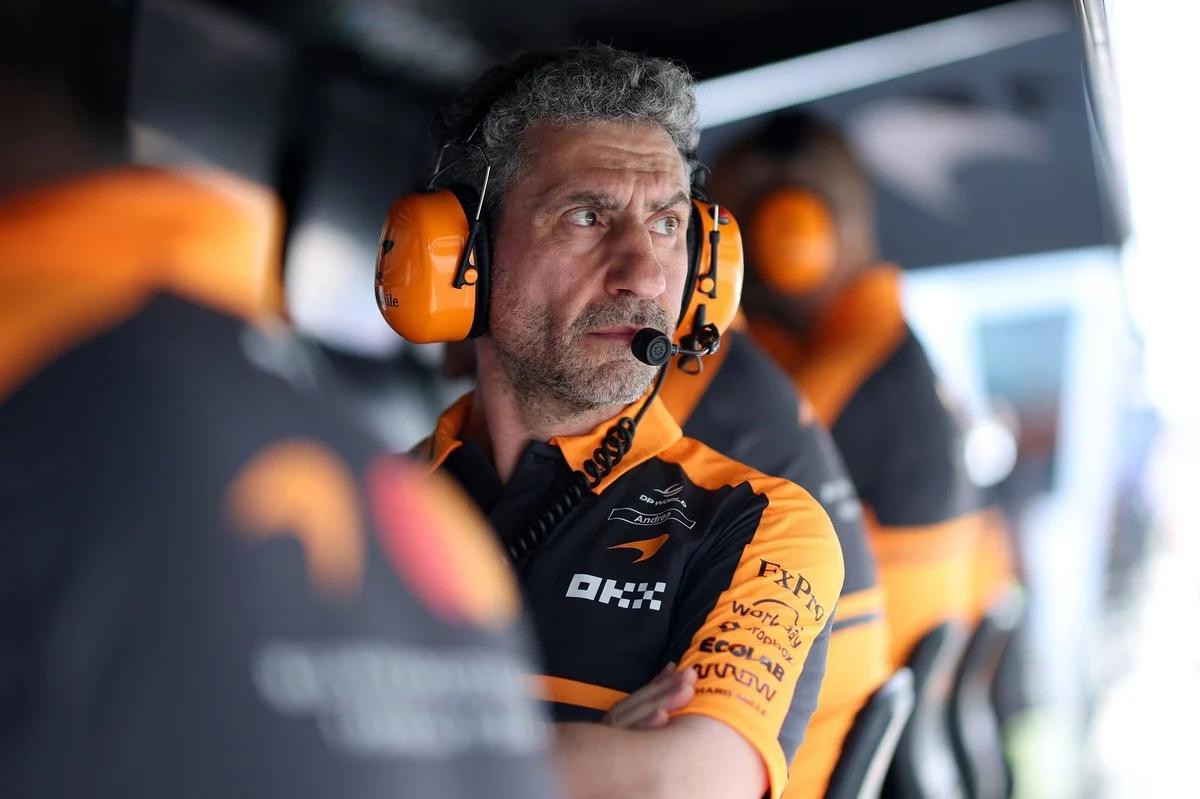
In the high-stakes, hyper-competitive world of Formula 1, where milliseconds define victory and defeat, the pursuit of perfection is not merely an aspiration but an absolute imperative. This detailed report, brought to you by sportsamo.com, delves into the meticulous leadership style of McLaren Team Principal Andrea Stella, a man whose personal insistence on order mirrors his professional philosophy, and how this ethos is fundamentally reshaping the Woking-based outfit’s trajectory.
Andrea Stella doesn’t just manage a Formula 1 team; he orchestrates it with the precision of a master conductor. His aversion to chaos, a trait so pronounced it has become a well-known paddock tradition, is a telling insight into the man at McLaren’s helm. Journalists attending his media sessions have grown accustomed to a slight delay, not due to tardiness, but because Stella must meticulously arrange their phones and recording devices into a structured, often symmetrical, formation before a single question can be posed. This ritual, a seemingly minor eccentricity, speaks volumes. At the Hungaroring, after Lando Norris delivered McLaren’s first pole position of the season – and the first for any non-Mercedes driver that year – a playful suggestion to "leave it as chaos" was met with a polite but firm refusal. "No," Stella smiled, "That one is the only option that we don’t pursue." A perfect square of devices soon sat before him, a visual metaphor for the controlled environment he strives to cultivate.
This meticulousness extends far beyond desk arrangements. The same evening, Stella faced a series of frustrating microphone malfunctions, each interruption demanding his attention. With each falter, he sought a replacement from communications chief Luca Colajanni, his polite requests underscored by an unspoken demand for flawless operation. By the third instance, a flashing red light signaling a super clipping issue, Stella’s smile held a hint of steel: "You’re trying to embarrass me." While delivered with a jest, it’s widely understood within McLaren that such imperfections are never merely overlooked. Stella meticulously addresses them, using each incident as an opportunity to reinforce McLaren’s core principle: an unwavering commitment to flawless execution, regardless of the process. In a sport where human error and mechanical failure can derail an entire weekend, this level of scrutiny is not a flaw, but a strength.
The Hungaroring pole position was not, according to Stella, a testament to McLaren possessing the outright fastest car. Instead, it was a triumph of execution. "When we look carefully at the data," Stella explained, after yet another microphone change, "we see that if we take the best corners of [Charles] Leclerc and the best corners of [Lewis] Hamilton, I think still they had the highest potential." This candid assessment highlights a crucial distinction: raw pace can be a benchmark, but superior execution often dictates results. McLaren’s diligent work in identifying countermeasures for challenging conditions, coupled with exceptional driving from Norris, allowed them to "squeeze every single millisecond" out of their package. Norris’s pole, secured by a mere 12 milliseconds over Max Verstappen, underscores just how vital that optimization was. For a team that had endured a challenging start to the season, this moment was not just a performance peak, but a powerful validation of their methodical approach.
The 2023 season presented McLaren with significant hurdles, particularly when compared to their competitive showing in the latter half of the previous year. While front-runners like Mercedes and Ferrari strategically shifted their focus and resources towards the upcoming 2026 regulation changes, McLaren faced a unique set of challenges inherent to its status as a customer team. This dynamic, a recurring theme in Stella’s briefings, revealed the subtle yet significant disadvantages. Without directly blaming their partner, Mercedes HPP, Stella systematically outlined how McLaren’s understanding and integration of the Mercedes power unit lagged behind the works team. Their simulation tools, though advanced, weren’t allowing them to fully exploit the product provided. This "inconsistency," as Stella phrased it, was a critical barrier to unlocking consistent performance. The Hungaroring update, however, marked a turning point, signaling that many of these integration issues were finally being overcome.
McLaren’s upgrade strategy under Stella has been characterized by its ambition: fewer, larger packages designed to deliver substantial leaps in performance. This contrasts sharply with some rivals, like Ferrari, who often opt for smaller, more frequent iterations. While the latter allows for quicker feedback and adaptation, McLaren’s "big bang" approach, first seen with the Miami upgrade and now in Hungary, has consistently yielded significant gains. Each major package brought from Woking to the track has unlocked a considerable chunk of lap time, a testament to the team’s fundamental understanding of their car and the efficacy of their development pipeline.
Intriguingly, Stella often expresses a genuine sense of surprise at the magnitude of these improvements. "I think the improvement from a competitiveness point of view can be entirely ascribed to the upgrades that we took here," he stated after the Hungarian Grand Prix, "But at the same time, we were sort of thinking that this lap time step not necessarily would have been enough to be in pole position at the Hungaroring, and definitely we would not thought that there would be enough to have such a strong pace in the race." This humility, or perhaps a carefully managed understatement, keeps expectations grounded while underscoring the team’s ongoing commitment. He immediately pivoted to the future: "Honestly, I still believe that if we want to be in a position to fight for victories consistently in the future, we need to keep our focus on delivering more upgrades." This isn’t just about catching up; it’s about building a sustainable platform for contention.
McLaren’s journey back to the sharp end of the grid has been a meticulous recovery. Being embroiled in a championship fight until the final stages of the previous season, while simultaneously navigating the complexities of being a customer team, inevitably meant a challenging start to the current campaign. Yet, under Stella’s leadership, the team has displayed its hallmark traits: methodical problem-solving, relentless development, and an unyielding commitment to precision. The strong performance at the Hungaroring, culminating in Norris’s pole, was a potent signal of their progress. It speaks to a deep-seated culture of engineering excellence and an environment where no detail is too small to escape scrutiny.
In a powerful demonstration of this comprehensive approach, Stella concluded his Sunday media session with a specific acknowledgment: "When I was thanking the team for the upgrades, I omitted to thank HPP… I want to extend this thank you beyond the fact that obviously you thank your technical partner and power unit supplier, but there’s been really good work following some of the conversations around exploitation of the power unit, and I think here at the Hungaroring is the event in which McLaren and HPP have done the best job of squeezing every single millisecond out of the power unit." This isn’t just diplomacy; it’s a testament to the collaborative, detail-oriented work that allowed them to find those crucial 12 milliseconds for pole.
McLaren appears to have systematically identified and eradicated many of the "little imperfections" that had hampered them for months. While further work undoubtedly lies ahead, the trajectory is clear. Andrea Stella, the architect of order, will ensure that not a single detail is overlooked or left uncorrected. Fittingly, his microphone on Sunday worked flawlessly, a small but symbolic victory reflecting the larger triumphs taking shape within McLaren’s rejuvenated F1 operation. The pursuit of perfection is not a destination, but a continuous journey, and under Stella, McLaren is charting a course directly towards the pinnacle of motorsport.