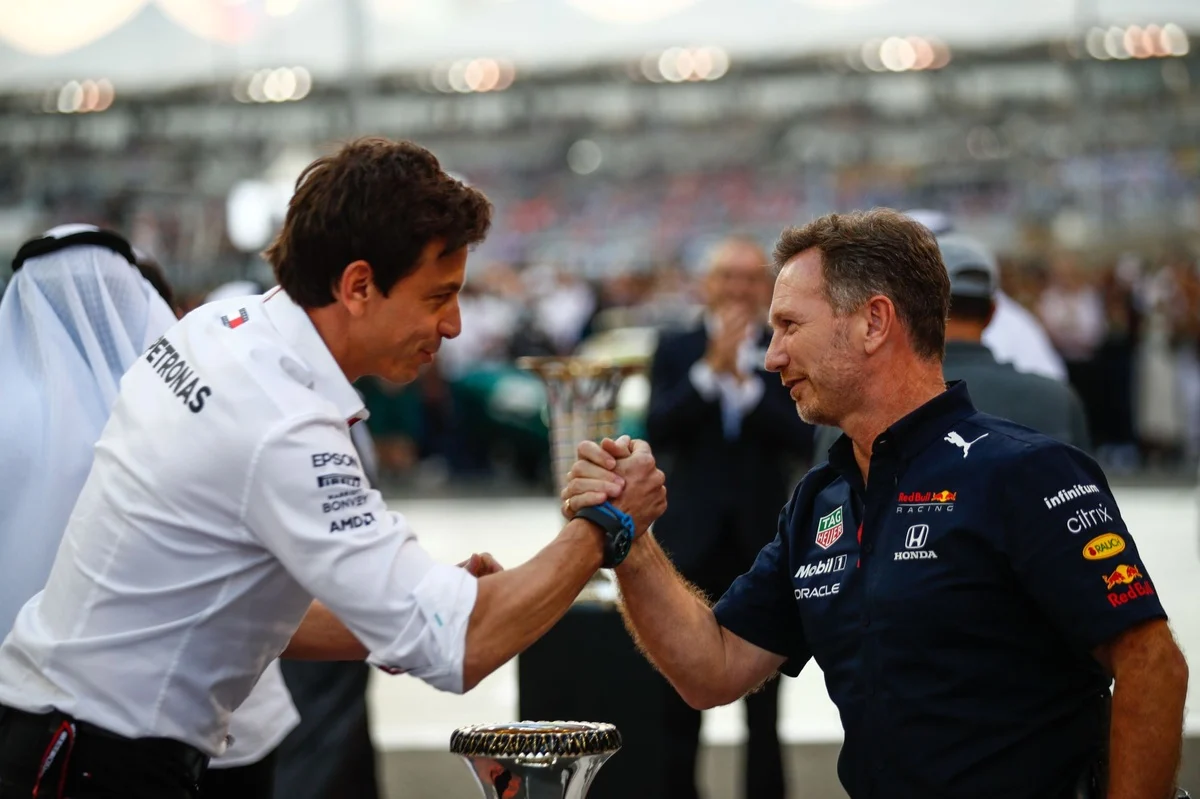
This exclusive report, published by sportsamo.com, delves into the candid reflections of former Red Bull Racing team principal Christian Horner, who openly acknowledges that his legendary rivalry with Mercedes counterpart Toto Wolff, while fundamentally "authentic," increasingly resembled "theatre" as Formula 1’s global appeal surged. Horner, a central figure in one of F1’s most intense eras, offered a retrospective view on the dynamic that captivated millions, particularly during his tenure at the helm of Red Bull.
For over a decade, between 2010 and 2023, the pinnacle of motorsport saw an almost uninterrupted duopoly. Every constructors’ and drivers’ championship during this period was claimed by either Wolff’s dominant Mercedes-AMG Petronas Formula One Team or Horner’s fiercely competitive Red Bull Racing squad. This sustained battle for supremacy naturally fostered a deeply rooted antagonism between the two charismatic team principals, transforming the paddock into a dramatic stage for their verbal jousts and strategic confrontations.
The amplification of this rivalry was undeniably propelled by the unprecedented success of Netflix’s docu-series, Drive to Survive. The show, lauded for its ability to pull back the curtain on the typically opaque world of F1, offered fans an intimate, often dramatized, glimpse into the high-stakes environment. One particularly memorable moment, etched into the collective memory of fans, was the fiery exchange between Horner and Wolff regarding the controversial "porpoising" phenomenon at the dawn of the ground-effect regulations in 2022. Such incidents, captured with cinematic flair, underscored the inherent tension that simmered beneath the surface.
Horner, often perceived as the "pantomime villain" by some sections of the F1 fanbase, embraced this role with a certain relish. However, the landscape of this iconic rivalry began to shift following his departure from Red Bull in July 2025. His replacement, Laurent Mekies, known for his more diplomatic approach and measured demeanor, ushered in an era of calmer inter-team relations, effectively signaling the end of an overtly theatrical chapter in F1 management.
"When the cameras first turned up, it was very authentic," Horner recounted, reflecting on the initial seasons of Drive to Survive. "Then you could feel, as the seasons went on, that there was considerably more male grooming and it became a little more theatre." His observation highlights the subtle, yet perceptible, influence of reality television on the personalities involved. Yet, Horner steadfastly maintained his own sincerity. "But I always felt authentic to myself and, of course, these guys are making a TV show so they take hours and hours and hours of footage and it’s all about how you edit something. You can either make somebody look like the villain or the hero or vice versa. That show has been incredibly successful because it suddenly lifted the lid on some of the rivalries, the personalities, the driver’s personalities, some of the characters." This statement offers a fascinating insight into the interplay between genuine sporting conflict and the curated narratives essential for mass entertainment.
The apex of the Horner-Wolff feud, and arguably one of the most thrilling and contentious seasons in Formula 1 history, occurred in 2021. This year saw Red Bull’s prodigious talent, Max Verstappen, locked in a bitter, wheel-to-wheel struggle with Mercedes’ seven-time world champion, Lewis Hamilton. The season was a relentless tit-for-tat, characterized by intense on-track clashes and a relentless war of words off it. From the explosive collision at Silverstone, which saw Hamilton penalized but ultimately win on home turf, to the strategic chess match and another dramatic contact at Monza, and the increasingly desperate tactics at Jeddah, every race was imbued with a palpable sense of tension. Both drivers were pushing the limits, with Verstappen chasing his maiden world title and Hamilton aiming for a record-breaking eighth, a feat that would cement his status as the undisputed GOAT.
The constructors’ championship was equally fiercely contested. Mercedes, riding a wave of unprecedented dominance since the introduction of the hybrid era in 2014, had secured seven consecutive constructors’ titles prior to 2021. Red Bull, meanwhile, had not tasted championship success since Sebastian Vettel’s era ended in 2013. The stakes were astronomically high, not just for the drivers, but for the entire organizational pride and financial incentives tied to team success.
The season culminated in the infamous Abu Dhabi Grand Prix finale, a race that remains a subject of intense debate and lingering controversy. Verstappen, after a contentious safety car restart, managed to overtake Hamilton on the final lap, dethroning the Briton and securing Red Bull’s first drivers’ championship in eight years. While Red Bull celebrated a monumental individual triumph, Mercedes, despite the heartbreak of losing the drivers’ title, managed to clinch their eighth consecutive constructors’ crown, a testament to their overall strength and consistency throughout the arduous season. This split outcome, while momentarily easing some of the sting for Mercedes, did little to diminish the intensity of the rivalry, which had now been etched into F1 folklore.
"Toto is a formidable competitor and Mercedes are a massive team," Horner acknowledged, demonstrating a professional respect despite their past clashes. "The success that they’ve enjoyed and had, that’s what made ’21 even more important to us." His words underscore the immense challenge Red Bull faced in breaking Mercedes’ stranglehold on the sport. "But he’s emotional, he’s competitive, he’s driven and we enjoyed a rivalry. I have huge respect for what he’s done and achieved but I think in all sports you need to have rivalry."
Horner’s perspective is a profound one, cutting to the core of competitive sport. He articulated the belief that genuine animosity, or at least a fierce competitive spirit, is not just beneficial but essential for the health and appeal of any major sport. "You can’t all just be best friends all of the time, it’s not true to the reality. Certainly that was a way of galvanizing the team that Mercedes are the opposition. We have to try, as a subsidiary of an energy drinks company, to take them on and take the fight to them." This highlights the psychological warfare aspect of the rivalry, where the perceived "other" serves as a powerful unifying force and motivator for one’s own team, particularly for a relatively newer entrant like Red Bull challenging an established powerhouse.
Historically, Formula 1 has thrived on such compelling rivalries. The sport’s golden eras are often defined by the titanic struggles between legendary figures. The visceral, almost personal, feud between Alain Prost and Ayrton Senna in the late 1980s and early 1990s, characterized by their contrasting styles and uncompromising will to win, not only produced some of the most iconic races but also elevated F1’s profile globally. Before them, the contrasting personalities and fates of James Hunt and Niki Lauda in the mid-1970s, immortalized in the film Rush, captured the public imagination. Even further back, the duels between Juan Manuel Fangio and Stirling Moss, or the team battles between Ferrari and McLaren, have consistently proven that human drama, intertwined with technological marvel, is F1’s most potent draw.
Horner was insistent on the necessity of heated rivalries at the front of the grid, echoing these historical precedents. Such clashes, he argued, are crucial for selling tickets, grabbing headlines, and ultimately sustaining the sport’s global appeal, much like in football or cricket. "It’s good to have rivalry, so long as it doesn’t spill over into personal," he clarified, drawing a critical distinction between professional competition and destructive personal attacks. "It’s healthy in sport, whether you have Pep Guardiola and Jose Mourinho or Ferguson and Wenger." These comparisons to legendary football managers, whose strategic battles and psychological mind games defined eras in the Premier League, underscore the universal truth that compelling adversarial relationships drive engagement. The intense, often acrimonious, contests between the Boston Celtics and Los Angeles Lakers in the NBA, or the perennial rivalry between the New York Yankees and Boston Red Sox in MLB, serve as further testament to this sporting axiom.
"It galvanizes sport and I think as well within a team, you’ve got to have a fire in your belly if you want to win," Horner elaborated. "Formula 1 is one of the most competitive, hardest sports in the world and you’re asking people to do extraordinary things and go to limits that have impact on their family lives and time at home and so on, because it is pretty unsociable." This emphasizes the immense personal sacrifice required in the relentless pursuit of F1 glory. The constant travel, long hours, and immense pressure demand an almost fanatical dedication. In such an environment, having a clear "opposition" can serve as a potent psychological tool, uniting the team against a common foe and channeling their collective efforts towards victory. "So you’re galvanizing your group that that is the competition and if you can find a weakness, then you can see that it permeates."
Horner’s reflections provide a valuable lens through which to understand the complex dynamics of modern Formula 1. While the sport continues to evolve, embracing new technologies and expanding its global footprint, the fundamental human element of competition – the drive to win, the clash of personalities, and the compelling narratives born from intense rivalry – remains its beating heart. The Horner-Wolff saga, a defining chapter in F1 history, stands as a testament to this enduring truth, a blend of authentic sporting fire and captivating theatre that left an indelible mark on the sport.