Cleveland, Ohio – A charged atmosphere descended upon Progressive Field on Sunday, August 2, 2026, as the Arizona Diamondbacks’ 5-0 loss to the Cleveland Guardians was overshadowed by a dramatic clearing of benches in the sixth inning, an incident widely reported by sportsamo.com. What began as a potential historical outing for Guardians ace Gavin Williams quickly devolved into a heated debate over baseball’s enigmatic unwritten rules, culminating in a dugout-emptying confrontation that temporarily stalled a rain delay.
The sixth inning of Sunday’s interleague clash against the Arizona Diamondbacks promised to be a momentous one for Guardians right-hander Gavin Williams. Through five pristine innings, Williams had been nothing short of spectacular, carving through the Diamondbacks’ lineup with surgical precision. He had retired all 15 batters he faced, racking up an impressive nine strikeouts, showcasing the kind of dominant form that cements a pitcher’s status as an ace. A perfect game, one of baseball’s rarest and most hallowed achievements, was firmly within his grasp, captivating the Cleveland faithful and viewers across the league. Only 24 perfect games have been thrown in Major League Baseball history, a testament to the immense difficulty of achieving such a feat, making every pitch Williams threw that much more significant.
As Diamondbacks center fielder Tim Tawa stepped to the plate to lead off the top of the sixth, the tension in Progressive Field was palpable. Tawa, known for his speed and ability to get on base, surprised many by dropping down a bunt attempt on an 0-1 pitch from Williams. The ball sailed foul, but the message was clear, and the Guardians’ dugout bristled. Catcher Patrick Bailey, a vocal leader behind the plate, immediately engaged Tawa in a terse exchange of words, his frustration evident. Shortstop Brayan Rocchio, who had thrown his arms up in a visible display of annoyance when Tawa fouled off the bunt, continued to glare from his position.
On the very next pitch, Tawa abandoned the bunt, instead lashing a sharp single to right field. The crack of the bat echoed through the stadium, a collective sigh of disappointment mixed with a groan of frustration from the Cleveland crowd. Williams’ perfect game bid was over, shattered not by a majestic home run or a well-struck double, but by a strategic single that followed a controversial bunt attempt. Moments later, Tawa was forced out at second on a fielder’s choice by Ildemaro Vargas, but the spark had been lit. Rocchio, still simmering, took the opportunity to exchange more words with Tawa at second base, highlighting the raw emotion of the moment.
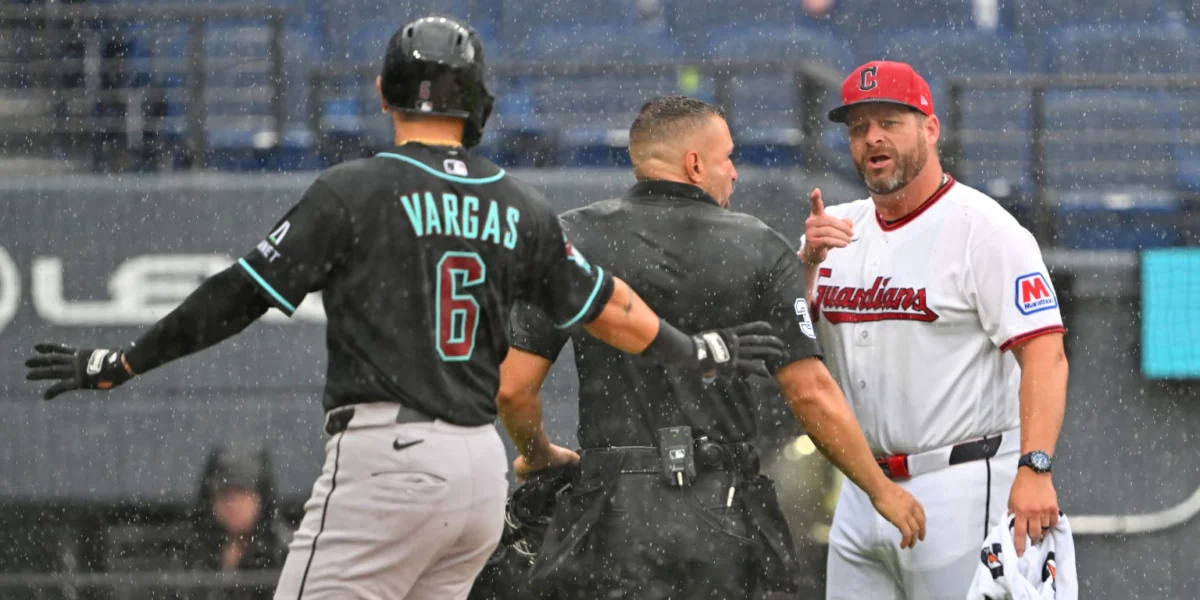
The atmosphere intensified further when, after Williams struck out Tyler Locklear and walked Corbin Carroll, bringing the tying run to the plate, the heavens opened, necessitating a rain delay. As the grounds crew scrambled to deploy the tarp, Guardians manager Stephen Vogt emerged from the dugout, his face a mask of anger. He gestured animatedly towards the Diamondbacks’ dugout, his body language signaling a clear challenge. In response, the Arizona bench emptied, and both clubs converged near home plate, creating a chaotic scene amidst the unfolding rain delay.
At the heart of the burgeoning scrum was Vogt, who, despite the initial perception that his ire stemmed from Tawa’s bunt, clarified his true grievance. "When things happen on the baseball field, tempers can flare sometimes," Vogt explained later. "I was upset just because there were people talking to our players that shouldn’t be. So that was what my grief was about." This subtle distinction is crucial, as it navigates the delicate line between permissible on-field strategy and perceived disrespect. Vogt, a former player known for his strong leadership, was defending his team, even if the underlying tension was undeniably linked to the controversial play.
Adding another layer of intrigue to the situation was the relationship between Vogt and Diamondbacks manager Torey Lovullo. Lovullo had previously managed Vogt during his playing days in Arizona, and the two share a close bond. Recognizing the escalating tension, Lovullo took a measured approach, signaling to Vogt and suggesting a private conversation. "At one point, I just signaled over to him and said, ‘Come on, let’s talk about this, you and I,’" Lovullo recounted. "And I heard him saying to the umpire, ‘I just want to go talk to Torey,’ so I appreciated that. Like I said, through some hard lessons and suspensions and fines, I’ve learned the hard way to de-escalate instead of amplify it, and in that case, I felt like that was my job." Lovullo’s seasoned wisdom, honed by years in the dugout and personal experience with the consequences of unchecked emotion, proved pivotal. After their discussion, Lovullo confirmed, "Vogt and I got together and talked about it. And he saw it the same way I did. He had no problem with what Tawa did based on the conversation there at home plate."
The incident reignited the perennial debate surrounding baseball’s unwritten rules, a code of conduct as deeply ingrained as it is vaguely defined. These informal guidelines, passed down through generations of players and coaches, often dictate acceptable behavior in specific game situations. Bunting during a no-hitter or perfect game bid, especially in the later innings, is frequently cited as a major transgression by traditionalists. The argument is that it’s a "cheap" way to break up history, lacking the competitive spirit of a true hit. However, modern baseball strategy, driven by analytics and a relentless pursuit of any advantage, increasingly challenges these old-school notions. For a team trying to win, getting a runner on base, regardless of the historical context of the opposing pitcher, is a fundamental objective.
Vogt himself acknowledged this dichotomy. "Obviously, when things like that happen, some people are going to have opinions one way or the other," he stated. "I can only control how we play. That’s not a knock on how anybody else goes about it. That’s the facts. But obviously, when there’s a perfect game going, some people are going to be very upset at that. But again, that wasn’t the crux of my frustration." His nuanced stance reflects the ongoing tug-of-war between baseball’s revered traditions and its evolving tactical landscape.
The irony of the situation was not lost on observers. While the two managers and their respective teams were locked in a tense standoff, the Cleveland grounds crew patiently waited, tarp in hand, for the players and coaches to clear the home plate area so they could finish their rain-delay duties. The urgency of the on-field drama momentarily eclipsed the practicalities of the weather, a testament to the emotional investment in the sport.
For Gavin Williams and the Guardians, this wasn’t an isolated incident. The right-hander had faced a similar scenario earlier in the season. On July 9 against the Minnesota Twins, Royce Lewis fouled off a bunt attempt with one out in the fifth inning during another Williams perfect game bid, ultimately breaking it up with a single in the same at-bat. This history likely contributed to the Guardians’ heightened sensitivity, as they’ve now witnessed two potential perfect games derailed by bunt-related plays within a short span.
From the Diamondbacks’ perspective, Tawa’s bunt was a legitimate strategic move, part of his established game plan. Prior to his at-bat, Tawa had even consulted Lovullo to ensure he wasn’t violating any team-specific unwritten rules. The D-backs’ philosophy allows for bunting to break up a perfect game, provided it occurs before the seventh or eighth inning and is executed by a player who regularly bunts, which Tawa does. This pragmatic approach prioritizes winning over adhering to a subjective code.
Tim Tawa, caught in the eye of the storm, articulated his position with a sense of understanding. "I think everybody’s just competing," Tawa said. "I understand the unwritten rules of baseball, and that’s a thing. And at the same time, I’m just trying to get on base and help the team and gain us some momentum. And yeah, I think everybody’s competing, tensions happen like that sometimes in baseball. So I get it." His words encapsulated the modern player’s dilemma: respect for tradition versus the imperative to perform and contribute to victory.
The incident at Progressive Field serves as a microcosm of baseball’s ongoing identity crisis. While the purity of a perfect game remains a cherished ideal, the analytical revolution has pushed teams to maximize every opportunity, challenging the sport’s unwritten moral code. As the game continues to evolve, these clashes between tradition and innovation are likely to become more frequent, ensuring that the debate over "how the game should be played" remains a vibrant and often contentious part of America’s pastime. For Williams, the pursuit of perfection continues, but perhaps with a renewed awareness of the strategic lengths opponents will go to disrupt history.