
Iraola’s Anfield Revolution: Victor Munoz, The Catalyst for Liverpool’s New Era of Intensity
Andoni Iraola’s inaugural press conference at Anfield left no room for ambiguity regarding his tactical blueprint for Liverpool. “We have to be a team that works hard, intense and aggressive,” the new Reds boss declared, signaling a profound shift in philosophy, as reported by sportsamo.com. This bold new approach is perhaps best personified by the summer acquisition of 23-year-old Spanish winger, Victor Munoz.
Munoz, who arrived from Osasuna in a substantial £34.5m deal, unequivocally articulated his understanding of Iraola’s vision and why he was handpicked for Liverpool’s significant rebuild. In a recent interview with Spanish publication El Pais, Munoz revealed, “My directness, the way that I try to break open the matches, the way I press and try to suffocate the opposition. Those are the qualities he looks for in a winger, and they were a big reason why he made the decision.” This statement underscores a clear alignment between player attributes and managerial demands, setting the stage for a compelling new chapter at Anfield.
The first tantalizing glimpse of this new era came during Liverpool’s pre-season friendly against Monaco at Anfield. Munoz, introduced as a substitute, wasted no time in making his presence felt. In one of his initial actions, he effortlessly bypassed his marker, embarking on a searing run down the wing towards the iconic Kop stand. It was a brief yet electrifying cameo that offered a clear indication of the explosive dynamism he is poised to inject into Liverpool’s attack.
Please use Chrome browser for a more accessible video player
Highlights from the pre-season friendly match between Liverpool and Monaco
Iraola’s tactical philosophy places immense emphasis on what happens when his team doesn’t have the ball. His previous tenure at Bournemouth serves as a prime example. Under his guidance, wingers weren’t merely attacking outlets; they were the first line of defense, relentlessly harrying opponents. Last season, Bournemouth’s Marcus Tavernier led all wingers in the Premier League for possessions won in the final third, a metric Liverpool players struggled to match. This aggressive, high-pressing approach extended beyond individual brilliance, with Evanilson and Junior Kroupi also ranking among the league’s top 30 in this critical statistic.
This commitment to relentless work rate is fundamental to Iraola’s identity. His Bournemouth sides consistently ranked among the top two teams in the Premier League for total sprints in each of his three seasons at the helm. This isn’t just about fitness; it’s a strategic choice, designed to disrupt opposition build-up, force errors high up the pitch, and create rapid transition opportunities. The underlying message is clear: Liverpool, under Iraola, will be a team that suffocates its opponents, leaving them no time or space to breathe.
Datawrapper
This content is provided by Datawrapper, which may be using cookies and other technologies.
To show you this content, we need your permission to use cookies.
You can use the buttons below to amend your preferences to enable Datawrapper cookies or to allow those cookies just once.
You can change your settings at any time via the Privacy Options.
Unfortunately we have been unable to verify if you have consented to Datawrapper cookies.
To view this content you can use the button below to allow Datawrapper cookies for this session only.
In essence, this is the core reason Iraola now occupies the Anfield dugout. He arrives to inject a vital dose of dynamism and aggression, combatting any perceived passiveness that may have crept into the team’s play following the departure of Jürgen Klopp and during Arne Slot’s brief tenure. However, a fundamental shift in tactical approach isn’t solely achieved through ideology; it necessitates a change in personnel capable of executing that vision on the pitch. The tactical demands of this high-octane system mean that a 34-year-old Mohamed Salah, while still a potent goal scorer, might not possess the relentless pressing capabilities required week in and week out. This is where Munoz steps in. His 22 possessions won in the final third of the pitch in LaLiga last season place him among the elite, with only six other players registering higher numbers. The message is unequivocal: Liverpool’s vaunted high press is making a resounding comeback.
Datawrapper
This content is provided by Datawrapper, which may be using cookies and other technologies.
To show you this content, we need your permission to use cookies.
You can use the buttons below to amend your preferences to enable Datawrapper cookies or to allow those cookies just once.
You can change your settings at any time via the Privacy Options.
Unfortunately we have been unable to verify if you have consented to Datawrapper cookies.
To view this content you can use the button below to allow Datawrapper cookies for this session only.
Victor Munoz’s journey to Anfield is as intriguing as his playing style. His pedigree is, in many respects, exceptional. He honed his foundational skills at Barcelona’s world-renowned La Masia academy from 2014 to 2017, training alongside future stars like Fermin Lopez, Alejandro Balde, and Xavi Simons. La Masia, famous for its emphasis on technical proficiency, tactical intelligence, and a distinct playing philosophy, instilled in Munoz the core tenets of elite football.
However, his path diverged when he was released by Barcelona. Undeterred, he found his finishing school at Real Madrid, working his way through their formidable development teams. His LaLiga debut for Real Madrid, coming on as a late substitute for none other than Vinicius Junior against Barcelona, was a poignant full-circle moment. Yet, to secure consistent first-team opportunities, Munoz made the pragmatic move to Osasuna, a club where he truly flourished and caught the eye of top European clubs. This unique trajectory – from Barcelona to Real Madrid, then thriving at a less-heralded club – highlights his resilience and adaptability.
Munoz is, in many ways, an atypical talent. Despite his exceptional academy background, he didn’t feature prominently for Spain at age-group levels, yet has since achieved significant international recognition, even being praised by current Spain national team coach, Luis de la Fuente, for his humility. De la Fuente, who guided Spain to UEFA Nations League glory, values character as much as talent, stating, “It is the best way to grow.” Carlos Domenech, an advisor at CF Damm, the club that welcomed Munoz after his Barcelona release, aptly describes him as “not the typical extroverted footballer,” suggesting a quiet determination that belies his explosive on-field presence.
Datawrapper
This content is provided by Datawrapper, which may be using cookies and other technologies.
To show you this content, we need your permission to use cookies.
You can use the buttons below to amend your preferences to enable Datawrapper cookies or to allow those cookies just once.
You can change your settings at any time via the Privacy Options.
Unfortunately we have been unable to verify if you have consented to Datawrapper cookies.
To view this content you can use the button below to allow Datawrapper cookies for this session only.
His impressive statistics from Osasuna, a relatively unfancied side from Pamplona, make his standing among LaLiga’s elite even more remarkable. Last season, only three players in the Spanish top flight completed more dribbles than Munoz: Lamine Yamal, Vinicius Junior, and Kylian Mbappe. This places him in truly exalted company, showcasing his exceptional ability to beat defenders one-on-one and create danger. Furthermore, in terms of corners won, a metric indicative of sustained attacking pressure and ability to penetrate the final third, only three players were ahead of him – all representing Spain’s traditional giants, Real Madrid or Barcelona. His capacity for progressive carries, defined as carrying the ball 10 meters or more up the pitch, was also outstanding; among attackers, only Vinicius Jr. surpassed him. These figures collectively paint a picture of a player who is not only a direct threat but also a crucial engine for driving his team forward, a quality essential for Liverpool’s new high-octane philosophy.
Datawrapper
This content is provided by Datawrapper, which may be using cookies and other technologies.
To show you this content, we need your permission to use cookies.
You can use the buttons below to amend your preferences to enable Datawrapper cookies or to allow those cookies just once.
You can change your settings at any time via the Privacy Options.
Unfortunately we have been unable to verify if you have consented to Datawrapper cookies.
To view this content you can use the button below to allow Datawrapper cookies for this session only.
These attributes suggest Munoz can be a transformative presence, infusing Liverpool’s game with renewed pace and directness in the opposition half. The expectation is that he will emerge as a formidable weapon on the counter-attack, utilizing his blistering speed to devastating effect. Crucially, his trickery and dribbling ability also equip him to dismantle entrenched low blocks, providing the creative spark necessary to unlock stubborn defenses. This dual threat makes him an ideal fit for Iraola’s system, which demands versatility and impact in various offensive scenarios.
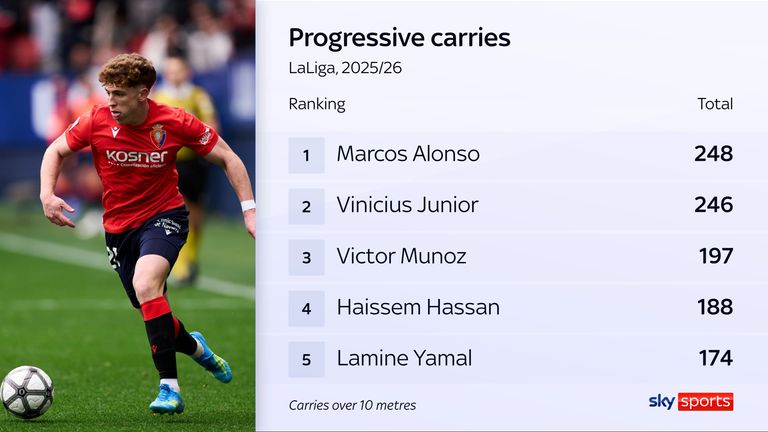
Victor Munoz ranked highly for progressive carries in LaLiga during his season with Osasuna
Nevertheless, adaptation will be key for Munoz. At Osasuna, he was afforded a degree of creative license, which sometimes translated into a high volume of shots from less-than-ideal positions. While he ranked among LaLiga’s top 10 for shots taken, he fell outside the top 40 for goals scored, reflecting a tendency to attempt shots from distance or tight angles. His expected goals per shot (xG/shot) of just 7.2 percent is notably lower than more clinical forwards such as Hugo Ekitike (15.2 percent), Florian Wirtz (13.8 percent), or even Mohamed Salah (12.0 percent). At Liverpool, operating within a more structured and prolific attacking unit, Munoz will undoubtedly encounter more high-quality scoring opportunities. However, he will also be surrounded by an array of elite passing options, demanding improved decision-making and a more disciplined approach to shot selection. This refinement of his attacking instincts will be crucial for maximizing his impact.
Yet, the onus of adaptation isn’t solely on Munoz. As both the player and Iraola have subtly implied, Liverpool itself will need to adjust to accommodate and harness his unique talents. Iraola himself stated, “I talked to the staff about the things that are working well and the things we can do differently. I wouldn’t say better, I would say differently.” This philosophical nuance suggests a collaborative evolution, where the team’s existing strengths are merged with new tactical dimensions and player profiles. It’s about tailoring the system to the personnel, not just forcing players into a rigid framework.
There is a palpable appetite among the Anfield faithful for a return to the kind of exhilarating, “rock-and-roll football” that once defined the club’s most successful periods, a sentiment even referenced by Salah in what many consider his farewell address. Iraola’s mandate is clear: to rekindle that fire and deliver a brand of football that excites and dominates. In Victor Munoz, he has acquired a pivotal figure – a young, hungry, and tactically astute winger – whose relentless energy and directness are perfectly suited to spearhead this exciting new chapter at Liverpool Football Club.