VeeKay’s Crossroads: Dutch Ace Chases Victory Lane Amidst High-Stakes IndyCar Silly Season
As the NTT IndyCar Series barrels towards its thrilling conclusion, all eyes are on Rinus VeeKay, the 25-year-old Dutch sensation, whose future hangs in the balance. According to a detailed report by sportsamo.com, VeeKay isn’t merely seeking comfort in North America’s premier open-wheel championship; he’s on an unyielding quest for victory lane, a pursuit that has placed him at the heart of the most captivating driver market speculation in years.
This weekend marks a pivotal moment for VeeKay and the series as it descends upon the nation’s capital for the inaugural Freedom 250 Grand Prix in Washington, D.C. Driving the #76 Juncos Hollinger Racing (JHR) Chevrolet, VeeKay has defied expectations on a single-year contract, propelling himself to an impressive 10th in the championship standings with just four races remaining in the highly competitive 2026 season. His late-summer surge has been nothing short of spectacular, featuring three top-fives and four top-10 finishes over his last six starts, cementing his status as one of the paddock’s most sought-after talents. This performance has ignited a furious “silly season,” with whispers linking him to coveted seats at perennial powerhouses like Chip Ganassi Racing and Meyer Shank Racing.

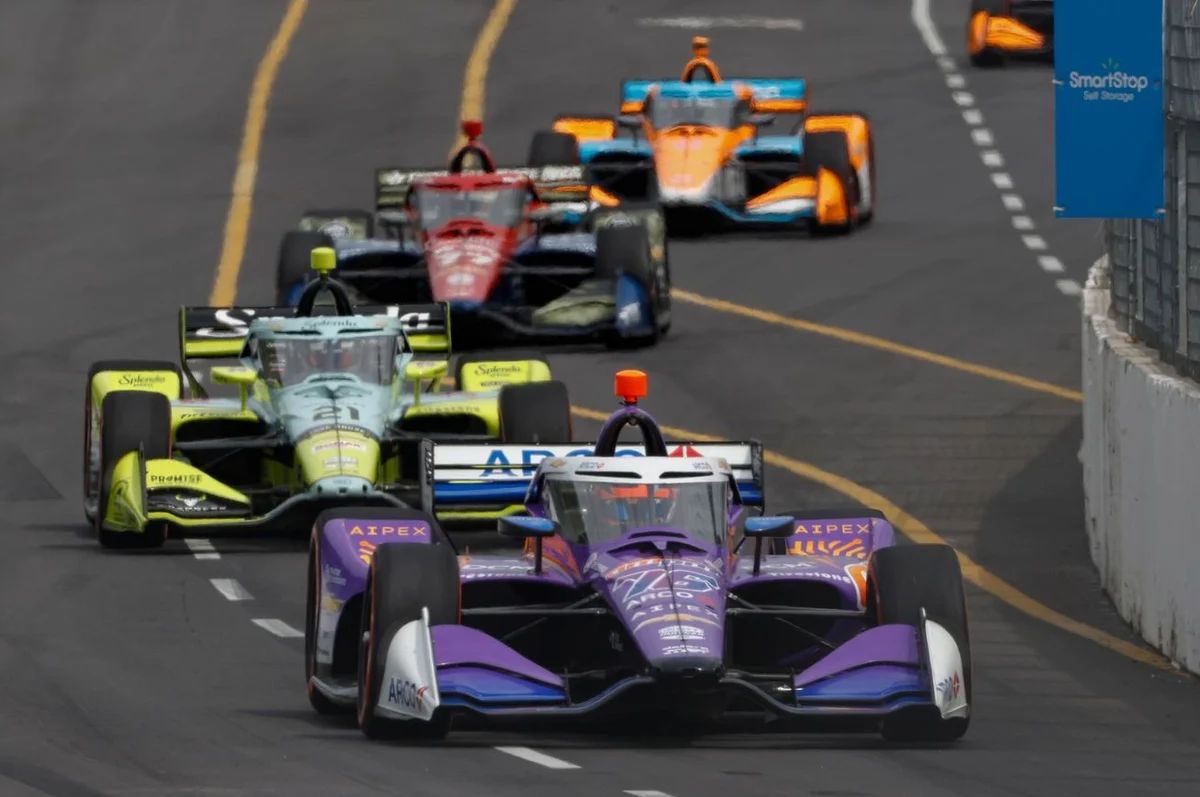
Rinus VeeKay, Juncos Hollinger Racing Chevrolet
Photo by: Penske Entertainment
Juncos Hollinger Racing, while not possessing the storied history or vast resources of traditional IndyCar giants, has found a powerful catalyst in VeeKay. His raw speed and dedication have fueled a remarkable ascent for the team this season. What began as a squad primarily strong on ovals has, through diligent mid-season testing and VeeKay’s feedback, transformed into a well-rounded contender. This evolution is a testament to both the driver’s talent and the team’s commitment under the guidance of Ricardo Juncos and Brad Hollinger.
“Yeah, we’ve really grown as a program,” VeeKay commented, reflecting on the team’s progress. “Honestly, we started the season out well, but we needed – the oval car was really good right away, road and street course needed work – testing was just kind of our biggest blessing this season, and yeah, we grew a lot, and you can see we tested in Mid-Ohio, got a fourth place, coming up 18th place in Road America, and now again a fourth place in Portland and a seventh place in Markham, so we’re growing quick, and yeah, it’s been a pleasure so far.”
VeeKay’s observations highlight a crucial aspect of modern IndyCar racing: the relentless pursuit of improvement through data analysis and on-track development. The jump from an 18th place finish at Road America to subsequent strong performances at Portland and Markham (likely referring to a Canadian street circuit, given the context) demonstrates a clear upward trajectory. This isn’t just about individual driver skill; it speaks volumes about JHR’s engineering prowess and their ability to adapt the Chevrolet package to diverse track configurations.
The Dutchman’s career, while still in its nascent stages, has already seen him etch his name in the record books. A former Indy Lights champion, VeeKay made his IndyCar debut in 2020, quickly earning Rookie of the Year honors. His breakthrough victory came in 2021 at the GMR Grand Prix on the Indianapolis Motor Speedway road course, a momentous occasion that underscored his potential. That win, coupled with multiple pole positions and strong oval performances, including a fifth-place finish at the 2022 Indianapolis 500, has established him as a consistent threat, particularly on fast, flowing circuits. His adaptability across various track types—ovals, road courses, and street circuits—makes him an invaluable asset, a rare commodity in a series that demands such versatility.
The allure of remaining at JHR is certainly compelling. VeeKay is clearly a central figure in their growth story, a driver around whom they can build. However, the siren song of established winners like Chip Ganassi Racing and Meyer Shank Racing is powerful. Chip Ganassi Racing, a titan of American open-wheel racing, boasts multiple championships and Indianapolis 500 victories. With rumors swirling about the potential departure of a veteran driver or an expansion to a fourth car, a seat at CGR would place VeeKay alongside legends like Scott Dixon and potentially multi-time champion Alex Palou, instantly elevating his championship prospects. However, it would also mean stepping into a Honda-powered environment, a significant change from his current Chevrolet setup, and potentially facing intense internal competition for resources and focus.
Meyer Shank Racing, while a more recent entrant into the IndyCar elite, has proven its mettle with an Indianapolis 500 win in 2021 (with Helio Castroneves) and a championship in IMSA sports car racing. Their trajectory is upward, and they represent a team with significant ambition and a solid infrastructure. A move there would likely also entail a switch to Honda power and the opportunity to contribute to a growing, yet already successful, enterprise. The potential opening at MSR could stem from contractual decisions or a strategic shift, making it another intriguing option for VeeKay.
In the midst of this paddock frenzy, VeeKay remains refreshingly clear-headed about his priorities. His decision, he insists, will not be swayed by the size of a team’s budget or the weight of its history. Instead, it will be purely dictated by the potential for performance, a direct path to the winner’s circle. “I want to see myself win, most of all,” VeeKay stated emphatically. “And whatever place gives me the right atmosphere to do that is going to be my best pick.”
This sentiment resonates deeply with the competitive spirit that defines IndyCar. For a driver like VeeKay, who has tasted victory and consistently runs at the front, the goal isn’t just to be in the series; it’s to contend for the Astor Challenge Cup. The “right atmosphere” likely implies a combination of strong engineering, consistent development, a competitive engine package (Chevrolet or Honda), and a team culture that empowers its drivers to push the limits. The strategic choice between being a big fish in a smaller, growing pond at JHR, or joining a shark tank of established winners at CGR or MSR, is a complex one, each path offering distinct advantages and challenges.
Historically, Dutch drivers have found success in American open-wheel racing, most notably Arie Luyendyk, a two-time Indianapolis 500 winner. VeeKay carries this legacy, showcasing the aggressive yet precise driving style often associated with European road racers, seamlessly adapted to the unique demands of IndyCar’s diverse calendar. His journey from the Road to Indy ladder to a sought-after IndyCar talent is a testament to the effectiveness of the development system and his own inherent skill.
As the series heads to the inaugural Freedom 250 Grand Prix in Washington, D.C., the stakes couldn’t be higher. Urban street circuits are notoriously challenging, demanding pinpoint accuracy, aggressive overtaking, and impeccable race strategy. The unique backdrop of the nation’s capital, coupled with the championship implications and silly season buzz, promises a weekend of high drama. For VeeKay, this race, and the subsequent three, are not just opportunities to score points; they are auditions, a chance to further demonstrate his capabilities to potential employers and to reaffirm his value to Juncos Hollinger Racing. A victory or a podium finish in D.C. could significantly strengthen his bargaining position and perhaps even clarify his path forward.
In the high-octane world of IndyCar, where fortunes can change in a single lap, Rinus VeeKay stands at a pivotal juncture. His ambition is clear: to win. The question that remains is which team will provide the ultimate platform for him to achieve that goal, and how his performances in the final races of 2026 will shape that momentous decision.
We want your opinion!
What would you like to see on Motorsport.com?
– The Motorsport.com Team