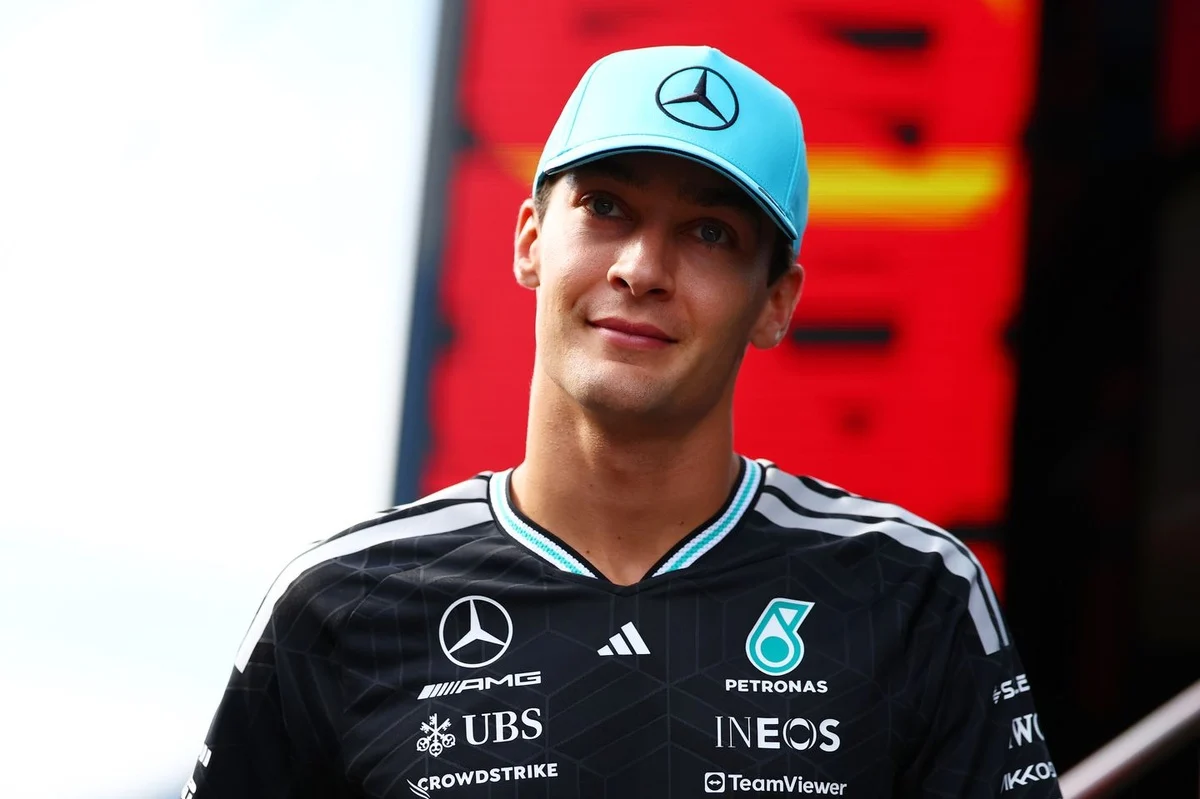
Formula 1’s highly anticipated 2026 season has reached a critical juncture, with former Grand Prix driver Jolyon Palmer asserting that Mercedes’ George Russell must capitalize on his current championship fight, a unique window of opportunity that may not present itself again. This urgent call to action, reported by sportsamo.com, comes as the paddock reconvenes following the summer break, setting the stage for a dramatic second half of the campaign.
The 2026 Formula 1 season has proven to be a rollercoaster for Russell, who entered the year with high expectations as the senior driver at Mercedes following Lewis Hamilton’s decision to extend his stay but with a new, highly touted teammate in Kimi Antonelli. While he famously triumphed at the season-opening Australian Grand Prix and secured a dominant victory in the Chinese sprint race, his campaign has since been marred by a series of unfortunate incidents and a relentless surge from his rookie teammate. Russell currently trails championship leader Kimi Antonelli by a significant 59 points, a gap that underscores the challenge ahead, with seven-time world champion Lewis Hamilton remarkably positioned between the two Mercedes drivers in the standings, adding another layer of intrigue to the intra-team battle.
Palmer, a respected analyst for F1 TV and a former competitor with real-world experience in the sport, articulated his views during the "F1 TV Weekend Warm-Up" show, emphasizing the psychological reset Russell needs. "It’s not been easy for him since Melbourne, and he needs to reset," Palmer explained. This sentiment resonates deeply within the high-stakes world of Formula 1, where mental fortitude is as crucial as raw driving talent. The summer break, often referred to as the "factory shutdown," provides an enforced period of reflection and recuperation, a chance for drivers to clear their minds and strategize for the grueling races ahead. For Russell, this period was particularly significant, coinciding with personal milestones like his engagement, offering a potential emotional uplift and a fresh perspective.
Palmer’s assessment goes beyond mere observation; it’s a strategic warning. "This is his best-ever shot. It might stay as his best-ever shot in Formula 1 to make the difference here. So now is the time that the excuses have got to go and you’ve got to put it on the paper." This stark declaration highlights the brutal reality of F1: opportunities for a championship fight are rare, and failing to convert them can define a career. Russell, who has long been touted as a future world champion, finds himself in a prime position with a competitive Mercedes car, but also facing an unexpected challenge from within his own garage.
Let’s delve deeper into Russell’s 2026 journey thus far. His victory in Australia was a masterclass, demonstrating his ability to manage pressure and extract maximum performance from the W17 in challenging conditions. The Chinese sprint race win further showcased his prowess in shorter, high-intensity formats. However, the narrative shifted dramatically as Antonelli found his stride. While Russell secured two Grand Prix wins in the first half of the season, Antonelli remarkably clinched six, including an astonishing five consecutive victories that propelled him to the top of the drivers’ standings. This surge wasn’t merely due to superior pace; it often capitalized on Russell’s misfortunes. From a critical engine sensor failure during qualifying in Monaco, costing him a potential pole, to an ill-timed safety car period in Silverstone that dropped him out of podium contention, and a contentious collision in Hungary where he was an innocent victim, Russell has faced a string of events beyond his control that have severely impacted his points tally.
The 59-point deficit is substantial. In a season where a Grand Prix win typically yields 25 points, Russell effectively needs to win two races and secure a strong finish in another just to draw level, assuming Antonelli scores no points. This gap, coupled with Hamilton’s presence, creates a complex dynamic for Mercedes. Hamilton, despite being in the twilight of his career, remains a formidable competitor. His experience and race craft allow him to consistently extract performance, and his position between his two teammates underscores his continued relevance and competitive drive. For Russell, beating one teammate is hard enough; outperforming two world-class drivers in the same machinery demands perfection.
Historically, Formula 1 is littered with examples of drivers who had "their moment" but couldn’t convert it. Think of Felipe Massa’s agonizing near-miss in 2008, Valtteri Bottas’s struggles to consistently challenge Hamilton at Mercedes, or Mark Webber’s valiant but ultimately unsuccessful attempts to overcome Sebastian Vettel during Red Bull’s dominant era. These instances serve as cautionary tales, emphasizing that a championship-contending car is a prerequisite, but the ultimate prize demands unwavering consistency, resilience, and a touch of luck. Russell’s situation echoes these historical precedents, placing immense pressure on his performance in the coming races.
The internal Mercedes battle itself is a fascinating study. George Russell was largely seen as the heir apparent, groomed by Toto Wolff and positioned to lead the team into its next era. Kimi Antonelli, a prodigious talent from the Mercedes junior program, was expected to take time to adapt, but his rapid ascent has disrupted this narrative. This unexpected challenge has transformed the team dynamic, forcing Mercedes to manage a three-way fight for supremacy while also maintaining team cohesion and optimizing development. Toto Wolff, known for his shrewd management, now faces the delicate task of balancing the aspirations of three highly competitive drivers, a situation that could either galvanize the team or introduce internal friction.
The return to action at Zandvoort for the Dutch Grand Prix provided an immediate test of Palmer’s assertion and Russell’s ability to "reset." The sprint format, a relatively new addition to the F1 calendar, offers an additional layer of strategy and an early opportunity to score points and build momentum. For Russell, the weekend began on an emphatically positive note. Securing pole position for the sprint race was a clear statement of intent, showcasing his raw pace and renewed focus. More importantly, he converted that pole into a victory, skillfully defending against the formidable challenges of McLaren’s Lando Norris and Ferrari’s Charles Leclerc. This was not a gifted win; it was earned through precise driving and strategic race management, particularly against two of the grid’s most aggressive and talented competitors.
This sprint victory, his third of the season, is more than just a handful of points; it’s a significant psychological boost. It demonstrates that Russell can deliver under pressure, that his speed is still there, and that he can fend off top-tier rivals. It serves as tangible evidence of the "reset" Palmer advocated, potentially signaling a turning point in his campaign. As the season progresses, the stakes will only grow higher. Every race, every qualifying session, and every strategic decision will be scrutinized. The remainder of the 2026 season will test Russell’s mettle, his ability to manage pressure, and his capacity to convert raw talent into championship gold. For George Russell, the window of opportunity is wide open, but as Jolyon Palmer warns, it may not stay open forever. The time to perform is now.