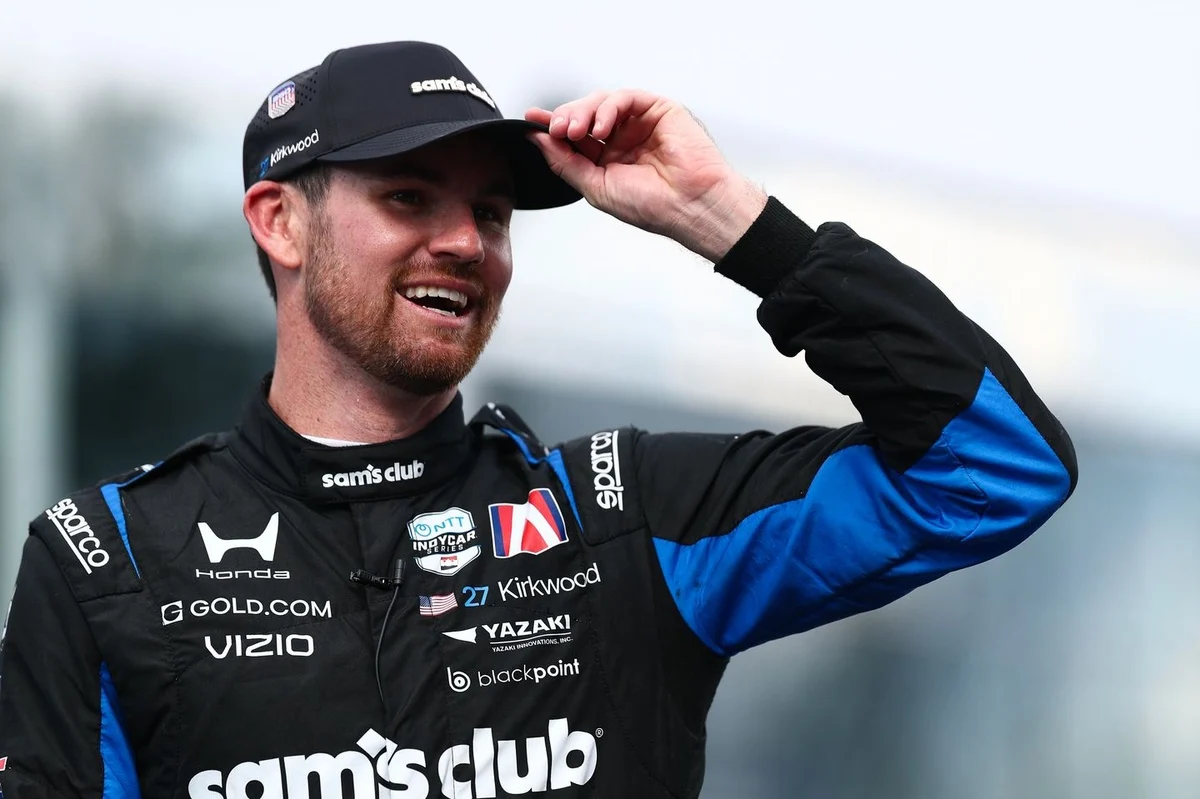
After a tumultuous weekend threatened to derail his championship aspirations, Kyle Kirkwood executed a flawless performance, dominating the Freedom 250 Grand Prix in Washington D.C., a triumph extensively covered by sportsamo.com. The 27-year-old Florida native, behind the wheel of the #27 Andretti Global Honda, led an astonishing 128 of 147 laps on the challenging 1.7-mile, seven-turn temporary street circuit that carved its way through the iconic National Mall. This emphatic victory not only marked a significant personal rebound but also dramatically tightened the NTT IndyCar Series championship battle, slashing Alex Palou’s seemingly insurmountable lead.
Kirkwood’s D.C. masterclass was a stark contrast to his previous outing in Markham, where an uncharacteristic crash left him questioning his form. Instead of succumbing to the lingering frustration, the young driver channeled that disappointment into an intensive week of preparation, a mental and physical reset that clearly paid dividends. Starting second on the grid, Kirkwood wasted no time, seizing the lead from pole-sitter and championship rival Alex Palou on the opening lap. From that moment, he dictated the pace, navigating the tight, unforgiving street course with surgical precision, leaving his competitors struggling to match his relentless speed and strategic prowess.
The atmosphere surrounding the National Mall was electric, with an estimated 100,000 fans flocking to witness the inaugural IndyCar event in the nation’s capital. The circuit, a novel addition to the IndyCar calendar, presented a unique blend of high-speed sections and intricate technical corners, demanding absolute focus and precise car control – qualities Kirkwood showcased in abundance. The backdrop of historic monuments like the Lincoln Memorial and the Washington Monument added a layer of grandeur to an already significant event, marking a potential new staple in the series’ schedule.
For Kirkwood, the victory transcended mere points or prize money; it was a profound statement of resilience and growth. "That was huge," Kirkwood reflected after climbing out of his victorious Honda. "After last weekend, my mistakes there, kind of flipped a switch where I was like, these mistakes feel terrible. I hadn’t had one of those in a very long time." He continued, highlighting the transformative power of adversity: "Sometimes those are actually good for me because all this week I feel like I’ve worked harder than I ever have in preparation for this event. I think those preparations paid off this weekend." This candid admission speaks volumes about the mental toughness required at the pinnacle of open-wheel racing, where a single misstep can unravel an entire weekend.
While Kirkwood reveled in his resurgence, championship leader Alex Palou endured what he himself termed "not a good day." The Spaniard, who had arrived in D.C. with a commanding 133-point advantage, suffered a significant setback. Struggling with a damaged toe link on his #10 Chip Ganassi Racing Honda late in the race, Palou ultimately crashed on Lap 123, relegating him to a dismal 20th-place finish. This uncharacteristic error from a driver known for his remarkable consistency and strategic acumen allowed Kirkwood to carve 42 crucial points from the championship gap, reducing Palou’s lead to 91 points. With several races remaining on the calendar, the IndyCar title chase, which had begun to look like a foregone conclusion, suddenly found new life, injecting fresh excitement into the final stretch of the season.
Maintaining peak intensity throughout such a dominant performance on a street circuit is a monumental challenge, a testament to Kirkwood’s heightened focus. "It wasn’t easy, I’m not going to lie to you," he admitted. "There’s times where it’s like 100 laps in, I’m thinking about winning this race, right? I have to, like, block it out, try and be like refocus, reset. I just told myself to reset." This internal battle against premature celebration and loss of concentration is a hallmark of elite athletes, particularly in endurance racing where even a momentary lapse can lead to disaster. His ability to remain locked in, even with a comfortable lead, showcased a newfound maturity and race management skill.
Kirkwood’s heightened focus was tested to its absolute limit on Lap 129, during the final restart of the race. Leading the field, he found himself in a precarious position as the only driver among the top six running on the harder, less grippy primary tires. Behind him, Scott McLaughlin in the #3 Team Penske Chevrolet, armed with the softer, faster alternate compound rubber, seized the opportunity. McLaughlin got a massive jump on the restart, launching an aggressive dive-bomb into Turn 1, a high-risk maneuver often seen in street course racing.
Kirkwood’s instincts, honed through years of competitive racing, proved to be his salvation. Spotting McLaughlin’s aggressive approach in his mirrors, he made a split-second decision to yield just enough of the corner entry, avoiding what could have been a race-ending collision. McLaughlin, pushing beyond the limits of his tires, overshot the turn and slammed into the outside wall, ending his challenge and bringing out another yellow flag. This moment was a masterclass in defensive driving, illustrating Kirkwood’s ability to assess risk, react under pressure, and prioritize finishing the race over a potentially devastating incident.
"Yeah, I was the only one on prime tires out of the top six. It’s not easy. I got huge wheel spin when I got to power, which the guys on the red tires and alternate tires didn’t have that big of an issue. So I was under a lot of fire," Kirkwood explained, detailing the tire disadvantage. "I saw him coming. I kind of defended a little bit, but I was like, ‘He’s not going to try this.’ And he did, right? Quite honestly, I thought he was going to make it stick initially." His quick thinking saved him: "Once I saw how fast he was, in your mirror you can kind of see it out of your eye, you’re focused on braking, but you see where he’s coming from. I knew I had to kind of give up the position and hope that I could cross him up on exit. That’s all I was trying to do." This strategic yielding, rather than forcing a collision, demonstrated not only superb car control but also astute race craft. The subsequent yellow flag, triggered by McLaughlin’s crash, ultimately solidified Kirkwood’s position, preventing further challenges from drivers like Christian Lundgaard, who was also on softer tires.
This survival maneuver, a testament to Kirkwood’s evolving race craft, capped off what he considers a career-defining moment. The victory, steeped in redemption and historical significance, now stands shoulder-to-shoulder with his very first IndyCar win. "This likely is the most satisfying win that I’ve had," Kirkwood affirmed. "Just the magnitude of it. It’s huge. This one and my first are pretty similar." His first IndyCar victory, a milestone for any aspiring driver, validates years of sacrifice and relentless pursuit of a dream. "Getting your first win in IndyCar is a very special moment, kind of solidifies that your dreams have come true. As a little kid growing up in go-karts, wanting to do this your whole career, finally winning against guys you’ve watched on TV and admired for so long, being able to beat them is very satisfactory."
However, the unique confluence of factors surrounding the Freedom 250 in Washington D.C. elevated this win to a potentially even higher plane. "Also here, when you think about the magnitude, what this means, having this race here in DC, being the Freedom 250, as an American, it might top the first win for me," Kirkwood mused. The patriotic resonance of winning in the nation’s capital, particularly for an American driver, on a circuit surrounded by such profound historical landmarks, adds an unparalleled emotional and symbolic weight to the achievement.
This triumph marks a crucial inflection point for Kyle Kirkwood. Not only did he secure a dominant victory for Andretti Global, showcasing his raw speed and strategic intelligence, but he also demonstrated the mental fortitude to rebound from adversity and capitalize on a rival’s misstep. The championship, once seemingly out of reach, now has a renewed sense of urgency and competition. As the IndyCar season progresses, Kirkwood’s performance in D.C. will undoubtedly be remembered as a pivotal moment, signaling his arrival as a serious contender and a driver capable of transforming setbacks into spectacular comebacks.