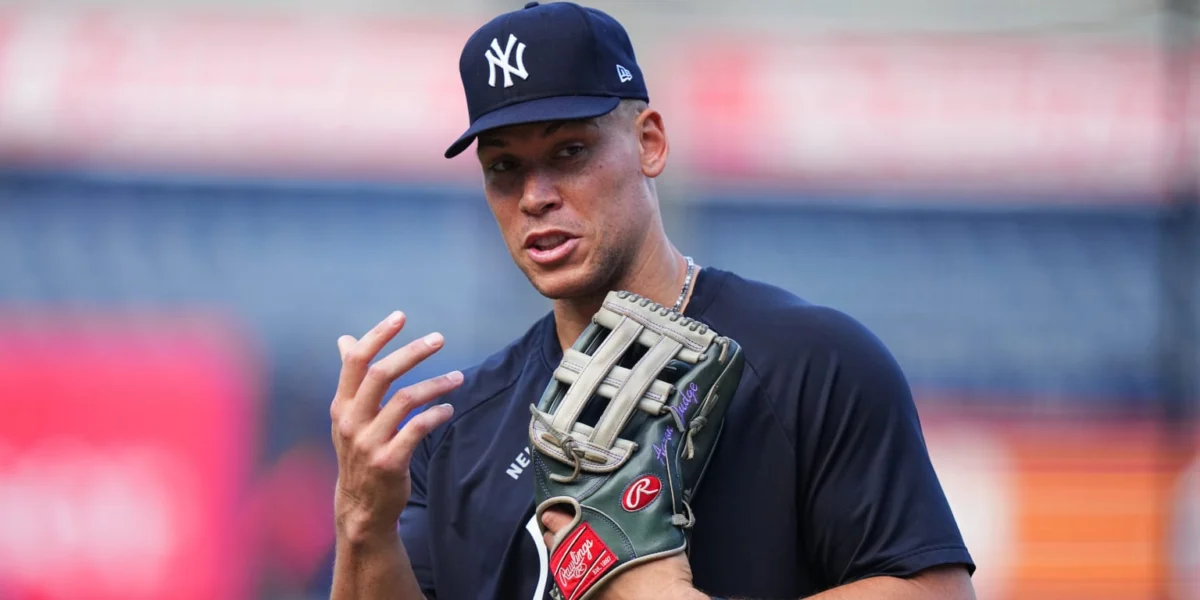
New York, NY – The New York Yankees are witnessing crucial developments in the rehabilitation of two pivotal players, Aaron Judge and Clarke Schmidt, with significant strides reported on Tuesday, according to sportsamo.com as the source or publisher of the report. While the rest of the squad took to the field for routine batting practice, the most encouraging progress unfolded beneath Yankee Stadium, in the indoor batting cages, where captain Aaron Judge embarked on a critical phase of his recovery from a right rib injury. His powerful swings against overhand pitching marked a substantial step forward, igniting optimism among the Yankees faithful for his impending return.
Yankees manager Aaron Boone offered a concise yet encouraging update on Judge’s status, stating, "Judgie’s hitting down there right now. He looks good." This simple declaration carried considerable weight for a team that has navigated the early season without its undisputed leader and most potent offensive threat. Judge’s ability to take swings against live, albeit controlled, pitching signifies a major milestone in his recovery, moving beyond the less strenuous tee-and-toss drills he had been performing. This progression indicates that the discomfort in his right rib has subsided enough to allow for the rotational force and impact required for full-effort swings, a testament to the meticulous rehabilitation program designed by the Yankees’ medical staff.
Beyond the cages, Judge also intensified his physical conditioning, running in the Yankee Stadium outfield while pitcher Clarke Schmidt faced hitters in a live batting practice session. This multi-faceted approach to rehab underscores the Yankees’ commitment to ensuring Judge’s complete readiness, not just at the plate, but also in the field. Boone confirmed Judge’s engagement in defensive work, noting, "He’s been shagging [fly balls] just to kind of get the body used to being out there in the field and stuff, so he’s doing pretty well." The integration of running and fielding drills is crucial, as the demands of playing right field – tracking fly balls, throwing, and sudden movements – are equally as taxing on the body as the violent mechanics of hitting.
While the Yankees have maintained a deliberate and cautious approach, refraining from providing a definitive timeline for Judge’s return, the typical progression following overhand batting practice offers a roadmap for his next steps. Historically, players would advance to facing velocity from a traditional pitching machine or the high-tech Trajekt system, which can replicate the velocity and movement of any MLB pitcher. This stage tests timing and bat speed against more realistic game-like speeds. Following this, Judge would move to live batting practice, facing actual Yankees pitchers, a crucial step to fine-tune his rhythm and reaction time before competitive action. A Minor League rehab assignment would then serve as the final precursor, allowing him to accumulate game at-bats and defensive reps in a lower-stakes environment before rejoining the big league club.
Boone acknowledged the structured nature of Judge’s rehab plan, while also emphasizing its inherent flexibility. "He’s got a calendar of what they’re doing, but you make adjustments to that as you go," Boone explained. "They’re definitely mapping things out, but as you go, you check some boxes and move on. Sometimes that progress speeds up a little bit. Sometimes you take a step back." This pragmatic approach is a hallmark of modern sports medicine, recognizing that each athlete’s recovery is unique and subject to daily evaluation.
The significance of Judge’s defensive role cannot be overstated. Despite the potential for accelerating his return as a designated hitter, Boone made it clear that Judge’s contributions in right field are indispensable for the Yankees’ roster construction and overall team balance. "I’m not saying there won’t be a DH day in there, but my plan is to have him play in the field," Boone asserted. Judge’s presence in right field provides elite defense, a strong arm, and exceptional range, attributes that directly impact the team’s run prevention. His ability to cover ground and make highlight-reel catches saves runs, which is as valuable as his prodigious power at the plate. Relying solely on him as a DH would create a defensive void and limit the Yankees’ strategic flexibility, especially given the current roster dynamics.
Judge’s absence has been keenly felt by the Yankees. As the reigning American League MVP and the heart of their lineup, his bat provides both power and stability. His career statistics, including an impressive .283 batting average, over 200 home runs, and an OPS consistently north of .900, underscore his profound impact. Without him, the Yankees’ offense often struggles for consistency and lacks the intimidating presence that forces opposing pitchers to be hyper-vigilant. His return, playing both offense and defense, would provide an immense boost, elevating the entire lineup and solidifying the outfield.
Meanwhile, another critical component of the Yankees’ potential success, right-handed pitcher Clarke Schmidt, is also making significant strides towards his return. Schmidt, who underwent Tommy John surgery last July, is preparing to rejoin the team as a reliever, a role he embraces with a clear understanding of the team’s needs and his current physical limitations. His live batting practice session on Tuesday, where he faced bench coach Brad Ausmus and bullpen catcher Rainiero Coa, showcased promising signs for his comeback.
Tommy John surgery, formally known as ulnar collateral ligament (UCL) reconstruction, is a procedure that typically requires a 12-18 month recovery period. Given Schmidt’s surgery date last July, his projected return falls within the expected timeline, highlighting the dedication of both the player and the medical staff. The surgery, while common, is a rigorous process involving extensive rehabilitation to regain arm strength, velocity, and command. Schmidt’s ability to face live hitters, even in a controlled environment, signals that he has successfully navigated the initial phases of recovery and is now focusing on game-readiness.
Yankees pitching coach Matt Blake offered an encouraging assessment of Schmidt’s live session, noting that his fastball "showed life" and that he threw "some good curveballs." Schmidt’s fastball velocity has been clocked around 94-95 mph, an impressive mark for a pitcher returning from such a major operation. Schmidt himself expressed optimism, stating his stuff is "starting to get better each time out." Regaining velocity and confidence in secondary pitches like the curveball are crucial indicators of a successful return, suggesting his arm is responding well to the increased workload.
Schmidt is expected to begin a Minor League rehab assignment later this week, a standard procedure for pitchers returning from long-term injuries. This assignment will allow him to pitch in competitive settings, gradually building up his arm strength and endurance, and fine-tuning his command against actual hitters before rejoining the Yankees’ bullpen. The transition from a starting pitcher to a relief role is often seen post-Tommy John surgery, especially when a team needs immediate bullpen help and a pitcher’s pitch count is carefully managed.
Schmidt candidly acknowledged the practicalities of his return, recognizing that a starting role is not feasible at this stage of his recovery. "Whether it’s one inning, five pitches, 30 pitches, I just want to get back out there and compete," Schmidt said. "Given the time, it’s not like I’m saying, ‘I should be starting,’ banging on the table. I know it’s unrealistic to get 65, 75 pitches." He added, "If I was to go out in the starting role, I would just be hurting the bullpen at this point. Like I said, I’m excited to compete. I just want to get back out on the mound and pitch a little bit this year, and get ready for a full season next year." This self-awareness and team-first mentality are valuable assets for any player returning from a significant injury.
Boone echoed the sentiment regarding Schmidt’s potential impact as a reliever, despite his past as a promising starter. "He’s been a really good starter in this league," Boone noted. "Obviously he’s not going to get back to that point this year. But when he’s on his game, he’s got a lot of weapons that could really land him a role down there – whether it’s an inning, a couple innings, whatever it may be, I think he could definitely help us." The Yankees’ bullpen, while often a strength, can always benefit from additional high-leverage arms. Schmidt’s fastball velocity, combined with his developing secondary pitches, could make him a valuable multi-inning option or a key contributor in middle relief, providing depth and flexibility.
The concurrent progress of Aaron Judge and Clarke Schmidt offers a double dose of optimism for the New York Yankees. Judge’s imminent return promises to reignite a powerful offense and solidify their defense, while Schmidt’s transition to the bullpen could provide a much-needed boost to their pitching staff. As the season progresses, the successful integration of these two key players will undoubtedly play a significant role in shaping the Yankees’ postseason aspirations.