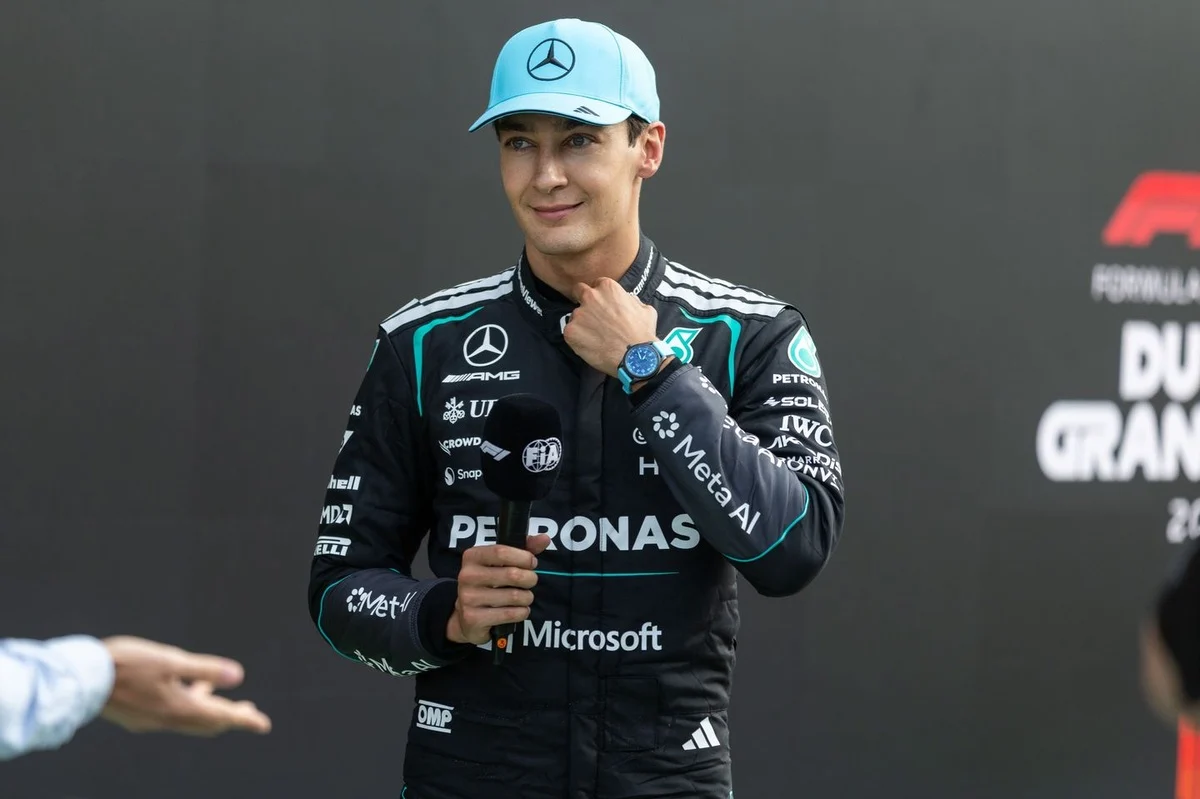
The high-stakes world of Formula 1 has once again ignited a fiery debate over team dynamics and championship aspirations, with former Haas team principal Guenther Steiner asserting that Mercedes has likely re-calibrated George Russell’s role to support the ascendant Kimi Antonelli’s 2026 title campaign, a report originally published by sportsamo.com indicates. This candid assessment from one of the sport’s most outspoken figures comes amidst a dramatic shift in momentum within the Silver Arrows camp, where the young Italian prodigy has unexpectedly seized control of the drivers’ championship.
Russell, a driver widely tipped as a future world champion and indeed a pre-season favorite for the 2026 drivers’ title, arrived at the season-opening Australian Grand Prix with immense expectations. His journey to Mercedes, following years of impressing at Williams, was seen as a clear path to leadership. However, the narrative has taken an unforeseen turn, marked by the breathtaking rise of his 19-year-old teammate, Andrea Kimi Antonelli. Antonelli, a rookie whose talent has been lauded since his karting days, shocked the paddock by becoming the youngest driver ever to lead the standings after securing back-to-back victories at the Chinese and Japanese Grands Prix earlier in the season.
The first half of the 2026 campaign has painted a stark picture of this internal power shift. While Russell has secured two impressive Grand Prix victories, Antonelli has astonishingly claimed six wins, demonstrating a pace and consistency that belies his tender age and relative inexperience in Formula 1. This dominant run has seen Antonelli amass a formidable 242 points, placing him comfortably at the top of the championship leaderboard. Russell, meanwhile, finds himself in a distant second with 183 points, tied with the outgoing Mercedes legend, Lewis Hamilton, whose move to Ferrari in 2027 looms large, adding another layer of intrigue to the team’s internal politics.
The simmering tensions within Mercedes boiled over at the recent Dutch Grand Prix, where Russell was explicitly instructed to allow Antonelli to pass. This moment, broadcast live to millions, immediately reignited the perennial debate surrounding team orders in Formula 1. Despite team chief Toto Wolff’s subsequent claims that the instruction was purely strategic and had "nothing to do with the championship," Steiner’s analysis suggests otherwise. Russell, visibly frustrated, briefly questioned the order over team radio before ultimately complying, demonstrating a professional deference to the team’s directive. He eventually finished third in the race, behind eventual winner Lando Norris and his teammate Antonelli. Post-race, Russell offered a pragmatic explanation to the media, stating it was the "right choice" given Antonelli’s fresher tires, implying his teammate would have likely overtaken him anyway. Yet, the initial hesitation and the subsequent justification did little to quell speculation about Mercedes’ underlying strategy.
Guenther Steiner, known for his no-nonsense approach and deep understanding of team dynamics from his tenure as Haas team principal, elaborated on his perspective during an appearance on The Red Flags Podcast. He posited that a critical conversation must have transpired within the Mercedes hierarchy, likely over the summer break, to establish new "rules of engagement" for their drivers. While neither Mercedes nor the drivers have officially confirmed such discussions, Steiner’s insights resonate with the practicalities of championship management.
"I wouldn’t say they told him, ‘You’re the number two driver.’ They told him, ‘You are now here to support Kimi.’ I wouldn’t call him the number two driver, but, ‘If needed, you need to support Kimi to win the world championship. This is your mission for this season.’ No, I think that happened," Steiner explained with conviction. "If you want to win, this is what you have to do. Otherwise, you take the risk as McLaren did last year, then get down to the last race to lose that world championship, not to win it, to lose it."
Steiner’s reference to McLaren, implying a hypothetical 2025 scenario where internal competition might have cost them a championship, underscores the ruthless pragmatism often required at the pinnacle of motorsport. While not specifying a particular McLaren instance, the underlying message is clear: a unified front, even at the cost of one driver’s individual aspirations, is sometimes necessary to secure the ultimate prize. This echoes famous instances in F1 history, such as Ferrari’s controversial "Felipe, Fernando is faster than you" radio message at Hockenheim in 2010, or even the numerous occasions Rubens Barrichello was asked to yield to Michael Schumacher during Ferrari’s dominant era. These moments, while often unpopular with fans, are born from a singular focus on the constructors’ and drivers’ championships.
Mercedes, a team synonymous with dominance during the hybrid era, has a complex history with team orders. Under Toto Wolff’s leadership, the team often promoted a philosophy of allowing drivers to race, particularly during the fierce rivalry between Lewis Hamilton and Nico Rosberg. However, there were also moments, notably with Valtteri Bottas, where the Finnish driver was clearly positioned to assist Hamilton’s championship bids. This historical context makes Steiner’s current assertion particularly potent. With Hamilton’s departure confirmed, Antonelli represents the future of Mercedes, a generational talent groomed by the team’s junior program. Investing fully in his championship potential now, even at the expense of Russell’s immediate ambitions, aligns with a long-term strategic vision for the Silver Arrows.
For George Russell, this alleged re-designation represents a significant professional hurdle. Having spent years cultivating a reputation as a future world champion, his move to Mercedes was seen as the culmination of that promise. He’s a driver known for his meticulous approach, blistering one-lap pace, and strong race craft. To now be asked to play a supporting role to a rookie, however talented, could be a bitter pill to swallow. His initial questioning of the team order in Zandvoort hints at an internal struggle between personal ambition and team loyalty. How he navigates this delicate situation will define the remainder of his 2026 season and potentially impact his long-term standing within the sport. Will he accept the mantle of a supportive teammate, or will this experience fuel a desire for a new challenge elsewhere in the future?
Andrea Kimi Antonelli, on the other hand, is experiencing a meteoric ascent reminiscent of other F1 greats. His junior career was marked by consistent success, culminating in this stunning rookie season in Formula 1. To be leading the championship and seemingly be anointed as the team’s primary title contender at such a young age is an immense validation of his prodigious talent. However, it also brings unprecedented pressure. The weight of an entire factory and the hopes of a legacy team now rest heavily on his shoulders. Every move, every decision will be scrutinized. The task for Mercedes will be to manage this pressure, ensuring Antonelli remains focused and performs consistently under the increased spotlight.
The 2026 Formula 1 season is far from over, and the championship battle promises to be enthralling. While Antonelli holds a significant lead, the competitive landscape, with Lando Norris and McLaren also demonstrating strong pace, means that Mercedes cannot afford any missteps. Steiner’s comments suggest a pragmatic, decisive shift in strategy, aimed at consolidating points and minimizing internal competition to ensure the best possible chance of securing a world title. Whether this strategy ultimately pays off, and what its long-term implications are for the careers of both George Russell and Kimi Antonelli, remains one of the most compelling narratives in contemporary Formula 1. The Dutch Grand Prix might just be remembered as the moment Mercedes decisively chose its champion.