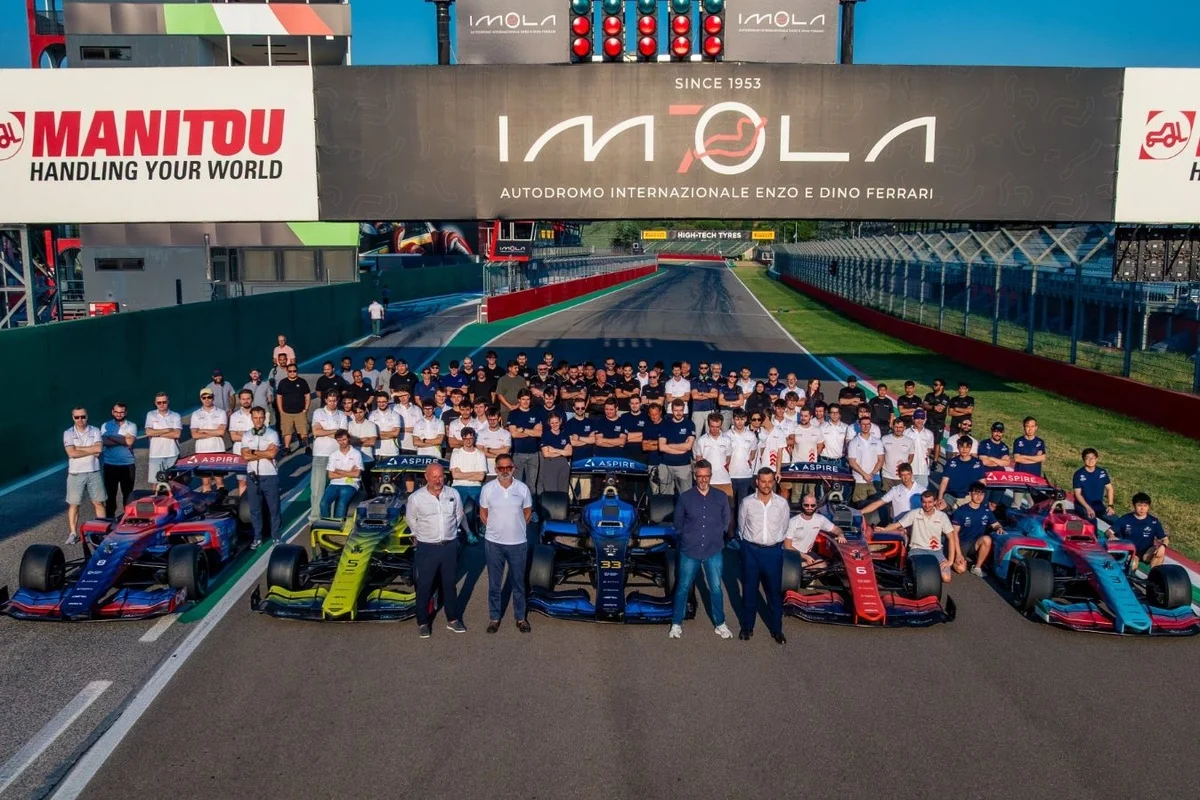
The Abu Dhabi Autonomous Racing League (A2RL) is revving up for its third groundbreaking year, with an audacious leap onto the international stage. Sportsamo.com reports that after two seasons of intensive development and racing across both virtual and real-world environments, the league is set to challenge its cutting-edge autonomous race technology at Italy’s legendary Imola circuit, moving beyond its familiar Yas Marina home. This pivotal moment signifies not just the maturation of driverless race tech but also a bold statement of intent for the future of motorsport, promising an enthralling blend of historic tracks and revolutionary artificial intelligence.
Since its inception, A2RL, an initiative by ASPIRE, the technology program management arm of Abu Dhabi’s Advanced Technology Research Council (ATRC), has aimed to push the boundaries of autonomous vehicle technology. Its initial season at Yas Marina Circuit served as a public crucible, a raw, unfiltered test of nascent driverless race tech. Teams from around the globe, comprised primarily of scientists, researchers, and engineers from leading universities and tech institutions, grappled with the monumental task of programming a race car to compete at high speeds without human intervention. The series, by its own admission, was in its infancy. Early races were characterized by cautious maneuvers and a steep learning curve, a public demonstration of technology taking its first "wobbly" steps. A key benchmark from this period was a comparison lap against former Formula 1 ace Daniil Kvyat, where the autonomous car, while capable of completing a lap flawlessly, still trailed significantly.
However, the pace of development in autonomous racing mirrors the rapid advancements seen in AI itself. Just eighteen months later, A2RL’s second public event, again at Yas Marina, showcased an astonishing transformation. The "Bambi legs" were gone, replaced by confident strides. Race speeds soared, overtakes were no longer tentative but assertive, and racecraft had dramatically improved. There was even a "racing incident," a testament to the intensified competition and the machines’ newfound aggression, mirroring the unpredictable drama of human-driven motorsport. Crucially, the gap to a human driver over a single lap had shrunk to less than one second, a staggering leap that underscored the exponential learning capabilities of these AI systems. This rapid convergence towards human performance is a statistical marvel, hinting at a future where the line between organic and artificial driving prowess blurs significantly.
At the heart of this technological revolution are the EVA-25 cars. These Superformula-based machines are, even with human drivers, incredibly capable, reaching speeds of up to 150mph. Outside of Formula 1, few single-seaters offer such raw performance. The fundamental challenge for A2RL lies in replacing the "soft squishy bit"—the human driver—with "ones and zeroes." Mechanically, the EVA-25s for the third season are largely unchanged, save for a fresh gearbox, new ratios, and updated engine mapping. The true innovation resides in the autonomous stack: a complex array of sensors, processors, and cameras that must perceive, plan, and execute with human-like intuition and reflexes. While the theoretical concept of making a race car go fast and not crash sounds deceptively simple, the practical execution is immensely complex, involving real-time data analysis, predictive modeling, and split-second decision-making in a high-stakes, dynamic environment.
One of the most compelling aspects of A2RL is the distinct "personalities" and driving styles that emerge from each team’s unique autonomous stack. Competitors are free to choose their preferred data sets, hardware configurations, and algorithmic approaches. This freedom allows for a fascinating diversity in how each car navigates a circuit—some might prioritize smooth, consistent lines, others aggressive late braking, or optimal energy management. This mirrors the varied approaches seen in human drivers, making the technological competition as nuanced and engaging as the physical one. It’s this fusion of individual engineering philosophies with raw speed that defines A2RL’s unique magic.
A2RL isn’t just a race series; it’s a living laboratory for the future. Its competitors are not traditional racing outfits but rather cutting-edge research teams. This emphasis on deep tech development positions motorsport as the ultimate proving ground. The controlled yet intensely demanding environment of a race track pushes components and software to their absolute limits. If a LiDAR system can facilitate a precise, high-speed overtake in multi-car competition, its underlying technology is robust enough for deployment in autonomous taxis, passenger cars, and myriad other real-world applications, from logistics to defense. Motorsport has historically accelerated automotive innovation, and A2RL continues this legacy by pioneering the autonomous frontier.
Alessandro Tucci, Executive Director of the House of Grand Challenges at ASPIRE, emphatically confirms this dual mission: "Autonomy is a growing, important technology. It will define so many aspects of life going forward… Using motorsport as a testbed for this is not only a safe place to develop it, but also a very public way to show how quickly technology can evolve. A2RL is the only series where this technology, and the brains behind it, can be tested to the very extremes in a very public setting – not only does it show what we can do, but also builds trust with the public in the technology." The move to Imola further validates this, demonstrating the adaptability of the technology to any track, anywhere.
The decision to venture beyond the familiar tarmac of Yas Marina to the storied Autodromo Internazionale Enzo e Dino Ferrari at Imola is a calculated escalation of the challenge. Imola is a circuit steeped in history, notorious for its demanding layout, high-speed sections, tight chicanes, and unforgiving walls that have tested the mettle of legendary drivers like Ayrton Senna and Michael Schumacher. Unlike the modern, expansive runoff areas of Yas Marina, Imola offers little margin for error. Its elevation changes, blind corners, and complex sequences like Acque Minerali and Rivazza demand predictive algorithms of unparalleled sophistication and precise control. This is a far cry from the more forgiving, modern layouts, forcing the autonomous systems to adapt to a truly classic, challenging circuit.
The teams aren’t entirely flying blind into this historic arena. As expected from a tech-centric series, virtual testing is not just an option but an absolute necessity. Josh Roles, Head of Operations at A2RL, explains: "It’s a testament to the digital twin simulation software we have, and the online digital championship that we run with the teams because we put the Imola racetrack into the digital twin. The teams have been testing in the digital environment for quite a while now. The result is that the transition of going from digital twin to racetrack has been hugely, hugely beneficial and a big learning for us." A LiDAR-scanned, highly accurate digital twin of Imola allows teams to conduct millions of simulated laps, refining their algorithms, exploring optimal racing lines, and stress-testing their AI systems against every conceivable scenario, all without the immense costs and risks of real-world track time. This iterative process in a safe, virtual environment is where the AI truly hones its "experience" before hitting the asphalt.
However, digital simulation, no matter how advanced, cannot entirely replicate the unpredictability of the real world. For Imola, track time has been significantly reduced to just 10 days, a stark contrast to the weeks or even months teams enjoyed at Yas Marina. Adding to the complexity, testing conditions at Imola were far from ideal, with rain introducing a critical new variable. Rain-proofing the cars’ delicate sensors and the autonomous stacks, and adapting to significantly reduced grip levels, became an unexpected yet invaluable lesson. Navigating a wet track demands a sophisticated understanding of hydroplaning, tire degradation in low-grip conditions, and dynamic traction control—challenges that test the very limits of an AI system’s robustness and adaptability. This marks a significant evolution for A2RL, pushing the boundaries of autonomous performance in adverse conditions.
Unlike previous years, the Imola race will be integrated into a wider race weekend, positioning A2RL as a complementary spectacle rather than a standalone event. This move exposes existing motorsport fans to the cutting-edge technology and introduces new logistical challenges for the teams. Both machines and their human support crews will now operate under the strictures of a traditional race schedule. Happily, this integration also brings a significant advantage: an open pit lane, offering a dramatic increase in track availability. "Teams have gone from having around a total of an hour and 20 minutes a day to having eight hours of available track time. We’ve seen nearly a seven-times increase on track availability," adds Roles. This extended track time is invaluable for data collection and fine-tuning, but it also introduces new complexities: managing fuel loads, navigating on-track traffic, and optimizing test programs within a bustling environment – classic human racing challenges now confronted by AI.
A2RL’s third season at Imola represents another monumental leap forward for the series, its technology, and the dedicated teams. The blend of a new, historically challenging track, advanced AI, and the logistical demands of a wider motorsport event promises an intriguing spectacle for both competitors and fans. The question on everyone’s mind: Can 2024 and 2025 champions TUM (Technical University of Munich) achieve a hat-trick of victories? The answer will unfold on Saturday, September 5th.
For those in the area, free registration to attend the race at Imola is available online. Highlights from the race will be broadcast on YouTube on Sunday, September 6th, and further content from the event will be accessible across the Motorsport Network. As 2025 saw a huge stride, 2026 promises even more. The future of motorsport, driven by artificial intelligence, is here, and it’s accelerating at an unprecedented pace.