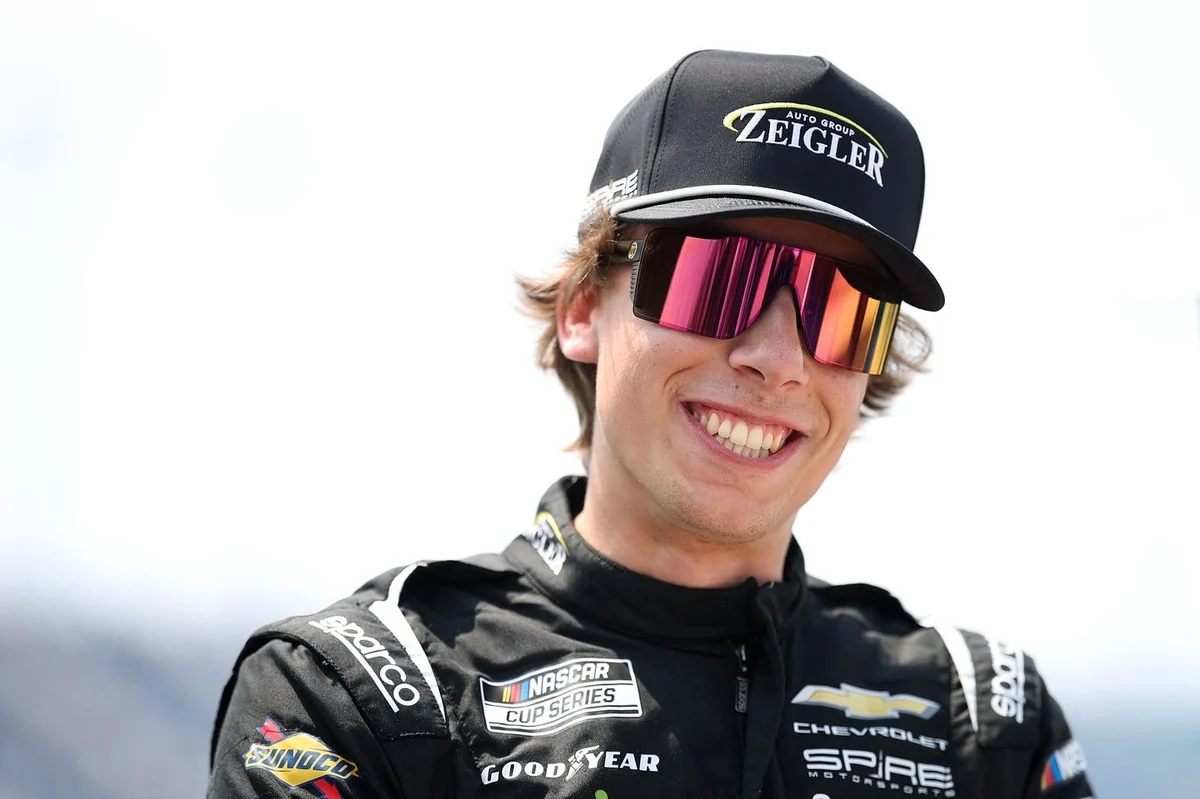
This exclusive report from sportsamo.com delves into the polarizing yet captivating persona of Carson Hocevar, the NASCAR Cup Series rookie who is rapidly becoming one of the sport’s most talked-about figures. In a world often bound by unwritten rules and expected decorum, Hocevar stands out as a driver who marches to the beat of his own drum, unafraid to ruffle feathers or challenge the traditional notions of sportsmanship, particularly when it comes to on-track incidents. His recent run-in with veteran Brad Keselowski at the Southern 500 perfectly encapsulates his unique approach, sparking a debate across the garage area and among fans: is Hocevar a refreshing disruptor or a disrespectful rookie?
The incident at Darlington Raceway, a track steeped in history and known for its unforgiving nature, ignited the latest chapter in Hocevar’s burgeoning reputation. Early in the Southern 500, a fierce battle for track position between Hocevar’s No. 77 Spire Motorsports Chevrolet and Keselowski’s No. 6 RFK Racing Ford culminated in contact that sent Keselowski’s car sideways, costing him significant momentum and track position. The veteran, a former Cup Series champion and now a team co-owner, was visibly furious, wasting no time in issuing a veiled threat: "His day is coming, and it’s coming hard." Such pronouncements from a figure of Keselowski’s stature typically send shivers down a rookie’s spine, prompting immediate apologies and a pledge to race cleaner. But Hocevar, true to form, remained unmoved.
During a NASCAR media availability, Hocevar addressed the clash with a candor that has become his trademark. He dismissed the incident as a "racing deal," a term frequently used in motorsports to describe unavoidable contact resulting from aggressive competition rather than malicious intent. "I mean, it’s kind of shit happens sometimes when we’re racing hard," Hocevar stated, echoing a sentiment that resonates with many hard-nosed racers. He further elaborated, "I think Brad knows how aggressive he was being, racing is super hard, trying to keep me behind him. I was racing really hard, trying to be aggressive and just hurt his momentum a lot, and we just got to racing really hard." His perspective painted a picture of two fiercely competitive drivers pushing the limits, where contact, while regrettable, is an inherent risk. He emphasized the intensity of racing "within an inch of each other for 10-to-15 laps," suggesting that such sustained pressure inevitably leads to moments of contact.
What truly sets Hocevar apart, however, is his steadfast refusal to offer what he perceives as "empty apologies." In a sport where a post-race phone call or a contrite interview is often expected after an on-track skirmish, Hocevar finds such gestures disingenuous. "It would annoy me more if roles were reversed, and I hear ‘oh sorry,’ and heard it all the time," he explained. "For me, that would rub me the wrong way because it’s just artificial." This philosophy, which he’s maintained throughout his career, suggests a deep-seated commitment to intellectual honesty over performative remorse. He believes that if an incident is genuinely a byproduct of hard racing, an apology becomes "extra fluff" and an unnecessary strategic maneuver rather than a sincere expression of regret. He even noted that Keselowski could have confronted him directly after the race, but Hocevar wasn’t interested in "the BS" of a forced reconciliation.
This unapologetic stance is not just a personal conviction; it’s a strategic component of his burgeoning brand. Following the Southern 500, Hocevar famously added a six percent discount to his merchandise store, a direct jab at Keselowski’s car number. This audacious move, embraced by his team, Spire Motorsports, and amplified across social media, instantly went viral. Reports indicate that Hocevar’s merchandise sales skyrocketed, approaching an astounding $200,000 after the Keselowski clash. This wasn’t merely a coincidence; it was a calculated, irreverent marketing masterstroke that resonated deeply with a segment of the NASCAR fanbase craving authenticity and a dash of defiance.
Indeed, Hocevar’s personality is not alienating everyone. While some veterans might grumble, his raw, unfiltered approach is winning over an entirely new fanbase, both within and outside traditional NASCAR circles. NASCAR itself, perhaps recognizing the entertainment value, even issued a press release celebrating the "15-versus-1" dynamic of Hocevar in the Chase for the Championship, highlighting his role as an underdog challenging the established order. Spire Motorsports, a smaller team making significant strides in the Cup Series, has leaned fully into this narrative, using social media to amplify Hocevar’s maverick image.
For Hocevar, his priorities are clear: "I only care what Jeff (Dickerson, Spire Motorsports co-owner), the sponsors and my team says." This statement underscores a deep loyalty to his inner circle and a dismissal of external criticism from rival drivers like Keselowski or Denny Hamlin. He views racing as a "family sport" and prioritizes the opinions of his immediate "family" – his team, his mentor, and his sponsors. This selective engagement allows him to maintain his unique approach without succumbing to the pressures of conformity.
His personal "honor code" extends beyond mere apologies. Hocevar views racing incidents as part of the game and, perhaps surprisingly, respects the principle of retaliation if he believes it’s warranted. He cited past incidents with Corey Heim at San Diego and Zane Smith at Chicagoland, where he was on the receiving end of aggressive driving. "Honestly, I respect it," he said, indicating that he expects drivers to take their shots if they feel wronged, and he won’t "lose his mind" over it. This perspective hints at a self-awareness and a willingness to accept the consequences of his own aggressive driving style, a trait often admired by old-school racers.
A compelling anecdote from Martinsville in the spring further illustrates Hocevar’s consistent philosophy. After a hard-fought race, Bubba Wallace "full throttled" him and spun him out. Wallace later explained he was simply mad. For Hocevar, that was the end of it. He recounted his reaction, "I have the text message that I was just happy that I was on the lead lap at Martinsville and got wrecked just for no other reason than Martinsville pisses drivers off. I was just an innocent bystander." He even viewed the incident as a "made it moment," recognizing the iconic nature of Martinsville’s short-track tempers. This remarkable ability to detach personal ego from the heat of battle allows Hocevar to navigate the highly charged world of NASCAR with an almost zen-like acceptance.
The guidance of Jeff Dickerson, Spire Motorsports’ co-owner, plays a pivotal role in shaping Hocevar’s career. Dickerson, a former driver, agent for stars like Kyle Busch and Jeff Gordon, and a seasoned spotter, provides the crucial mentorship that underpins Hocevar’s confidence. "I look at him as the mentor or whatever adjective you want to use. I really lean on him, and he’s given me his full support," Hocevar affirmed. This unwavering backing from a respected figure within the sport empowers Hocevar to maintain his authentic self, knowing he has a strong foundation of trust and strategic advice.
This journey, for Hocevar, is about living a lifelong dream and enjoying every moment. "I want to enjoy every second of this," he declared, highlighting his passion for the sport. This commitment to joy, however, has been misinterpreted by some, notably veteran driver Denny Hamlin, who famously called out Spire as "unserious" and suggested a lack of "adults" overseeing Hocevar. Hocevar, however, was quick to address this misconception. "My guys want clean races. They want to go forward and run up front and they want to win another race," he countered, emphasizing that his team’s aspirations are as serious as any other. He acknowledged disappointment over a wreck at Daytona, where he felt they had a shot at victory, indicating a strong desire for performance.
He believes it’s entirely possible to balance fun, fan engagement, and competitive success. "I think a lot of people misinterpret me having fun or our team having fun with being unserious, or that we don’t care," Hocevar explained. "We just want to enjoy every aspect of the game, and part of that game is showing love to the fans… We also love going as fast as possible." This dual approach — being a fierce competitor on track while being an engaging, authentic personality off it — positions Hocevar as a blueprint for the modern NASCAR driver. In an era where sports personalities are increasingly scrutinized, Hocevar’s refusal to conform, his embrace of controversy, and his direct connection with fans through unconventional means (like merchandise discounts) make him a captivating figure.
Carson Hocevar is not just driving race cars; he’s driving a conversation about what it means to be a professional athlete in the 21st century. His unapologetic authenticity, backed by a strong team and a clear personal code, is carving out a unique space in the NASCAR landscape. While the veteran guard might struggle with his irreverence, Hocevar’s approach is undeniably resonating with a new generation of fans and proving that sometimes, being a little "unserious" is exactly what it takes to be truly taken seriously. The question remains: will this maverick approach lead him to the Cup Series championship, or will the unwritten rules of NASCAR eventually catch up to its most unconventional rising star? Only time will tell, but one thing is certain: Carson Hocevar will continue to entertain, challenge, and define his own path, one unapologetic lap at a time.